A Noninvasive Nanoeyedrop Therapy for the Inhibition of Uveal Melanoma: Tetrahedral Framework Nucleic Acid–Based Bioswitchable MicroRNA Delivery System
Zhou Jiang, Yichen Yang, Ziqi Yue, Ye Chen, Long Bai, Ruiqing Wang, Songhang Li, Yunfeng Lin
{"title":"A Noninvasive Nanoeyedrop Therapy for the Inhibition of Uveal Melanoma: Tetrahedral Framework Nucleic Acid–Based Bioswitchable MicroRNA Delivery System","authors":"Zhou Jiang, Yichen Yang, Ziqi Yue, Ye Chen, Long Bai, Ruiqing Wang, Songhang Li, Yunfeng Lin","doi":"10.1021/acsnano.4c16427","DOIUrl":null,"url":null,"abstract":"Uveal melanoma (UM) is the most prevalent primary intraocular malignancy, exhibiting pronounced invasive characteristics and a dismal prognosis. Conventional therapeutic modalities, including radiotherapy, laser therapy, and surgery, are frequently invasive and can lead to complications, underscoring the need for the development of efficacious, safe, and noninvasive therapeutic approaches. This study investigated a tetrahedral framework nucleic acid (tFNA)-based bioswitchable microRNA (miRNA) delivery system, designated BiRDS, engineered for the inhibition of UM through the use of miRNA suppressors via noninvasive eyedrops. The BiRDS construct exhibited a tetrahedral structure, which was small in size, easily synthesizable, stable, and biosafe, and was able to efficiently carry miR-30a-5p into UM cells. Functionally, BiRDS was observed to inhibit the proliferation, migration, and invasion of UM cells while promoting apoptosis through the miR-30a-5p/E2F7 axis. It is noteworthy that BiRDS nanoeyedrops were able to penetrate the complex ocular barrier structure and reach the fundus, thereby inhibiting the growth of UM in a xenograft model. As a patient-friendly, eyedrop-based miRNA delivery system, BiRDS not only inhibited UM without enucleation of the eyeball but was also expected to improve patient compliance and quality of life while providing a safer alternative for ocular drug administration. This work substantiates BiRDS nanoeyedrops as a potential paradigm shift in the local treatment of early UM, facilitating its application in treating other ocular diseases via miRNA therapies.","PeriodicalId":21,"journal":{"name":"ACS Nano","volume":"3 1","pages":""},"PeriodicalIF":16.0000,"publicationDate":"2025-04-10","publicationTypes":"Journal Article","fieldsOfStudy":null,"isOpenAccess":false,"openAccessPdf":"","citationCount":"0","resultStr":null,"platform":"Semanticscholar","paperid":null,"PeriodicalName":"ACS Nano","FirstCategoryId":"88","ListUrlMain":"https://doi.org/10.1021/acsnano.4c16427","RegionNum":1,"RegionCategory":"材料科学","ArticlePicture":[],"TitleCN":null,"AbstractTextCN":null,"PMCID":null,"EPubDate":"","PubModel":"","JCR":"Q1","JCRName":"CHEMISTRY, MULTIDISCIPLINARY","Score":null,"Total":0}
引用次数: 0
Abstract
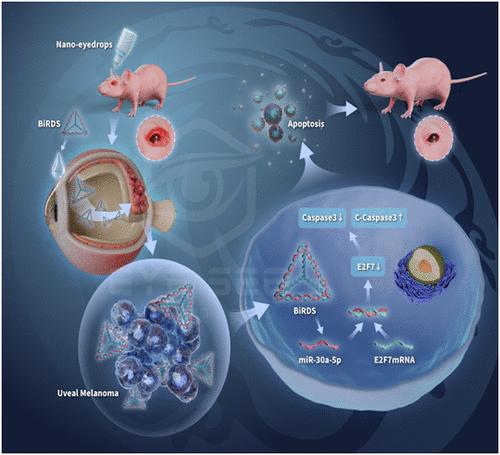
Uveal melanoma (UM) is the most prevalent primary intraocular malignancy, exhibiting pronounced invasive characteristics and a dismal prognosis. Conventional therapeutic modalities, including radiotherapy, laser therapy, and surgery, are frequently invasive and can lead to complications, underscoring the need for the development of efficacious, safe, and noninvasive therapeutic approaches. This study investigated a tetrahedral framework nucleic acid (tFNA)-based bioswitchable microRNA (miRNA) delivery system, designated BiRDS, engineered for the inhibition of UM through the use of miRNA suppressors via noninvasive eyedrops. The BiRDS construct exhibited a tetrahedral structure, which was small in size, easily synthesizable, stable, and biosafe, and was able to efficiently carry miR-30a-5p into UM cells. Functionally, BiRDS was observed to inhibit the proliferation, migration, and invasion of UM cells while promoting apoptosis through the miR-30a-5p/E2F7 axis. It is noteworthy that BiRDS nanoeyedrops were able to penetrate the complex ocular barrier structure and reach the fundus, thereby inhibiting the growth of UM in a xenograft model. As a patient-friendly, eyedrop-based miRNA delivery system, BiRDS not only inhibited UM without enucleation of the eyeball but was also expected to improve patient compliance and quality of life while providing a safer alternative for ocular drug administration. This work substantiates BiRDS nanoeyedrops as a potential paradigm shift in the local treatment of early UM, facilitating its application in treating other ocular diseases via miRNA therapies.
期刊介绍:
ACS Nano, published monthly, serves as an international forum for comprehensive articles on nanoscience and nanotechnology research at the intersections of chemistry, biology, materials science, physics, and engineering. The journal fosters communication among scientists in these communities, facilitating collaboration, new research opportunities, and advancements through discoveries. ACS Nano covers synthesis, assembly, characterization, theory, and simulation of nanostructures, nanobiotechnology, nanofabrication, methods and tools for nanoscience and nanotechnology, and self- and directed-assembly. Alongside original research articles, it offers thorough reviews, perspectives on cutting-edge research, and discussions envisioning the future of nanoscience and nanotechnology.




 京公网安备 11010802042870号
京ICP备2023020795号-1
京公网安备 11010802042870号
京ICP备2023020795号-1

 分享
分享
 求助内容:
求助内容: 应助结果提醒方式:
 扫码关注我们
