Haifeng Zhang, Wei Zhou, Haibing Wang, Jiayi Zhang, Huocheng Yang, Junnian Chen, Siya Wang, Weikang Zhao, Menghuan Li, Zhong Luo
{"title":"Hydrogel-Based Bioactive Synthetic Skin Stimulates Regenerative Gas Signaling and Eliminates Interfacial Pathogens to Promote Burn Wound Healing","authors":"Haifeng Zhang, Wei Zhou, Haibing Wang, Jiayi Zhang, Huocheng Yang, Junnian Chen, Siya Wang, Weikang Zhao, Menghuan Li, Zhong Luo","doi":"10.1021/acsnano.5c01134","DOIUrl":null,"url":null,"abstract":"Skin burn wounds (SBWs) are common clinical injuries due to excessive exposure to factors including heat, radiation, chemical agents, etc. However, the efficient healing of SBWs is still challenging due to persistent inflammation and high risk of local infection. To meet these challenges, we report a hydrogel-based bioactive synthetic skin (HBSS) from biocompatible components as dressing materials for burn wound treatment, which mediated localized H<sub>2</sub>S release to stimulate tissue regeneration while preventing bacterial infection and excessive inflammation. Here, the H<sub>2</sub>S donor (<i>N</i>-(benzoyl mercapto) benzamide) was first coassembled with thioketal (TK)-ligated dopamine dimer to form nanoscale assemblies (DDNs), which were then integrated into Schiff base-cross-linked hyaluronic acid-carboxymethyl chitosan hydrogels. The elevated acidity in burn wounds would trigger hydrogel degradation to release DDNs, which were further activated by ROS-induced cleavage of TK linkers to release H<sub>2</sub>S gas while attenuating local ROS stress in a self-immolative manner, thus promoting local angiogenesis and tissue regeneration through activating the AMPK and RAS-MAPK-AP1 prohealing pathways, while enabling M1-to-M2 macrophage reprogramming through activating the ERK1/2 and NRF2 signaling. Meanwhile, the chitosan components in the hydrogel network could inhibit bacterial colonization at the wound site to prevent local infection. These merits acted in a cooperative manner to enable accelerated and robust burn wound healing, offering an approach for burn wound treatment in the clinic.","PeriodicalId":21,"journal":{"name":"ACS Nano","volume":"25 1","pages":""},"PeriodicalIF":16.0000,"publicationDate":"2025-04-10","publicationTypes":"Journal Article","fieldsOfStudy":null,"isOpenAccess":false,"openAccessPdf":"","citationCount":"0","resultStr":null,"platform":"Semanticscholar","paperid":null,"PeriodicalName":"ACS Nano","FirstCategoryId":"88","ListUrlMain":"https://doi.org/10.1021/acsnano.5c01134","RegionNum":1,"RegionCategory":"材料科学","ArticlePicture":[],"TitleCN":null,"AbstractTextCN":null,"PMCID":null,"EPubDate":"","PubModel":"","JCR":"Q1","JCRName":"CHEMISTRY, MULTIDISCIPLINARY","Score":null,"Total":0}
引用次数: 0
Abstract
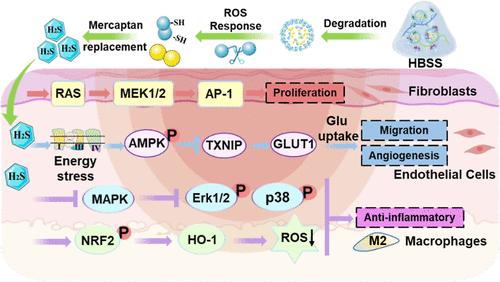
Skin burn wounds (SBWs) are common clinical injuries due to excessive exposure to factors including heat, radiation, chemical agents, etc. However, the efficient healing of SBWs is still challenging due to persistent inflammation and high risk of local infection. To meet these challenges, we report a hydrogel-based bioactive synthetic skin (HBSS) from biocompatible components as dressing materials for burn wound treatment, which mediated localized H2S release to stimulate tissue regeneration while preventing bacterial infection and excessive inflammation. Here, the H2S donor (N-(benzoyl mercapto) benzamide) was first coassembled with thioketal (TK)-ligated dopamine dimer to form nanoscale assemblies (DDNs), which were then integrated into Schiff base-cross-linked hyaluronic acid-carboxymethyl chitosan hydrogels. The elevated acidity in burn wounds would trigger hydrogel degradation to release DDNs, which were further activated by ROS-induced cleavage of TK linkers to release H2S gas while attenuating local ROS stress in a self-immolative manner, thus promoting local angiogenesis and tissue regeneration through activating the AMPK and RAS-MAPK-AP1 prohealing pathways, while enabling M1-to-M2 macrophage reprogramming through activating the ERK1/2 and NRF2 signaling. Meanwhile, the chitosan components in the hydrogel network could inhibit bacterial colonization at the wound site to prevent local infection. These merits acted in a cooperative manner to enable accelerated and robust burn wound healing, offering an approach for burn wound treatment in the clinic.
期刊介绍:
ACS Nano, published monthly, serves as an international forum for comprehensive articles on nanoscience and nanotechnology research at the intersections of chemistry, biology, materials science, physics, and engineering. The journal fosters communication among scientists in these communities, facilitating collaboration, new research opportunities, and advancements through discoveries. ACS Nano covers synthesis, assembly, characterization, theory, and simulation of nanostructures, nanobiotechnology, nanofabrication, methods and tools for nanoscience and nanotechnology, and self- and directed-assembly. Alongside original research articles, it offers thorough reviews, perspectives on cutting-edge research, and discussions envisioning the future of nanoscience and nanotechnology.



 京公网安备 11010802042870号
京ICP备2023020795号-1
京公网安备 11010802042870号
京ICP备2023020795号-1

 分享
分享
 求助内容:
求助内容: 应助结果提醒方式:
 扫码关注我们
