Jing Lin, Huiliang Wen, Zhaobo Feng, Ruizhe Hu, Liping Wu, Chongbo Liu, Sen Lin, Yuhui Peng, Yifang Liu, Renchao Che
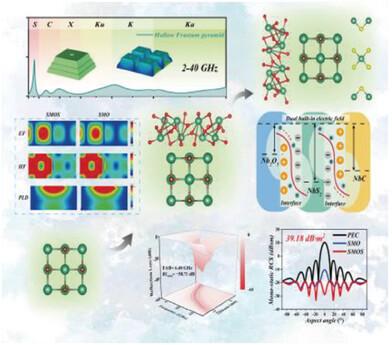
{"title":"Anion Injection in Dielectric Ecosystems to Construct Dual Built-in Electric Fields for Efficient Electromagnetic Response","authors":"Jing Lin, Huiliang Wen, Zhaobo Feng, Ruizhe Hu, Liping Wu, Chongbo Liu, Sen Lin, Yuhui Peng, Yifang Liu, Renchao Che","doi":"10.1002/adfm.202505381","DOIUrl":null,"url":null,"abstract":"<p>Constructing built-in electric fields is a proven method to enhance dielectric loss mechanisms by amplifying interfacial polarization. However, a single built-in electric field is often insufficient for significantly improving electromagnetic (EM) polarization loss. To address this, dielectric ecosystems are developed utilizing an anion injection strategy to regulate work function differences. Through first-principles calculations, the directional transfer of space charges at multi-heterogeneous interfaces is visualized. The resulting work function differences spontaneously establish a dual built-in electric field (DBIEF) structure, which substantially enhances EM polarization loss and EM wave absorption capabilities. Furthermore, an equivalent circuit model elucidates the competition between polarization and conduction species in the EM loss mechanism. This competition results in exceptional EM wave absorption performance, achieving a minimum reflection loss (<i>RL<sub>min</sub></i>) of −58.71 dB and an effective absorption bandwidth (EAB) of 7.92 GHz. Computer simulation technology demonstrates a maximum radar cross-section (RCS) reduction of 39.18 dB·m<sup>2</sup>. Additionally, the unique hollow-truncated-pyramid metamaterial design exhibits high incidence angle insensitivity (60°) over 2–38 GHz, and significant broadband absorption across 2–40 GHz. This comprehensive work offers novel insights into the structural design of EM nanomaterials and introduces a new dielectric ecosystem to elucidate the DBIEF loss mechanism for efficient EM wave absorption.</p>","PeriodicalId":112,"journal":{"name":"Advanced Functional Materials","volume":"35 37","pages":""},"PeriodicalIF":19.0000,"publicationDate":"2025-04-10","publicationTypes":"Journal Article","fieldsOfStudy":null,"isOpenAccess":false,"openAccessPdf":"","citationCount":"0","resultStr":null,"platform":"Semanticscholar","paperid":null,"PeriodicalName":"Advanced Functional Materials","FirstCategoryId":"88","ListUrlMain":"https://advanced.onlinelibrary.wiley.com/doi/10.1002/adfm.202505381","RegionNum":1,"RegionCategory":"材料科学","ArticlePicture":[],"TitleCN":null,"AbstractTextCN":null,"PMCID":null,"EPubDate":"","PubModel":"","JCR":"Q1","JCRName":"CHEMISTRY, MULTIDISCIPLINARY","Score":null,"Total":0}
引用次数: 0
Abstract
Constructing built-in electric fields is a proven method to enhance dielectric loss mechanisms by amplifying interfacial polarization. However, a single built-in electric field is often insufficient for significantly improving electromagnetic (EM) polarization loss. To address this, dielectric ecosystems are developed utilizing an anion injection strategy to regulate work function differences. Through first-principles calculations, the directional transfer of space charges at multi-heterogeneous interfaces is visualized. The resulting work function differences spontaneously establish a dual built-in electric field (DBIEF) structure, which substantially enhances EM polarization loss and EM wave absorption capabilities. Furthermore, an equivalent circuit model elucidates the competition between polarization and conduction species in the EM loss mechanism. This competition results in exceptional EM wave absorption performance, achieving a minimum reflection loss (RLmin) of −58.71 dB and an effective absorption bandwidth (EAB) of 7.92 GHz. Computer simulation technology demonstrates a maximum radar cross-section (RCS) reduction of 39.18 dB·m2. Additionally, the unique hollow-truncated-pyramid metamaterial design exhibits high incidence angle insensitivity (60°) over 2–38 GHz, and significant broadband absorption across 2–40 GHz. This comprehensive work offers novel insights into the structural design of EM nanomaterials and introduces a new dielectric ecosystem to elucidate the DBIEF loss mechanism for efficient EM wave absorption.
期刊介绍:
Firmly established as a top-tier materials science journal, Advanced Functional Materials reports breakthrough research in all aspects of materials science, including nanotechnology, chemistry, physics, and biology every week.
Advanced Functional Materials is known for its rapid and fair peer review, quality content, and high impact, making it the first choice of the international materials science community.






 京公网安备 11010802042870号
京ICP备2023020795号-1
京公网安备 11010802042870号
京ICP备2023020795号-1

 分享
分享
 求助内容:
求助内容: 应助结果提醒方式:
 扫码关注我们
