{"title":"Multi-Hierarchically Constructing Durable and Flame Retardant CNF/MXene/PDMS Composite Aerogels for Superhigh Electromagnetic Shielding Performance and Ultralow Thermal Conductivity","authors":"Yongqian Shi, Yanjun Zhu, Shan Liu, Libi Fu, Juntian Chen, Jiawen Liu, Longcheng Tang, Jiefeng Gao, Pingan Song","doi":"10.1002/smll.202500556","DOIUrl":null,"url":null,"abstract":"<p>There is a significant increase in the demand for lightweight and compressible electromagnetic interference (EMI) shielding materials in various fields. Though MXene aerogels hold immense potential as EMI shielding materials, several shortcomings including poor water resistance, low mechanical robustness, easy oxidation, and high cost limits of their wide application. This work reported a novel strategy involving the co-assembly of MXene and cellulose nanofibers (CNF) through directional freezing and freeze-drying, followed by the capsulation-concreting of a thin layer of flame-retardant polydimethylsiloxane (PDMS) onto the aerogel, to multi-hierarchically construct a series of high-performance CNF/MXene/PDMS composite aerogels. The lightweight CNF/MXene/PDMS/MPP-Zr@PDA composite aerogel achieved ultrahigh EMI shielding effectiveness of 96.8 dB (X-band) and utilization efficiency of 1713.27 dB g g<sup>−1</sup>. Furthermore, the PDMS coating effectively imparted excellent compressibility and durability to the 3D scaffold, resulting in a compressive strength of 17.01 kPa for the composite aerogel, representing 199.5% increase compared to CNF aerogel. Additionally, the composite aerogel exhibited outstanding flame-retardant properties (54.6% reduction in heat release rate), ultralow thermal conductivity of 0.0530 W m<sup>−1</sup> K<sup>−1</sup> and excellent hydrophobicity. Therefore, the durable and flame-retardant CNF/MXene/PDMS composite aerogels hold promising applications in EMI protection, thermal management, smart fire detection, and other specific fields.</p>","PeriodicalId":228,"journal":{"name":"Small","volume":"21 22","pages":""},"PeriodicalIF":12.1000,"publicationDate":"2025-04-10","publicationTypes":"Journal Article","fieldsOfStudy":null,"isOpenAccess":false,"openAccessPdf":"","citationCount":"0","resultStr":null,"platform":"Semanticscholar","paperid":null,"PeriodicalName":"Small","FirstCategoryId":"88","ListUrlMain":"https://onlinelibrary.wiley.com/doi/10.1002/smll.202500556","RegionNum":2,"RegionCategory":"材料科学","ArticlePicture":[],"TitleCN":null,"AbstractTextCN":null,"PMCID":null,"EPubDate":"","PubModel":"","JCR":"Q1","JCRName":"CHEMISTRY, MULTIDISCIPLINARY","Score":null,"Total":0}
引用次数: 0
Abstract
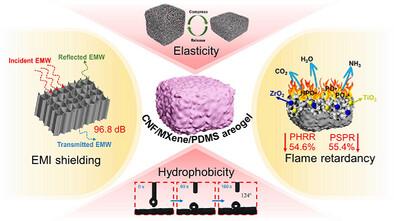
There is a significant increase in the demand for lightweight and compressible electromagnetic interference (EMI) shielding materials in various fields. Though MXene aerogels hold immense potential as EMI shielding materials, several shortcomings including poor water resistance, low mechanical robustness, easy oxidation, and high cost limits of their wide application. This work reported a novel strategy involving the co-assembly of MXene and cellulose nanofibers (CNF) through directional freezing and freeze-drying, followed by the capsulation-concreting of a thin layer of flame-retardant polydimethylsiloxane (PDMS) onto the aerogel, to multi-hierarchically construct a series of high-performance CNF/MXene/PDMS composite aerogels. The lightweight CNF/MXene/PDMS/MPP-Zr@PDA composite aerogel achieved ultrahigh EMI shielding effectiveness of 96.8 dB (X-band) and utilization efficiency of 1713.27 dB g g−1. Furthermore, the PDMS coating effectively imparted excellent compressibility and durability to the 3D scaffold, resulting in a compressive strength of 17.01 kPa for the composite aerogel, representing 199.5% increase compared to CNF aerogel. Additionally, the composite aerogel exhibited outstanding flame-retardant properties (54.6% reduction in heat release rate), ultralow thermal conductivity of 0.0530 W m−1 K−1 and excellent hydrophobicity. Therefore, the durable and flame-retardant CNF/MXene/PDMS composite aerogels hold promising applications in EMI protection, thermal management, smart fire detection, and other specific fields.
期刊介绍:
Small serves as an exceptional platform for both experimental and theoretical studies in fundamental and applied interdisciplinary research at the nano- and microscale. The journal offers a compelling mix of peer-reviewed Research Articles, Reviews, Perspectives, and Comments.
With a remarkable 2022 Journal Impact Factor of 13.3 (Journal Citation Reports from Clarivate Analytics, 2023), Small remains among the top multidisciplinary journals, covering a wide range of topics at the interface of materials science, chemistry, physics, engineering, medicine, and biology.
Small's readership includes biochemists, biologists, biomedical scientists, chemists, engineers, information technologists, materials scientists, physicists, and theoreticians alike.



 京公网安备 11010802042870号
京ICP备2023020795号-1
京公网安备 11010802042870号
京ICP备2023020795号-1

 分享
分享
 求助内容:
求助内容: 应助结果提醒方式:
 扫码关注我们
