Kumiko Samejima, Johan H. Gibcus, Sameer Abraham, Fernanda Cisneros-Soberanis, Itaru Samejima, Alison J. Beckett, Nina Puǎčeková, Maria Alba Abad, Christos Spanos, Bethan Medina-Pritchard, James R. Paulson, Linfeng Xie, A. Arockia Jeyaprakash, Ian A. Prior, Leonid A. Mirny, Job Dekker, Anton Goloborodko, William C. Earnshaw
{"title":"Rules of engagement for condensins and cohesins guide mitotic chromosome formation","authors":"Kumiko Samejima, Johan H. Gibcus, Sameer Abraham, Fernanda Cisneros-Soberanis, Itaru Samejima, Alison J. Beckett, Nina Puǎčeková, Maria Alba Abad, Christos Spanos, Bethan Medina-Pritchard, James R. Paulson, Linfeng Xie, A. Arockia Jeyaprakash, Ian A. Prior, Leonid A. Mirny, Job Dekker, Anton Goloborodko, William C. Earnshaw","doi":"10.1126/science.adq1709","DOIUrl":null,"url":null,"abstract":"<div >We used Hi-C, imaging, proteomics, and polymer modeling to define rules of engagement for SMC (structural maintenance of chromosomes) complexes as cells refold interphase chromatin into rod-shaped mitotic chromosomes. First, condensin disassembles interphase chromatin loop organization by evicting or displacing extrusive cohesin. Second, condensin bypasses cohesive cohesins, thereby maintaining sister chromatid cohesion as sisters separate. Studies of mitotic chromosomes formed by cohesin, condensin II, and condensin I alone or in combination lead to refined models of mitotic chromosome conformation. In these models, loops are consecutive and not overlapping, implying that condensins stall upon encountering each other. The dynamics of Hi-C interactions and chromosome morphology reveal that during prophase, loops are extruded in vivo at ∼1 to 3 kilobases per second by condensins as they form a disordered discontinuous helical scaffold within individual chromatids.</div>","PeriodicalId":21678,"journal":{"name":"Science","volume":"388 6743","pages":""},"PeriodicalIF":45.8000,"publicationDate":"2025-04-11","publicationTypes":"Journal Article","fieldsOfStudy":null,"isOpenAccess":false,"openAccessPdf":"","citationCount":"0","resultStr":null,"platform":"Semanticscholar","paperid":null,"PeriodicalName":"Science","FirstCategoryId":"103","ListUrlMain":"https://www.science.org/doi/10.1126/science.adq1709","RegionNum":1,"RegionCategory":"综合性期刊","ArticlePicture":[],"TitleCN":null,"AbstractTextCN":null,"PMCID":null,"EPubDate":"","PubModel":"","JCR":"Q1","JCRName":"MULTIDISCIPLINARY SCIENCES","Score":null,"Total":0}
引用次数: 0
Abstract
We used Hi-C, imaging, proteomics, and polymer modeling to define rules of engagement for SMC (structural maintenance of chromosomes) complexes as cells refold interphase chromatin into rod-shaped mitotic chromosomes. First, condensin disassembles interphase chromatin loop organization by evicting or displacing extrusive cohesin. Second, condensin bypasses cohesive cohesins, thereby maintaining sister chromatid cohesion as sisters separate. Studies of mitotic chromosomes formed by cohesin, condensin II, and condensin I alone or in combination lead to refined models of mitotic chromosome conformation. In these models, loops are consecutive and not overlapping, implying that condensins stall upon encountering each other. The dynamics of Hi-C interactions and chromosome morphology reveal that during prophase, loops are extruded in vivo at ∼1 to 3 kilobases per second by condensins as they form a disordered discontinuous helical scaffold within individual chromatids.
我们利用 Hi-C、成像、蛋白质组学和聚合物建模来定义细胞将间期染色质重新折叠成杆状有丝分裂染色体时 SMC(染色体结构维护)复合物的参与规则。首先,冷凝素通过驱逐或移位外生凝聚素来分解间期染色质环组织。其次,凝集素绕过外显凝聚素,从而在姐妹染色单体分离时保持姐妹染色单体的凝聚力。通过对由凝聚素、凝聚素 II 和凝聚素 I 单独或联合形成的有丝分裂染色体的研究,我们完善了有丝分裂染色体构象模型。在这些模型中,环是连续的,而不是重叠的,这意味着凝集素在遇到彼此时会停滞。Hi-C相互作用的动力学和染色体形态显示,在有丝分裂前期,当冷凝蛋白在单个染色体内形成无序的不连续螺旋支架时,环在体内以每秒1至3千碱基的速度被挤出。
期刊介绍:
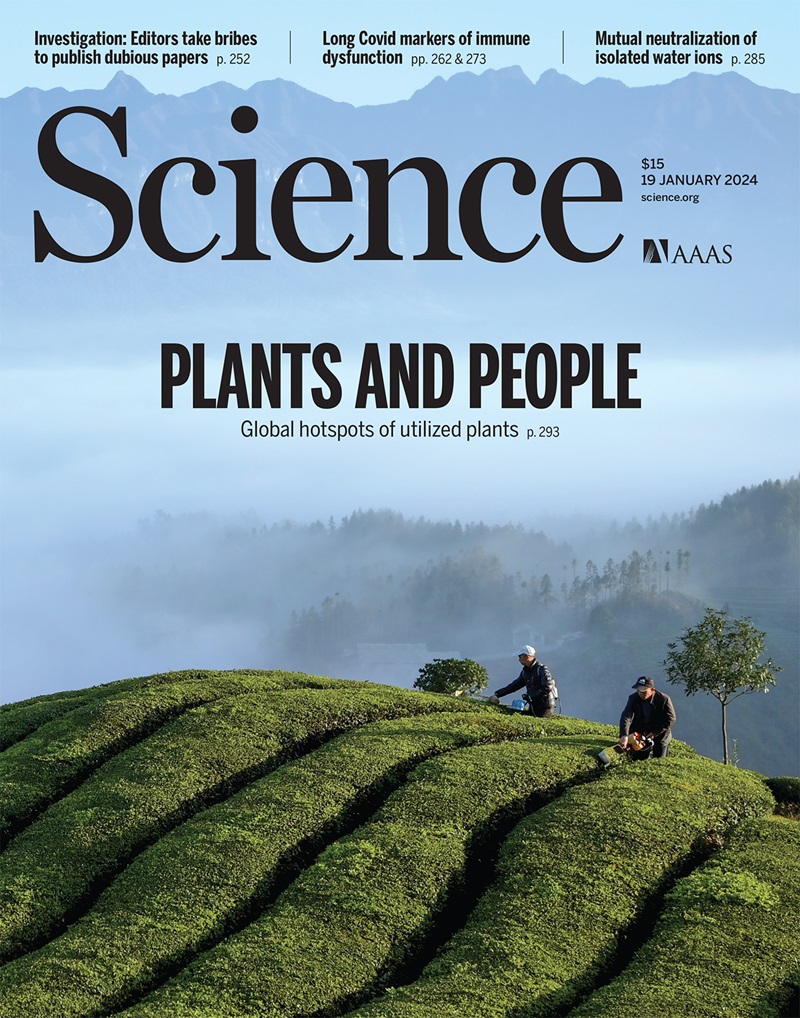
Science is a leading outlet for scientific news, commentary, and cutting-edge research. Through its print and online incarnations, Science reaches an estimated worldwide readership of more than one million. Science’s authorship is global too, and its articles consistently rank among the world's most cited research.
Science serves as a forum for discussion of important issues related to the advancement of science by publishing material on which a consensus has been reached as well as including the presentation of minority or conflicting points of view. Accordingly, all articles published in Science—including editorials, news and comment, and book reviews—are signed and reflect the individual views of the authors and not official points of view adopted by AAAS or the institutions with which the authors are affiliated.
Science seeks to publish those papers that are most influential in their fields or across fields and that will significantly advance scientific understanding. Selected papers should present novel and broadly important data, syntheses, or concepts. They should merit recognition by the wider scientific community and general public provided by publication in Science, beyond that provided by specialty journals. Science welcomes submissions from all fields of science and from any source. The editors are committed to the prompt evaluation and publication of submitted papers while upholding high standards that support reproducibility of published research. Science is published weekly; selected papers are published online ahead of print.




 京公网安备 11010802042870号
京ICP备2023020795号-1
京公网安备 11010802042870号
京ICP备2023020795号-1

 分享
分享
 求助内容:
求助内容: 应助结果提醒方式:
 扫码关注我们
