{"title":"2D Indium-Vacancy-Rich ZnIn2S4 Nanocatalysts for Sonocatalytic Cancer Suppression by Boosting Cancer-Cell Pyroptosis","authors":"Zeyu Wang, Xue Wang, Hongsheng Fang, Xinran Song, Li Ding, Meiqi Chang, Hao Yan, Yu Chen","doi":"10.1002/adma.202414432","DOIUrl":null,"url":null,"abstract":"<p>Sonocatalytic therapy is gaining interest for its non-invasive nature, precise control, and excellent tissue penetration, making it a promising approach for treating malignant tumors. While defect engineering enhances electron and hole separation to boost reactive oxygen species (ROS) generation, challenges in constructing effective hole traps compared to electron traps severely limit ROS production. In this study, 2D ZnIn<sub>2</sub>S<sub>4</sub>-V<sub>In</sub> nanosheets enriched are rationally designed with In vacancies for the efficient capture of electrons and holes, which has achieved substantial sonocatalytic performance in suppressing tumor growth. Compared to pristine ZnIn<sub>2</sub>S<sub>4</sub> nanosheets, which possess a periodic electrostatic potential inherent in their structure, In vacancies effectively disrupt this potential field, promote the simultaneous separation and migration of charge carriers, and inhibit their recombination, thereby boosting ROS production and inducing tumor cell pyroptosis via the ROS-NLRP3-caspase-1-GSDMD pathway under ultrasound (US) irradiation. Furthermore, both pristine ZnIn<sub>2</sub>S<sub>4</sub> and ZnIn<sub>2</sub>S<sub>4</sub>-V<sub>In</sub> nanosheets exhibited remarkable biocompatibility. In vitro and in vivo antineoplastic experiments demonstrate that this sonocatalytic approach effectively promotes tumor elimination, underscoring the critical importance of defect-engineered optimization in sonocatalytic tumor therapy.</p>","PeriodicalId":114,"journal":{"name":"Advanced Materials","volume":"37 24","pages":""},"PeriodicalIF":26.8000,"publicationDate":"2025-04-10","publicationTypes":"Journal Article","fieldsOfStudy":null,"isOpenAccess":false,"openAccessPdf":"","citationCount":"0","resultStr":null,"platform":"Semanticscholar","paperid":null,"PeriodicalName":"Advanced Materials","FirstCategoryId":"88","ListUrlMain":"https://advanced.onlinelibrary.wiley.com/doi/10.1002/adma.202414432","RegionNum":1,"RegionCategory":"材料科学","ArticlePicture":[],"TitleCN":null,"AbstractTextCN":null,"PMCID":null,"EPubDate":"","PubModel":"","JCR":"Q1","JCRName":"CHEMISTRY, MULTIDISCIPLINARY","Score":null,"Total":0}
引用次数: 0
Abstract
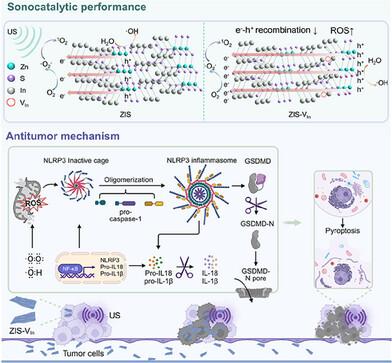
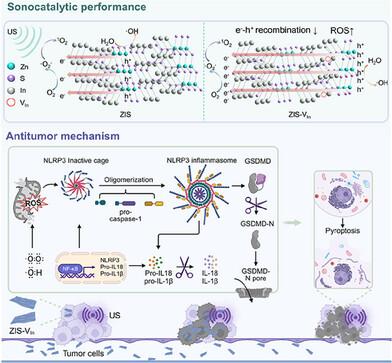
Sonocatalytic therapy is gaining interest for its non-invasive nature, precise control, and excellent tissue penetration, making it a promising approach for treating malignant tumors. While defect engineering enhances electron and hole separation to boost reactive oxygen species (ROS) generation, challenges in constructing effective hole traps compared to electron traps severely limit ROS production. In this study, 2D ZnIn2S4-VIn nanosheets enriched are rationally designed with In vacancies for the efficient capture of electrons and holes, which has achieved substantial sonocatalytic performance in suppressing tumor growth. Compared to pristine ZnIn2S4 nanosheets, which possess a periodic electrostatic potential inherent in their structure, In vacancies effectively disrupt this potential field, promote the simultaneous separation and migration of charge carriers, and inhibit their recombination, thereby boosting ROS production and inducing tumor cell pyroptosis via the ROS-NLRP3-caspase-1-GSDMD pathway under ultrasound (US) irradiation. Furthermore, both pristine ZnIn2S4 and ZnIn2S4-VIn nanosheets exhibited remarkable biocompatibility. In vitro and in vivo antineoplastic experiments demonstrate that this sonocatalytic approach effectively promotes tumor elimination, underscoring the critical importance of defect-engineered optimization in sonocatalytic tumor therapy.
期刊介绍:
Advanced Materials, one of the world's most prestigious journals and the foundation of the Advanced portfolio, is the home of choice for best-in-class materials science for more than 30 years. Following this fast-growing and interdisciplinary field, we are considering and publishing the most important discoveries on any and all materials from materials scientists, chemists, physicists, engineers as well as health and life scientists and bringing you the latest results and trends in modern materials-related research every week.







 京公网安备 11010802042870号
京ICP备2023020795号-1
京公网安备 11010802042870号
京ICP备2023020795号-1

 分享
分享
 求助内容:
求助内容: 应助结果提醒方式:
 扫码关注我们
