Wenxian Hu , Tianyi Ma , Yong Zhou , Michelina Soccio , Nadia Lotti , Dario Cavallo , Dujin Wang , Guoming Liu
{"title":"Crystal structure and crystalline morphology of poly(hexamethylene trans-1,4-cyclohexane dicarboxylate)","authors":"Wenxian Hu , Tianyi Ma , Yong Zhou , Michelina Soccio , Nadia Lotti , Dario Cavallo , Dujin Wang , Guoming Liu","doi":"10.1016/j.polymer.2025.128354","DOIUrl":null,"url":null,"abstract":"<div><div>The crystal structure of poly (hexamethylene <em>trans</em>-1, 4-cyclohexane dicarboxylate) (PHCE) was determined by X-ray fiber diffraction. Only one crystal form was observed, independent of the crystallization condition. The PHCE has a triclinic unit cell with the space group <span><math></math></span>. The cell parameters are: <em>a</em> = 5.47 Å, <em>b</em> = 7.36 Å, <em>c</em> = 15.95 Å, <em>α</em> = 141.14°, <em>β</em> = 113.69°, <em>γ</em> = 60.70°. One chain passes through a unit cell, resulting in a crystal density of 1.203 g/cm<sup>3</sup>. To study the crystal habit, the morphology of PHCE films was studied by imaging techniques. Depending on film thickness and crystallization temperature (<em>T</em><sub>c</sub>), the morphology varied from single crystals, S-shaped crystals, branched single-layer bent crystals, branched multilayer bent single crystals, and spherulites. By investigating the crystal growth rates, two scenarios were observed, characterized by diffusion-controlled growth or secondary nucleation. The interplay between crystal bending and chain tilting was investigated by electron diffraction.</div></div>","PeriodicalId":405,"journal":{"name":"Polymer","volume":"327 ","pages":"Article 128354"},"PeriodicalIF":4.5000,"publicationDate":"2025-04-10","publicationTypes":"Journal Article","fieldsOfStudy":null,"isOpenAccess":false,"openAccessPdf":"","citationCount":"0","resultStr":null,"platform":"Semanticscholar","paperid":null,"PeriodicalName":"Polymer","FirstCategoryId":"92","ListUrlMain":"https://www.sciencedirect.com/science/article/pii/S0032386125003404","RegionNum":2,"RegionCategory":"化学","ArticlePicture":[],"TitleCN":null,"AbstractTextCN":null,"PMCID":null,"EPubDate":"","PubModel":"","JCR":"Q2","JCRName":"POLYMER SCIENCE","Score":null,"Total":0}
引用次数: 0
Abstract
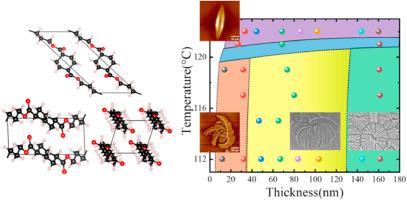
The crystal structure of poly (hexamethylene trans-1, 4-cyclohexane dicarboxylate) (PHCE) was determined by X-ray fiber diffraction. Only one crystal form was observed, independent of the crystallization condition. The PHCE has a triclinic unit cell with the space group . The cell parameters are: a = 5.47 Å, b = 7.36 Å, c = 15.95 Å, α = 141.14°, β = 113.69°, γ = 60.70°. One chain passes through a unit cell, resulting in a crystal density of 1.203 g/cm3. To study the crystal habit, the morphology of PHCE films was studied by imaging techniques. Depending on film thickness and crystallization temperature (Tc), the morphology varied from single crystals, S-shaped crystals, branched single-layer bent crystals, branched multilayer bent single crystals, and spherulites. By investigating the crystal growth rates, two scenarios were observed, characterized by diffusion-controlled growth or secondary nucleation. The interplay between crystal bending and chain tilting was investigated by electron diffraction.
期刊介绍:
Polymer is an interdisciplinary journal dedicated to publishing innovative and significant advances in Polymer Physics, Chemistry and Technology. We welcome submissions on polymer hybrids, nanocomposites, characterisation and self-assembly. Polymer also publishes work on the technological application of polymers in energy and optoelectronics.
The main scope is covered but not limited to the following core areas:
Polymer Materials
Nanocomposites and hybrid nanomaterials
Polymer blends, films, fibres, networks and porous materials
Physical Characterization
Characterisation, modelling and simulation* of molecular and materials properties in bulk, solution, and thin films
Polymer Engineering
Advanced multiscale processing methods
Polymer Synthesis, Modification and Self-assembly
Including designer polymer architectures, mechanisms and kinetics, and supramolecular polymerization
Technological Applications
Polymers for energy generation and storage
Polymer membranes for separation technology
Polymers for opto- and microelectronics.




 京公网安备 11010802042870号
京ICP备2023020795号-1
京公网安备 11010802042870号
京ICP备2023020795号-1

 分享
分享
 求助内容:
求助内容: 应助结果提醒方式:
 扫码关注我们
