{"title":"PIM-1 membrane incorporated cPIM-1 grafted PP-DETA for high-efficiency CO2/N2 separation","authors":"Shuangqi Song, Hong Li, Jingde Li, Yanqin Yang","doi":"10.1016/j.memsci.2025.124051","DOIUrl":null,"url":null,"abstract":"<div><div>Mixed-matrix membranes (MMMs), developed through the combination of solid fillers with polymer matrices, represent an effective approach addressing the persistent challenge of balancing permeability and selectivity in polymer membrane. Diethylenetriamine-functionalized porous material of PP-DETA, which is synthesized from porous organic polymer of PP via one-step diethylenetriamine grafting, is an ideal material for MMMs production. However, designing and optimizing PP-DETA for high-performance CO<sub>2</sub> separation membranes remains a challenge. Herein, we develop an improved PP-DETA material, designated as PP-DETA-cPIM-1, by covalently attaching a carboxylated polymer of intrinsic microporosity (cPIM-1) network layer onto the PP-DETA surface. Membranes prepared from this PP-DETA-cPIM-1 filler and PIM-1 matrix demonstrate enhanced interfacial adhesion and stronger mechanical properties in comparison to the counterparts with the same loading of PP-DETA. The incorporation of PP-DETA-cPIM-1 into MMMs establishes an enhanced filler/polymer interface that facilitates the selective transport of CO<sub>2</sub> through the filler, while simultaneously improving membrane stability and suppressing physical aging. Specifically, with 5 wt% loading of PP-DETA-cPIM-1 filler, the MMM is able to enhance the CO<sub>2</sub>/N<sub>2</sub> selectivity and CO<sub>2</sub> permeability by 52.3 % and 25.3 %, respectively, exceeding the upper bound established in 2008. Furthermore, PP-DETA-cPIM-1/PIM-1 MMMs display superior anti-aging ability for 180 days of aging.</div></div>","PeriodicalId":368,"journal":{"name":"Journal of Membrane Science","volume":"727 ","pages":"Article 124051"},"PeriodicalIF":9.0000,"publicationDate":"2025-06-01","publicationTypes":"Journal Article","fieldsOfStudy":null,"isOpenAccess":false,"openAccessPdf":"","citationCount":"0","resultStr":null,"platform":"Semanticscholar","paperid":null,"PeriodicalName":"Journal of Membrane Science","FirstCategoryId":"5","ListUrlMain":"https://www.sciencedirect.com/science/article/pii/S0376738825003643","RegionNum":1,"RegionCategory":"工程技术","ArticlePicture":[],"TitleCN":null,"AbstractTextCN":null,"PMCID":null,"EPubDate":"2025/3/28 0:00:00","PubModel":"Epub","JCR":"Q1","JCRName":"ENGINEERING, CHEMICAL","Score":null,"Total":0}
引用次数: 0
Abstract
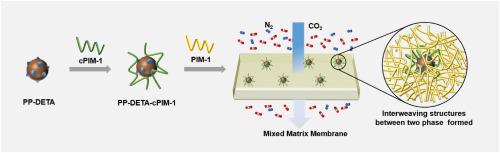
Mixed-matrix membranes (MMMs), developed through the combination of solid fillers with polymer matrices, represent an effective approach addressing the persistent challenge of balancing permeability and selectivity in polymer membrane. Diethylenetriamine-functionalized porous material of PP-DETA, which is synthesized from porous organic polymer of PP via one-step diethylenetriamine grafting, is an ideal material for MMMs production. However, designing and optimizing PP-DETA for high-performance CO2 separation membranes remains a challenge. Herein, we develop an improved PP-DETA material, designated as PP-DETA-cPIM-1, by covalently attaching a carboxylated polymer of intrinsic microporosity (cPIM-1) network layer onto the PP-DETA surface. Membranes prepared from this PP-DETA-cPIM-1 filler and PIM-1 matrix demonstrate enhanced interfacial adhesion and stronger mechanical properties in comparison to the counterparts with the same loading of PP-DETA. The incorporation of PP-DETA-cPIM-1 into MMMs establishes an enhanced filler/polymer interface that facilitates the selective transport of CO2 through the filler, while simultaneously improving membrane stability and suppressing physical aging. Specifically, with 5 wt% loading of PP-DETA-cPIM-1 filler, the MMM is able to enhance the CO2/N2 selectivity and CO2 permeability by 52.3 % and 25.3 %, respectively, exceeding the upper bound established in 2008. Furthermore, PP-DETA-cPIM-1/PIM-1 MMMs display superior anti-aging ability for 180 days of aging.
期刊介绍:
The Journal of Membrane Science is a publication that focuses on membrane systems and is aimed at academic and industrial chemists, chemical engineers, materials scientists, and membranologists. It publishes original research and reviews on various aspects of membrane transport, membrane formation/structure, fouling, module/process design, and processes/applications. The journal primarily focuses on the structure, function, and performance of non-biological membranes but also includes papers that relate to biological membranes. The Journal of Membrane Science publishes Full Text Papers, State-of-the-Art Reviews, Letters to the Editor, and Perspectives.



 京公网安备 11010802042870号
京ICP备2023020795号-1
京公网安备 11010802042870号
京ICP备2023020795号-1

 分享
分享
 求助内容:
求助内容: 应助结果提醒方式:
 扫码关注我们
