Ziyang Guo , Runhao Li , Yumei Wang , Haoling Zhang , Haitao Wang , Yue Sun , Na Chang
{"title":"Macrocyclic pillararene-based polyester loose nanofiltration membranes for efficient dye/salt separation","authors":"Ziyang Guo , Runhao Li , Yumei Wang , Haoling Zhang , Haitao Wang , Yue Sun , Na Chang","doi":"10.1016/j.memsci.2025.124087","DOIUrl":null,"url":null,"abstract":"<div><div>Loose nanofiltration membranes, particularly those fabricated using hydroxyl-based monomers, have garnered considerable interest due to their exceptional ability to reject dyes while allowing the passage of monovalent salts. These properties make them highly suitable for applications in resource recovery and the treatment of saline textile wastewater. In this study, a series of well-designed macrocyclic polyester loose nanofiltration membranes were fabricated through classic interfacial polymerization, involving the reaction of an aqueous monomer containing pillar[n]arenes with their intrinsic cavity structure and an organic phase containing 1,3,5-benzenetricarboxylic acid chloride. Notably, triethylamine was employed as an acid-binding agent to enhance the solubility and esterification reactivity of P[n], facilitating the formation of an ultrathin polyester selective layer (56–85 nm). The macrocyclic pillar[n]arene-based polyester loose nanofiltration membranes exhibited a smooth, negatively charged surface and achieved a high water permeance of 89.35 L m<sup>−2</sup> h<sup>−1</sup> bar<sup>−1</sup>, good dye rejection (97.92 % for Congo red, 95.27 % for Methyl blue), and low rejection of inorganic salts (4.3 % for NaCl, 3.5 % for MgCl<sub>2</sub>). Remarkably, the Congo red/NaCl mixture selectivity reached 46.0. These macrocyclic loose nanofiltration membranes showed stable performance during continuous filtration, confirming the significant potential of macrocyclic pillar[n]arene-based polyester loose nanofiltration membranes for treating salt-containing textile wastewater.</div></div>","PeriodicalId":368,"journal":{"name":"Journal of Membrane Science","volume":"727 ","pages":"Article 124087"},"PeriodicalIF":9.0000,"publicationDate":"2025-06-01","publicationTypes":"Journal Article","fieldsOfStudy":null,"isOpenAccess":false,"openAccessPdf":"","citationCount":"0","resultStr":null,"platform":"Semanticscholar","paperid":null,"PeriodicalName":"Journal of Membrane Science","FirstCategoryId":"5","ListUrlMain":"https://www.sciencedirect.com/science/article/pii/S0376738825004004","RegionNum":1,"RegionCategory":"工程技术","ArticlePicture":[],"TitleCN":null,"AbstractTextCN":null,"PMCID":null,"EPubDate":"2025/4/7 0:00:00","PubModel":"Epub","JCR":"Q1","JCRName":"ENGINEERING, CHEMICAL","Score":null,"Total":0}
引用次数: 0
Abstract
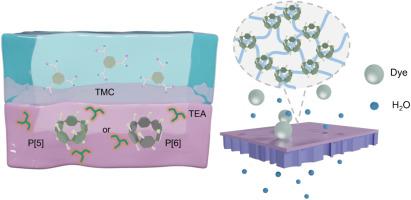
Loose nanofiltration membranes, particularly those fabricated using hydroxyl-based monomers, have garnered considerable interest due to their exceptional ability to reject dyes while allowing the passage of monovalent salts. These properties make them highly suitable for applications in resource recovery and the treatment of saline textile wastewater. In this study, a series of well-designed macrocyclic polyester loose nanofiltration membranes were fabricated through classic interfacial polymerization, involving the reaction of an aqueous monomer containing pillar[n]arenes with their intrinsic cavity structure and an organic phase containing 1,3,5-benzenetricarboxylic acid chloride. Notably, triethylamine was employed as an acid-binding agent to enhance the solubility and esterification reactivity of P[n], facilitating the formation of an ultrathin polyester selective layer (56–85 nm). The macrocyclic pillar[n]arene-based polyester loose nanofiltration membranes exhibited a smooth, negatively charged surface and achieved a high water permeance of 89.35 L m−2 h−1 bar−1, good dye rejection (97.92 % for Congo red, 95.27 % for Methyl blue), and low rejection of inorganic salts (4.3 % for NaCl, 3.5 % for MgCl2). Remarkably, the Congo red/NaCl mixture selectivity reached 46.0. These macrocyclic loose nanofiltration membranes showed stable performance during continuous filtration, confirming the significant potential of macrocyclic pillar[n]arene-based polyester loose nanofiltration membranes for treating salt-containing textile wastewater.
期刊介绍:
The Journal of Membrane Science is a publication that focuses on membrane systems and is aimed at academic and industrial chemists, chemical engineers, materials scientists, and membranologists. It publishes original research and reviews on various aspects of membrane transport, membrane formation/structure, fouling, module/process design, and processes/applications. The journal primarily focuses on the structure, function, and performance of non-biological membranes but also includes papers that relate to biological membranes. The Journal of Membrane Science publishes Full Text Papers, State-of-the-Art Reviews, Letters to the Editor, and Perspectives.



 京公网安备 11010802042870号
京ICP备2023020795号-1
京公网安备 11010802042870号
京ICP备2023020795号-1

 分享
分享
 求助内容:
求助内容: 应助结果提醒方式:
 扫码关注我们
