Xiaolong He , Xueyin Lu , Jiajun Xie , Ze-xian Low , Shasha Feng , Yutang Kang , Dong Zou , Peng Sun , Zhaoxiang Zhong , Weihong Xing
{"title":"Mechanical and functional enhancement of carbon nanofiber membranes via dual-scale defect control strategy for air purification","authors":"Xiaolong He , Xueyin Lu , Jiajun Xie , Ze-xian Low , Shasha Feng , Yutang Kang , Dong Zou , Peng Sun , Zhaoxiang Zhong , Weihong Xing","doi":"10.1016/j.memsci.2025.124083","DOIUrl":null,"url":null,"abstract":"<div><div>Carbon nanofiber membranes (CNFMs) have significant applications in lithium batteries, flexible electronics, sensing, and wave absorption, etc. Their high electrical conductivity, good thermal stability and high specific surface area also render them promising for multifunctional air purification. However, the poor mechanical strength of carbon nanofiber membranes seriously restricts their large-scale application. In this work, a dual-scale defect control strategy is proposed to enhance the mechanical properties and air purification performance of CNFM, which refers to repairing graphite carbon defects on the molecular scale and constructing more micropore defects on the nano scale of the carbon nanofibers. Polyvinylpyrrolidone (PVP) increases the ratio of graphitic carbon and graphitic nitrogen, and the repair of graphite carbon defects results in a higher tensile strength of CNFM. The tensile strength increases from 0.42 to 8.44 MPa, with an increase of 1910 %. Terephthalic acid (TPA) constructs more microporous structures through sublimation to increase micropore defects, thus increasing the elongation at break and flexibility. The Young's modulus decreases from 389 MPa to 89 MPa with a decrease of 81.4 %. The prepared CNFM has a specific surface area of 630 m<sup>2</sup> g<sup>−1</sup>. The PM<sub>0.3</sub> filtration efficiency, pressure drop, and quality factor are 99.53 %, 33.3 Pa, and 0.161 Pa<sup>-1</sup>, respectively. The static adsorption capacity for toluene and formaldehyde is 228.0 mg g<sup>−1</sup> and 390.9 mg g<sup>−1</sup>, respectively. This work provides clear insights into improving the mechanical properties of CNFM and its multifunctional air purification application.</div></div>","PeriodicalId":368,"journal":{"name":"Journal of Membrane Science","volume":"727 ","pages":"Article 124083"},"PeriodicalIF":9.0000,"publicationDate":"2025-06-01","publicationTypes":"Journal Article","fieldsOfStudy":null,"isOpenAccess":false,"openAccessPdf":"","citationCount":"0","resultStr":null,"platform":"Semanticscholar","paperid":null,"PeriodicalName":"Journal of Membrane Science","FirstCategoryId":"5","ListUrlMain":"https://www.sciencedirect.com/science/article/pii/S0376738825003965","RegionNum":1,"RegionCategory":"工程技术","ArticlePicture":[],"TitleCN":null,"AbstractTextCN":null,"PMCID":null,"EPubDate":"2025/4/7 0:00:00","PubModel":"Epub","JCR":"Q1","JCRName":"ENGINEERING, CHEMICAL","Score":null,"Total":0}
引用次数: 0
Abstract
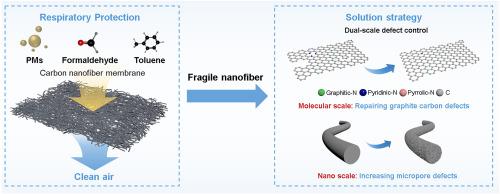
Carbon nanofiber membranes (CNFMs) have significant applications in lithium batteries, flexible electronics, sensing, and wave absorption, etc. Their high electrical conductivity, good thermal stability and high specific surface area also render them promising for multifunctional air purification. However, the poor mechanical strength of carbon nanofiber membranes seriously restricts their large-scale application. In this work, a dual-scale defect control strategy is proposed to enhance the mechanical properties and air purification performance of CNFM, which refers to repairing graphite carbon defects on the molecular scale and constructing more micropore defects on the nano scale of the carbon nanofibers. Polyvinylpyrrolidone (PVP) increases the ratio of graphitic carbon and graphitic nitrogen, and the repair of graphite carbon defects results in a higher tensile strength of CNFM. The tensile strength increases from 0.42 to 8.44 MPa, with an increase of 1910 %. Terephthalic acid (TPA) constructs more microporous structures through sublimation to increase micropore defects, thus increasing the elongation at break and flexibility. The Young's modulus decreases from 389 MPa to 89 MPa with a decrease of 81.4 %. The prepared CNFM has a specific surface area of 630 m2 g−1. The PM0.3 filtration efficiency, pressure drop, and quality factor are 99.53 %, 33.3 Pa, and 0.161 Pa-1, respectively. The static adsorption capacity for toluene and formaldehyde is 228.0 mg g−1 and 390.9 mg g−1, respectively. This work provides clear insights into improving the mechanical properties of CNFM and its multifunctional air purification application.
期刊介绍:
The Journal of Membrane Science is a publication that focuses on membrane systems and is aimed at academic and industrial chemists, chemical engineers, materials scientists, and membranologists. It publishes original research and reviews on various aspects of membrane transport, membrane formation/structure, fouling, module/process design, and processes/applications. The journal primarily focuses on the structure, function, and performance of non-biological membranes but also includes papers that relate to biological membranes. The Journal of Membrane Science publishes Full Text Papers, State-of-the-Art Reviews, Letters to the Editor, and Perspectives.



 京公网安备 11010802042870号
京ICP备2023020795号-1
京公网安备 11010802042870号
京ICP备2023020795号-1

 分享
分享
 求助内容:
求助内容: 应助结果提醒方式:
 扫码关注我们
