{"title":"Gradient or no gradient: Spatial hydrostatic pressure distributions in bilayer thin-film composite membranes","authors":"Ian Keen Koo , Meng Nan Chong , K.B. Goh","doi":"10.1016/j.memsci.2025.124023","DOIUrl":null,"url":null,"abstract":"<div><div>Water recovery through pressure-driven bilayer thin-film composite (TFC) membranes remains an open problem, with critical uncertainty centered on its driving forces, namely the hydrostatic pressure <em>gradient</em>, yet systematic investigation remains limited. Here, we present a poromechanics framework that explicitly accounts for the distinct mechanical, structural, and transport properties, elucidating the interplay between flow-induced compaction and water transport in a TFC membrane governing the transport upper limit performance. Our approach naturally splits the strain energy into two regions: (i) a linear-response selective layer and (ii) a non-linear supporting one, mechanically capturing the strain-hardening behavior as the compacted support layer transitions into its bulk polymer state. While the hydrostatic pressure distribution in the selective layer merely scales upward with the increasing applied transmembrane pressure, the distribution in the support layer, however, contorts from a zero slope to a linear one and finally to a non-linear slope, demonstrating how the water transport changes to a support layer-controlled system. Overall, we show how a cancellation between permeance and the hydrostatic pressure difference across TFC membranes drives the transition between (i) support layer-controlled and (ii) selective layer-controlled regimes.</div></div>","PeriodicalId":368,"journal":{"name":"Journal of Membrane Science","volume":"727 ","pages":"Article 124023"},"PeriodicalIF":9.0000,"publicationDate":"2025-06-01","publicationTypes":"Journal Article","fieldsOfStudy":null,"isOpenAccess":false,"openAccessPdf":"","citationCount":"0","resultStr":null,"platform":"Semanticscholar","paperid":null,"PeriodicalName":"Journal of Membrane Science","FirstCategoryId":"5","ListUrlMain":"https://www.sciencedirect.com/science/article/pii/S0376738825003369","RegionNum":1,"RegionCategory":"工程技术","ArticlePicture":[],"TitleCN":null,"AbstractTextCN":null,"PMCID":null,"EPubDate":"2025/4/5 0:00:00","PubModel":"Epub","JCR":"Q1","JCRName":"ENGINEERING, CHEMICAL","Score":null,"Total":0}
引用次数: 0
Abstract
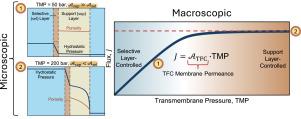
Water recovery through pressure-driven bilayer thin-film composite (TFC) membranes remains an open problem, with critical uncertainty centered on its driving forces, namely the hydrostatic pressure gradient, yet systematic investigation remains limited. Here, we present a poromechanics framework that explicitly accounts for the distinct mechanical, structural, and transport properties, elucidating the interplay between flow-induced compaction and water transport in a TFC membrane governing the transport upper limit performance. Our approach naturally splits the strain energy into two regions: (i) a linear-response selective layer and (ii) a non-linear supporting one, mechanically capturing the strain-hardening behavior as the compacted support layer transitions into its bulk polymer state. While the hydrostatic pressure distribution in the selective layer merely scales upward with the increasing applied transmembrane pressure, the distribution in the support layer, however, contorts from a zero slope to a linear one and finally to a non-linear slope, demonstrating how the water transport changes to a support layer-controlled system. Overall, we show how a cancellation between permeance and the hydrostatic pressure difference across TFC membranes drives the transition between (i) support layer-controlled and (ii) selective layer-controlled regimes.
期刊介绍:
The Journal of Membrane Science is a publication that focuses on membrane systems and is aimed at academic and industrial chemists, chemical engineers, materials scientists, and membranologists. It publishes original research and reviews on various aspects of membrane transport, membrane formation/structure, fouling, module/process design, and processes/applications. The journal primarily focuses on the structure, function, and performance of non-biological membranes but also includes papers that relate to biological membranes. The Journal of Membrane Science publishes Full Text Papers, State-of-the-Art Reviews, Letters to the Editor, and Perspectives.



 京公网安备 11010802042870号
京ICP备2023020795号-1
京公网安备 11010802042870号
京ICP备2023020795号-1

 分享
分享
 求助内容:
求助内容: 应助结果提醒方式:
 扫码关注我们
