Zhenpu Wang , Jing Xu , Suxia Ma , Guanjia Zhao , Jianfei Wang , Yujiong Gu
{"title":"Comparative investigation on heat pump solutions for peak shaving and heat-power decoupling in combined heat and power plants","authors":"Zhenpu Wang , Jing Xu , Suxia Ma , Guanjia Zhao , Jianfei Wang , Yujiong Gu","doi":"10.1016/j.rser.2025.115703","DOIUrl":null,"url":null,"abstract":"<div><div>One pressing concern for coal-fired power plants is the retrofitting of heating supply, as central heating demand continues to rise, and carbon emission reduction becomes a priority. However, the cogeneration of heat and power leads to unwanted heat-power coupling and restricts the power peak-shaving flexibility. In this study, heat pump (HP) is used in designing highly efficient and heat-power decoupling retrofit systems. Three retrofit cases integrating absorption heat pump (AHP) and electric heat pump (EHP) are proposed. Their energy utilization efficiency, exergy efficiency, coal consumption rate of power generation with varying operating conditions, and heat-power decoupling characteristics are compared. Moreover, the techno-economic considering the repayment time and the benefits of peak shaving in the retrofit cases is investigated. A 600 MW coal-fired power plant is studied. Results show that three retrofit cases can enhance the heating capacity and achieve heat-power decoupling. The EHP-CHP system has the largest heating capacity of 1049 MW and the minimum power load of 150 MW at the heating load of 546 MW. In contrast, the AHP-CHP system can only decrease the minimum power load to 300 MW. The EHP-CHP coupled with the extracted exhaust steam system shows the highest energy utilization efficiency of 90.46 % at the maximum heating capacity, with the lowest coal consumption rate of power generation of 141.96 g (kW h)<sup>−1</sup> under 50 % THA, which is lower than the 153.27 g (kW h)<sup>−1</sup> the EHP-CHP system. However, the utilization of EHP decreases the exergy efficiency compared to AHP. The AHP-CHP system provides a maximum exergy efficiency of 36.46 % under the design heating load. In addition, the EHP-CHP coupled with the extracted exhaust steam retrofit case leads to a short repayment time of only 1.9 years. The EHP-CHP coupled with exhaust steam system proves to be a preferable energy-efficient, heat-power decoupling, and economic benefit-favorable solution.</div></div>","PeriodicalId":418,"journal":{"name":"Renewable and Sustainable Energy Reviews","volume":"216 ","pages":""},"PeriodicalIF":16.3000,"publicationDate":"2025-07-01","publicationTypes":"Journal Article","fieldsOfStudy":null,"isOpenAccess":false,"openAccessPdf":"","citationCount":"0","resultStr":null,"platform":"Semanticscholar","paperid":null,"PeriodicalName":"Renewable and Sustainable Energy Reviews","FirstCategoryId":"1","ListUrlMain":"https://www.sciencedirect.com/science/article/pii/S1364032125003764","RegionNum":1,"RegionCategory":"工程技术","ArticlePicture":[],"TitleCN":null,"AbstractTextCN":null,"PMCID":null,"EPubDate":"2025/4/11 0:00:00","PubModel":"Epub","JCR":"Q1","JCRName":"ENERGY & FUELS","Score":null,"Total":0}
引用次数: 0
Abstract
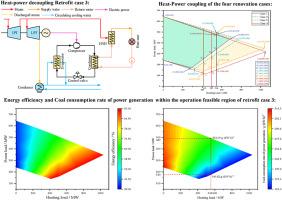
One pressing concern for coal-fired power plants is the retrofitting of heating supply, as central heating demand continues to rise, and carbon emission reduction becomes a priority. However, the cogeneration of heat and power leads to unwanted heat-power coupling and restricts the power peak-shaving flexibility. In this study, heat pump (HP) is used in designing highly efficient and heat-power decoupling retrofit systems. Three retrofit cases integrating absorption heat pump (AHP) and electric heat pump (EHP) are proposed. Their energy utilization efficiency, exergy efficiency, coal consumption rate of power generation with varying operating conditions, and heat-power decoupling characteristics are compared. Moreover, the techno-economic considering the repayment time and the benefits of peak shaving in the retrofit cases is investigated. A 600 MW coal-fired power plant is studied. Results show that three retrofit cases can enhance the heating capacity and achieve heat-power decoupling. The EHP-CHP system has the largest heating capacity of 1049 MW and the minimum power load of 150 MW at the heating load of 546 MW. In contrast, the AHP-CHP system can only decrease the minimum power load to 300 MW. The EHP-CHP coupled with the extracted exhaust steam system shows the highest energy utilization efficiency of 90.46 % at the maximum heating capacity, with the lowest coal consumption rate of power generation of 141.96 g (kW h)−1 under 50 % THA, which is lower than the 153.27 g (kW h)−1 the EHP-CHP system. However, the utilization of EHP decreases the exergy efficiency compared to AHP. The AHP-CHP system provides a maximum exergy efficiency of 36.46 % under the design heating load. In addition, the EHP-CHP coupled with the extracted exhaust steam retrofit case leads to a short repayment time of only 1.9 years. The EHP-CHP coupled with exhaust steam system proves to be a preferable energy-efficient, heat-power decoupling, and economic benefit-favorable solution.
期刊介绍:
The mission of Renewable and Sustainable Energy Reviews is to disseminate the most compelling and pertinent critical insights in renewable and sustainable energy, fostering collaboration among the research community, private sector, and policy and decision makers. The journal aims to exchange challenges, solutions, innovative concepts, and technologies, contributing to sustainable development, the transition to a low-carbon future, and the attainment of emissions targets outlined by the United Nations Framework Convention on Climate Change.
Renewable and Sustainable Energy Reviews publishes a diverse range of content, including review papers, original research, case studies, and analyses of new technologies, all featuring a substantial review component such as critique, comparison, or analysis. Introducing a distinctive paper type, Expert Insights, the journal presents commissioned mini-reviews authored by field leaders, addressing topics of significant interest. Case studies undergo consideration only if they showcase the work's applicability to other regions or contribute valuable insights to the broader field of renewable and sustainable energy. Notably, a bibliographic or literature review lacking critical analysis is deemed unsuitable for publication.



 京公网安备 11010802042870号
京ICP备2023020795号-1
京公网安备 11010802042870号
京ICP备2023020795号-1

 分享
分享
 求助内容:
求助内容: 应助结果提醒方式:
 扫码关注我们
