{"title":"Carbon nitride 2D nanosheets enhanced rGO membranes for water treatment: Forward osmosis and photocatalysis","authors":"Yiyang Liu, Mengyang Lu, Hao Fang, Hanmin Zhang","doi":"10.1016/j.memsci.2025.124089","DOIUrl":null,"url":null,"abstract":"<div><div>Although forward osmosis (FO) offers the advantage of high desalination capacity without additional driving forces, it faces two challenges: the trade-off effect and membrane fouling. Embedding 2D nanosheets into the membrane effectively enhances its properties by modulating the interlayer spacing and imparting catalytic functionality, providing a key strategy to address the outlined challenges. In this work, 2D nanomaterials with photocatalytic properties, specifically carbon nitride (gCN), were intercalated into reduced graphene oxide (rGO) laminates to prepare rGO@gCN composite FO membranes. Atomically 2D gCN nanosheets acted as nanospacers, increasing the interlayer spacing between rGO nanosheets and enhancing the membrane's surface hydrophilicity, thereby providing a direct water transport channel and reducing resistance to water transport. The rGO@gCN membrane exhibited optimal performance, with a water flux of 48.4 LMH (an 11-fold increase compared to the pristine rGO membrane), without sacrificing the rejection of divalent ions and organic dyes, thereby overcoming the constraints of the trade-off effect. Additionally, the rGO@gCN membrane demonstrated self-cleaning capabilities for methylene blue (MB) fouling on the surface during both static and dynamic photocatalytic performance tests. The rGO@gCN membrane maintained 70 % of the initial water flux even after 4 h FO filtration under visible light, and the MB-contaminated membrane could be self-cleaning to restore its original appearance and water permeability. Overall, this work provides a multifaceted strategy and valuable design insights for achieving high FO performance and enhanced resistance to membrane fouling in various potential applications of 2D nanomaterial-based FO membranes.</div></div>","PeriodicalId":368,"journal":{"name":"Journal of Membrane Science","volume":"726 ","pages":"Article 124089"},"PeriodicalIF":9.0000,"publicationDate":"2025-05-01","publicationTypes":"Journal Article","fieldsOfStudy":null,"isOpenAccess":false,"openAccessPdf":"","citationCount":"0","resultStr":null,"platform":"Semanticscholar","paperid":null,"PeriodicalName":"Journal of Membrane Science","FirstCategoryId":"5","ListUrlMain":"https://www.sciencedirect.com/science/article/pii/S0376738825004028","RegionNum":1,"RegionCategory":"工程技术","ArticlePicture":[],"TitleCN":null,"AbstractTextCN":null,"PMCID":null,"EPubDate":"2025/4/8 0:00:00","PubModel":"Epub","JCR":"Q1","JCRName":"ENGINEERING, CHEMICAL","Score":null,"Total":0}
引用次数: 0
Abstract
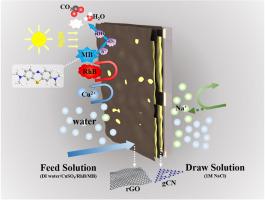
Although forward osmosis (FO) offers the advantage of high desalination capacity without additional driving forces, it faces two challenges: the trade-off effect and membrane fouling. Embedding 2D nanosheets into the membrane effectively enhances its properties by modulating the interlayer spacing and imparting catalytic functionality, providing a key strategy to address the outlined challenges. In this work, 2D nanomaterials with photocatalytic properties, specifically carbon nitride (gCN), were intercalated into reduced graphene oxide (rGO) laminates to prepare rGO@gCN composite FO membranes. Atomically 2D gCN nanosheets acted as nanospacers, increasing the interlayer spacing between rGO nanosheets and enhancing the membrane's surface hydrophilicity, thereby providing a direct water transport channel and reducing resistance to water transport. The rGO@gCN membrane exhibited optimal performance, with a water flux of 48.4 LMH (an 11-fold increase compared to the pristine rGO membrane), without sacrificing the rejection of divalent ions and organic dyes, thereby overcoming the constraints of the trade-off effect. Additionally, the rGO@gCN membrane demonstrated self-cleaning capabilities for methylene blue (MB) fouling on the surface during both static and dynamic photocatalytic performance tests. The rGO@gCN membrane maintained 70 % of the initial water flux even after 4 h FO filtration under visible light, and the MB-contaminated membrane could be self-cleaning to restore its original appearance and water permeability. Overall, this work provides a multifaceted strategy and valuable design insights for achieving high FO performance and enhanced resistance to membrane fouling in various potential applications of 2D nanomaterial-based FO membranes.
期刊介绍:
The Journal of Membrane Science is a publication that focuses on membrane systems and is aimed at academic and industrial chemists, chemical engineers, materials scientists, and membranologists. It publishes original research and reviews on various aspects of membrane transport, membrane formation/structure, fouling, module/process design, and processes/applications. The journal primarily focuses on the structure, function, and performance of non-biological membranes but also includes papers that relate to biological membranes. The Journal of Membrane Science publishes Full Text Papers, State-of-the-Art Reviews, Letters to the Editor, and Perspectives.



 京公网安备 11010802042870号
京ICP备2023020795号-1
京公网安备 11010802042870号
京ICP备2023020795号-1

 分享
分享
 求助内容:
求助内容: 应助结果提醒方式:
 扫码关注我们
