Numerical Simulation and Optimization of Droplet Transition in Bypass-Coupled Twin-Wire Indirect Arc Welding: Insights into Parameter Effects and Process Stability
Yuhang Zhang , Dongting Wu , Zhenhuan Gao , Haidong Yin , Liping Nie , Xiufang Gong , Ying Liu , Yong Zou
{"title":"Numerical Simulation and Optimization of Droplet Transition in Bypass-Coupled Twin-Wire Indirect Arc Welding: Insights into Parameter Effects and Process Stability","authors":"Yuhang Zhang , Dongting Wu , Zhenhuan Gao , Haidong Yin , Liping Nie , Xiufang Gong , Ying Liu , Yong Zou","doi":"10.1016/j.jmatprotec.2025.118853","DOIUrl":null,"url":null,"abstract":"<div><div>This study develops a numerical model for droplet transition in Bypass-Coupled Twin-Wire Indirect Arc Welding (BC-TWIAW), integrating electromagnetic and hydrodynamic interactions. Experimental validation confirms the model’s reliability with less than 10% error. Analysis reveals that shielding gas flow rate, welding current, and wire feed speed jointly govern droplet transition: gas flow rate exceeding 21<!--> <!-->L/min or excessive wire feed speed destabilises the transition, while balanced parameters suppress splashing. The bypass current critically controls the positive droplet stability, evidenced by smaller offset distances at currents between 90-110<!--> <!-->A. The main current, optimal in the range of 110-130<!--> <!-->A, along with the wire feed speed, regulates droplet size and transition frequency. An unbalanced mix between wire feed speeds—positive speeds between 0.1025 and 0.1225<!--> <!-->m/s and negative speeds between 0.14 and 0.16<!--> <!-->m/s—optimises droplet growth and detachment. The identified optimal ranges achieve stability by balancing electromagnetic forces and droplet dynamics, providing a transferable framework for multi-wire welding processes. This work advances process control strategies through systematic parameter space exploration, providing new insights into the optimisation of other welding processes and the control of droplet transition.</div></div>","PeriodicalId":367,"journal":{"name":"Journal of Materials Processing Technology","volume":"340 ","pages":"Article 118853"},"PeriodicalIF":7.5000,"publicationDate":"2025-04-08","publicationTypes":"Journal Article","fieldsOfStudy":null,"isOpenAccess":false,"openAccessPdf":"","citationCount":"0","resultStr":null,"platform":"Semanticscholar","paperid":null,"PeriodicalName":"Journal of Materials Processing Technology","FirstCategoryId":"88","ListUrlMain":"https://www.sciencedirect.com/science/article/pii/S0924013625001438","RegionNum":2,"RegionCategory":"材料科学","ArticlePicture":[],"TitleCN":null,"AbstractTextCN":null,"PMCID":null,"EPubDate":"","PubModel":"","JCR":"Q1","JCRName":"ENGINEERING, INDUSTRIAL","Score":null,"Total":0}
引用次数: 0
Abstract
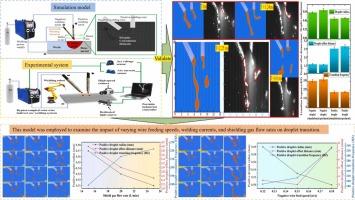
This study develops a numerical model for droplet transition in Bypass-Coupled Twin-Wire Indirect Arc Welding (BC-TWIAW), integrating electromagnetic and hydrodynamic interactions. Experimental validation confirms the model’s reliability with less than 10% error. Analysis reveals that shielding gas flow rate, welding current, and wire feed speed jointly govern droplet transition: gas flow rate exceeding 21 L/min or excessive wire feed speed destabilises the transition, while balanced parameters suppress splashing. The bypass current critically controls the positive droplet stability, evidenced by smaller offset distances at currents between 90-110 A. The main current, optimal in the range of 110-130 A, along with the wire feed speed, regulates droplet size and transition frequency. An unbalanced mix between wire feed speeds—positive speeds between 0.1025 and 0.1225 m/s and negative speeds between 0.14 and 0.16 m/s—optimises droplet growth and detachment. The identified optimal ranges achieve stability by balancing electromagnetic forces and droplet dynamics, providing a transferable framework for multi-wire welding processes. This work advances process control strategies through systematic parameter space exploration, providing new insights into the optimisation of other welding processes and the control of droplet transition.
期刊介绍:
The Journal of Materials Processing Technology covers the processing techniques used in manufacturing components from metals and other materials. The journal aims to publish full research papers of original, significant and rigorous work and so to contribute to increased production efficiency and improved component performance.
Areas of interest to the journal include:
• Casting, forming and machining
• Additive processing and joining technologies
• The evolution of material properties under the specific conditions met in manufacturing processes
• Surface engineering when it relates specifically to a manufacturing process
• Design and behavior of equipment and tools.



 京公网安备 11010802042870号
京ICP备2023020795号-1
京公网安备 11010802042870号
京ICP备2023020795号-1

 分享
分享
 求助内容:
求助内容: 应助结果提醒方式:
 扫码关注我们
