Suhaib Ardah , Francisco J. Profito , Daniele Dini
{"title":"A comprehensive review and trends in lubrication modelling","authors":"Suhaib Ardah , Francisco J. Profito , Daniele Dini","doi":"10.1016/j.cis.2025.103492","DOIUrl":null,"url":null,"abstract":"<div><div>Lubrication plays a pivotal role in modern society, given its significant economic and environmental implications, particularly in relation to friction, wear and the failure of moving mechanical systems. With recent breakthroughs in computational architectures, the development of advanced simulation frameworks has been greatly accelerated, facilitating the study of surfaces, lubricants and additives at unprecedented scales. However, the inherently multiscale nature of lubricated contacts necessitates a delicate balance between computationally efficient continuum descriptions and detailed atomistic accuracy for addressing the complex physiochemical phenomena spanning vastly different spatiotemporal scales. This review explores the dilemma of modelling inherently multiphysics tribological interactions, which drive the evolution of lubricated interfaces and shape tribosystem performances across the scales as accurately and simultaneously as efficiently as possible. It critically examines state-of-the-art modelling tools, their applications and limitations across spatiotemporal domains. Moreover, the capacity for machine learning to aggregate extensive datasets, address multi-physical complexities ranging from atomic dimensions to macroscopic scales and accelerate simulation workflows is explored, offering transformative perspectives for the future of lubrication modelling.</div></div>","PeriodicalId":239,"journal":{"name":"Advances in Colloid and Interface Science","volume":"342 ","pages":"Article 103492"},"PeriodicalIF":19.3000,"publicationDate":"2025-08-01","publicationTypes":"Journal Article","fieldsOfStudy":null,"isOpenAccess":false,"openAccessPdf":"","citationCount":"0","resultStr":null,"platform":"Semanticscholar","paperid":null,"PeriodicalName":"Advances in Colloid and Interface Science","FirstCategoryId":"92","ListUrlMain":"https://www.sciencedirect.com/science/article/pii/S0001868625001034","RegionNum":1,"RegionCategory":"化学","ArticlePicture":[],"TitleCN":null,"AbstractTextCN":null,"PMCID":null,"EPubDate":"2025/4/1 0:00:00","PubModel":"Epub","JCR":"Q1","JCRName":"CHEMISTRY, PHYSICAL","Score":null,"Total":0}
引用次数: 0
Abstract
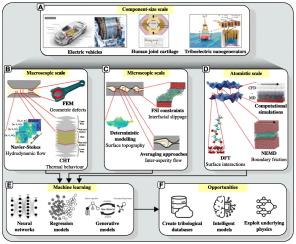
Lubrication plays a pivotal role in modern society, given its significant economic and environmental implications, particularly in relation to friction, wear and the failure of moving mechanical systems. With recent breakthroughs in computational architectures, the development of advanced simulation frameworks has been greatly accelerated, facilitating the study of surfaces, lubricants and additives at unprecedented scales. However, the inherently multiscale nature of lubricated contacts necessitates a delicate balance between computationally efficient continuum descriptions and detailed atomistic accuracy for addressing the complex physiochemical phenomena spanning vastly different spatiotemporal scales. This review explores the dilemma of modelling inherently multiphysics tribological interactions, which drive the evolution of lubricated interfaces and shape tribosystem performances across the scales as accurately and simultaneously as efficiently as possible. It critically examines state-of-the-art modelling tools, their applications and limitations across spatiotemporal domains. Moreover, the capacity for machine learning to aggregate extensive datasets, address multi-physical complexities ranging from atomic dimensions to macroscopic scales and accelerate simulation workflows is explored, offering transformative perspectives for the future of lubrication modelling.
期刊介绍:
"Advances in Colloid and Interface Science" is an international journal that focuses on experimental and theoretical developments in interfacial and colloidal phenomena. The journal covers a wide range of disciplines including biology, chemistry, physics, and technology.
The journal accepts review articles on any topic within the scope of colloid and interface science. These articles should provide an in-depth analysis of the subject matter, offering a critical review of the current state of the field. The author's informed opinion on the topic should also be included. The manuscript should compare and contrast ideas found in the reviewed literature and address the limitations of these ideas.
Typically, the articles published in this journal are written by recognized experts in the field.



 京公网安备 11010802042870号
京ICP备2023020795号-1
京公网安备 11010802042870号
京ICP备2023020795号-1

 分享
分享
 求助内容:
求助内容: 应助结果提醒方式:
 扫码关注我们
