Gwangtaek Lee , Yewon Park , Jungho Hwang , Bangwoo Han , Yongjin Kim , Hak Joon Kim
{"title":"Absorption of nitrogen dioxide via a non-packing scrubber using a sulfite/thiosulfate complex absorbent","authors":"Gwangtaek Lee , Yewon Park , Jungho Hwang , Bangwoo Han , Yongjin Kim , Hak Joon Kim","doi":"10.1016/j.chemosphere.2025.144387","DOIUrl":null,"url":null,"abstract":"<div><div>The conventional packing-type scrubber was found to exhibit high efficiency in treating exhaust gases. However, achieving effective performance requires large surface areas of packing materials, leading to a substantial pressure drop and a large energy consumption. Therefore, the present study demonstrates the advantages of a non-packing scrubbing system and investigates the effect of thiosulfate (S<sub>2</sub>O<sub>3</sub><sup>2−</sup>) ion on NO<sub>2</sub> absorption using a sulfite solution. The efficiency of the system with 0.1 M Na<sub>2</sub>SO<sub>3</sub> solution increased substantially upon the addition of 0.1 M Na<sub>2</sub>S<sub>2</sub>O<sub>3</sub> and maintained an efficiency of 90 % over extended periods. It also improved the absorbent oxidation ratio of O<sub>2</sub> to NO<sub>2</sub> from 13.6 to 3.9 mol O<sub>2</sub> (mol NO<sub>2</sub><sup>−1</sup>) because the Na<sub>2</sub>S<sub>2</sub>O<sub>3</sub> was regarded as an effective oxidation inhibitor. Therefore, the total chemical usage for 450 min was lowered by a factor of 11.3 (to 0.192 mol d<sup>−1</sup>) when 0.1 M Na<sub>2</sub>S<sub>2</sub>O<sub>3</sub>-assisted 0.1 M Na<sub>2</sub>SO<sub>3</sub> solution was used. This analysis showed that the addition of S<sub>2</sub>O<sub>3</sub><sup>2−</sup> ion can improve the NO<sub>2</sub> removal efficiency and lower the chemical usage. In addition, because the implementation of the PHRS substantially reduces the pressure drop below 0.01 hPa in the scrubbing system, the cost-effective adaptation of the PHRS is feasible.</div></div>","PeriodicalId":276,"journal":{"name":"Chemosphere","volume":"378 ","pages":"Article 144387"},"PeriodicalIF":8.1000,"publicationDate":"2025-04-10","publicationTypes":"Journal Article","fieldsOfStudy":null,"isOpenAccess":false,"openAccessPdf":"","citationCount":"0","resultStr":null,"platform":"Semanticscholar","paperid":null,"PeriodicalName":"Chemosphere","FirstCategoryId":"93","ListUrlMain":"https://www.sciencedirect.com/science/article/pii/S0045653525003303","RegionNum":2,"RegionCategory":"环境科学与生态学","ArticlePicture":[],"TitleCN":null,"AbstractTextCN":null,"PMCID":null,"EPubDate":"","PubModel":"","JCR":"Q1","JCRName":"ENVIRONMENTAL SCIENCES","Score":null,"Total":0}
引用次数: 0
Abstract
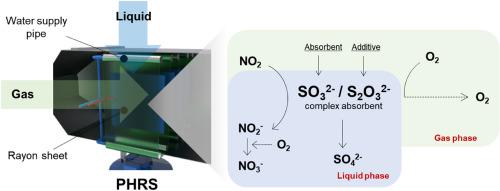
The conventional packing-type scrubber was found to exhibit high efficiency in treating exhaust gases. However, achieving effective performance requires large surface areas of packing materials, leading to a substantial pressure drop and a large energy consumption. Therefore, the present study demonstrates the advantages of a non-packing scrubbing system and investigates the effect of thiosulfate (S2O32−) ion on NO2 absorption using a sulfite solution. The efficiency of the system with 0.1 M Na2SO3 solution increased substantially upon the addition of 0.1 M Na2S2O3 and maintained an efficiency of 90 % over extended periods. It also improved the absorbent oxidation ratio of O2 to NO2 from 13.6 to 3.9 mol O2 (mol NO2−1) because the Na2S2O3 was regarded as an effective oxidation inhibitor. Therefore, the total chemical usage for 450 min was lowered by a factor of 11.3 (to 0.192 mol d−1) when 0.1 M Na2S2O3-assisted 0.1 M Na2SO3 solution was used. This analysis showed that the addition of S2O32− ion can improve the NO2 removal efficiency and lower the chemical usage. In addition, because the implementation of the PHRS substantially reduces the pressure drop below 0.01 hPa in the scrubbing system, the cost-effective adaptation of the PHRS is feasible.
期刊介绍:
Chemosphere, being an international multidisciplinary journal, is dedicated to publishing original communications and review articles on chemicals in the environment. The scope covers a wide range of topics, including the identification, quantification, behavior, fate, toxicology, treatment, and remediation of chemicals in the bio-, hydro-, litho-, and atmosphere, ensuring the broad dissemination of research in this field.



 京公网安备 11010802042870号
京ICP备2023020795号-1
京公网安备 11010802042870号
京ICP备2023020795号-1

 分享
分享
 求助内容:
求助内容: 应助结果提醒方式:
 扫码关注我们
