Dileep Kumar, Yang Pei, Bing Han, Sui Yang Khoo, Michael Norton, Scott D. Adams, Abbas Z. Kouzani
{"title":"Comparative analysis of waste tyre treatment technologies: Environmental and economic perspectives","authors":"Dileep Kumar, Yang Pei, Bing Han, Sui Yang Khoo, Michael Norton, Scott D. Adams, Abbas Z. Kouzani","doi":"10.1016/j.rser.2025.115691","DOIUrl":null,"url":null,"abstract":"<div><div>Around 75 % of waste tyres are disposed of in landfills annually worldwide, posing significant environmental and resource management challenges. Several waste tyre treatment (WTT) technologies have been developed to overcome the environmental impacts of used tyres worldwide. This study aims to identify the most eco-friendly and cost-effective technology by comparing the environmental and economic performance of different WTT technologies. It first conducts a systematic literature survey to identify and select the most relevant scientific studies published in the last two decades. It discusses the technical attributes of different WTT technologies. Then, the life cycle assessment (LCA) methodology determines the selected impact categories for comparative analysis. The WTT technologies are compared against each other using selected impact categories by harmonising their characterisation factor at 1 ton of waste tyre. Afterwards, it identifies the most eco-friendly WTT technology irrespective of technical and geographical boundary conditions, comparing the minimum and maximum characterisation values of each WTT technology. The comparative analysis reveals that pyrolysis is the most efficient WTT technology, exhibiting the lowest global warming potential (−1298 kgCO<sub>2</sub>-eq/t), the highest resource recovery (−60 eco-points/t), and the best economic performance ($133/t profit). Pyrolysis facilitates the recovery of steel wires (150–263 kg/t), carbon black (330–380 kg/t), diesel (167 kg/t), and petrol (72 kg/t), contributing to sustainable waste management. Finally, this study proposes a carbon credit trading mechanism to ensure transparency in emissions trading and incentivise waste tyre recycling.</div></div>","PeriodicalId":418,"journal":{"name":"Renewable and Sustainable Energy Reviews","volume":"216 ","pages":"Article 115691"},"PeriodicalIF":16.3000,"publicationDate":"2025-07-01","publicationTypes":"Journal Article","fieldsOfStudy":null,"isOpenAccess":false,"openAccessPdf":"","citationCount":"0","resultStr":null,"platform":"Semanticscholar","paperid":null,"PeriodicalName":"Renewable and Sustainable Energy Reviews","FirstCategoryId":"1","ListUrlMain":"https://www.sciencedirect.com/science/article/pii/S1364032125003648","RegionNum":1,"RegionCategory":"工程技术","ArticlePicture":[],"TitleCN":null,"AbstractTextCN":null,"PMCID":null,"EPubDate":"2025/4/10 0:00:00","PubModel":"Epub","JCR":"Q1","JCRName":"ENERGY & FUELS","Score":null,"Total":0}
引用次数: 0
Abstract
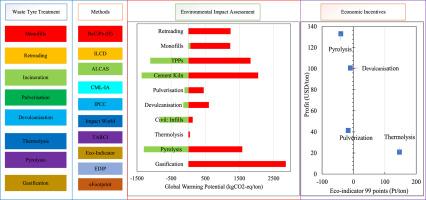
Around 75 % of waste tyres are disposed of in landfills annually worldwide, posing significant environmental and resource management challenges. Several waste tyre treatment (WTT) technologies have been developed to overcome the environmental impacts of used tyres worldwide. This study aims to identify the most eco-friendly and cost-effective technology by comparing the environmental and economic performance of different WTT technologies. It first conducts a systematic literature survey to identify and select the most relevant scientific studies published in the last two decades. It discusses the technical attributes of different WTT technologies. Then, the life cycle assessment (LCA) methodology determines the selected impact categories for comparative analysis. The WTT technologies are compared against each other using selected impact categories by harmonising their characterisation factor at 1 ton of waste tyre. Afterwards, it identifies the most eco-friendly WTT technology irrespective of technical and geographical boundary conditions, comparing the minimum and maximum characterisation values of each WTT technology. The comparative analysis reveals that pyrolysis is the most efficient WTT technology, exhibiting the lowest global warming potential (−1298 kgCO2-eq/t), the highest resource recovery (−60 eco-points/t), and the best economic performance ($133/t profit). Pyrolysis facilitates the recovery of steel wires (150–263 kg/t), carbon black (330–380 kg/t), diesel (167 kg/t), and petrol (72 kg/t), contributing to sustainable waste management. Finally, this study proposes a carbon credit trading mechanism to ensure transparency in emissions trading and incentivise waste tyre recycling.
期刊介绍:
The mission of Renewable and Sustainable Energy Reviews is to disseminate the most compelling and pertinent critical insights in renewable and sustainable energy, fostering collaboration among the research community, private sector, and policy and decision makers. The journal aims to exchange challenges, solutions, innovative concepts, and technologies, contributing to sustainable development, the transition to a low-carbon future, and the attainment of emissions targets outlined by the United Nations Framework Convention on Climate Change.
Renewable and Sustainable Energy Reviews publishes a diverse range of content, including review papers, original research, case studies, and analyses of new technologies, all featuring a substantial review component such as critique, comparison, or analysis. Introducing a distinctive paper type, Expert Insights, the journal presents commissioned mini-reviews authored by field leaders, addressing topics of significant interest. Case studies undergo consideration only if they showcase the work's applicability to other regions or contribute valuable insights to the broader field of renewable and sustainable energy. Notably, a bibliographic or literature review lacking critical analysis is deemed unsuitable for publication.



 京公网安备 11010802042870号
京ICP备2023020795号-1
京公网安备 11010802042870号
京ICP备2023020795号-1

 分享
分享
 求助内容:
求助内容: 应助结果提醒方式:
 扫码关注我们
