O. Soriano-Romero , M.Y. Espinosa-Cerón , S. Carmona-Tellez , U. Caldiño , Ma E. Zayas , C. Falcony , R. Lozada-Morales , A.N. Meza-Rocha
{"title":"Up-conversion and down-shifting emission traits of Er3+-doped CdO–V2O5–ZnO–B2O3 novel inverted glasses for photonic applications","authors":"O. Soriano-Romero , M.Y. Espinosa-Cerón , S. Carmona-Tellez , U. Caldiño , Ma E. Zayas , C. Falcony , R. Lozada-Morales , A.N. Meza-Rocha","doi":"10.1016/j.optmat.2025.116970","DOIUrl":null,"url":null,"abstract":"<div><div>Er<sup>3+</sup>-doped CdO–V<sub>2</sub>O<sub>5</sub>–ZnO–B<sub>2</sub>O<sub>3</sub> (CVZB-Er) inverted glasses were synthesized by the melt-quenching method. X-ray diffraction (XRD) patterns showed an amorphous structure in all Er<sup>3+</sup> doping ranges. This fact was verified by the line shape of Raman spectra, which revealed two broad vibrational bands attributed to V<sub>2</sub>O<sub>5</sub> and B<sub>2</sub>O<sub>3</sub> glass former species. The direct optical band gap (<span><math><mrow><msubsup><mi>E</mi><mi>g</mi><mi>d</mi></msubsup></mrow></math></span>) values were found around 2.74 eV, without tendency with Er<sup>3+</sup> concentration. Under 980 nm laser excitation, the down-shifting emission spectra exhibited the featured near-infrared Er<sup>3+</sup>: <sup>4</sup>I<sub>13/2</sub> → <sup>4</sup>I<sub>15/2</sub> emission band. Meanwhile, the upconverting (UC) emission spectra, with color purities up to 97 %, displayed the well-known green and red emission bands related to relaxations from the (<sup>2</sup>H<sub>11/2</sub>, <sup>4</sup>S<sub>3/2</sub>) and <sup>4</sup>F<sub>9/2</sub> excited states to the <sup>4</sup>I<sub>15/2</sub> ground one, respectively. This process is dominated by a linear decay mechanism, as revealed by the dependence of the intensity versus the excitation laser power. The Judd-Ofelt (JO) parameters, obtained by the least-square method from the experimental and calculated oscillator strengths, resulted in Ω<sub>2</sub> = 6.43 × 10<sup>−20</sup> cm<sup>2</sup>, Ω<sub>4</sub> = 0.96 × 10<sup>−20</sup> cm<sup>2</sup> and Ω<sub>6</sub> = 1.53 × 10<sup>−20</sup> cm<sup>2</sup> for the CVZB glass activated with 2.8 mol% of Er<sup>3+</sup>. Such values are close to those reported in other glass systems. Moreover, the radiative transitions arising from the <sup>4</sup>I<sub>13/2</sub> and <sup>4</sup>S<sub>3/2</sub>, states to the <sup>4</sup>I<sub>15/2</sub> ground one presented radiative branching ratio (<span><math><mrow><msub><mi>β</mi><mi>R</mi></msub></mrow></math></span>) values higher than 0.6, and total radiative transfer probabilities <span><math><mrow><msub><mi>A</mi><mi>T</mi></msub></mrow></math></span> (<sup>4</sup>I<sub>13/2</sub> <span><math><mrow><mo>→</mo></mrow></math></span><sup>4</sup>I<sub>15/2</sub>) = 782.46 s<sup>−1</sup> and <span><math><mrow><msub><mi>A</mi><mi>T</mi></msub></mrow></math></span> (<sup>4</sup>S<sub>3/2</sub> <span><math><mrow><mo>→</mo></mrow></math></span><sup>4</sup>I<sub>15/2</sub>) = 10248.56 s<sup>−1</sup>. For the <sup>4</sup>I<sub>13/2</sub>→<sup>4</sup>I<sub>15/2</sub> emission transition, laser parameters such as the stimulated emission cross-section (σ<sub>em</sub>(λ) = 1.57 × 10<sup>−20</sup> cm<sup>2</sup>), gain bandwidth (σ<sub>em</sub>(λ) × Δλ<sub>em</sub>=9.3 × 10<sup>−26</sup> cm<sup>3</sup>), optical gain (σ<sub>em</sub>(λ) × <span><math><mrow><msub><mi>τ</mi><mi>R</mi></msub></mrow></math></span>=2.0 × 10<sup>−23</sup> cm<sup>2</sup>s) and quantum yield (η=0.33) were calculated.</div></div>","PeriodicalId":19564,"journal":{"name":"Optical Materials","volume":"163 ","pages":"Article 116970"},"PeriodicalIF":4.2000,"publicationDate":"2025-06-01","publicationTypes":"Journal Article","fieldsOfStudy":null,"isOpenAccess":false,"openAccessPdf":"","citationCount":"0","resultStr":null,"platform":"Semanticscholar","paperid":null,"PeriodicalName":"Optical Materials","FirstCategoryId":"88","ListUrlMain":"https://www.sciencedirect.com/science/article/pii/S0925346725003301","RegionNum":3,"RegionCategory":"材料科学","ArticlePicture":[],"TitleCN":null,"AbstractTextCN":null,"PMCID":null,"EPubDate":"2025/4/3 0:00:00","PubModel":"Epub","JCR":"Q2","JCRName":"MATERIALS SCIENCE, MULTIDISCIPLINARY","Score":null,"Total":0}
引用次数: 0
Abstract
Er3+-doped CdO–V2O5–ZnO–B2O3 (CVZB-Er) inverted glasses were synthesized by the melt-quenching method. X-ray diffraction (XRD) patterns showed an amorphous structure in all Er3+ doping ranges. This fact was verified by the line shape of Raman spectra, which revealed two broad vibrational bands attributed to V2O5 and B2O3 glass former species. The direct optical band gap () values were found around 2.74 eV, without tendency with Er3+ concentration. Under 980 nm laser excitation, the down-shifting emission spectra exhibited the featured near-infrared Er3+: 4I13/2 → 4I15/2 emission band. Meanwhile, the upconverting (UC) emission spectra, with color purities up to 97 %, displayed the well-known green and red emission bands related to relaxations from the (2H11/2, 4S3/2) and 4F9/2 excited states to the 4I15/2 ground one, respectively. This process is dominated by a linear decay mechanism, as revealed by the dependence of the intensity versus the excitation laser power. The Judd-Ofelt (JO) parameters, obtained by the least-square method from the experimental and calculated oscillator strengths, resulted in Ω2 = 6.43 × 10⁻²⁰ cm2, Ω4 = 0.96 × 10⁻²⁰ cm2 and Ω6 = 1.53 × 10⁻²⁰ cm2 for the CVZB glass activated with 2.8 mol% of Er3+. Such values are close to those reported in other glass systems. Moreover, the radiative transitions arising from the 4I13/2 and 4S3/2, states to the 4I15/2 ground one presented radiative branching ratio () values higher than 0.6, and total radiative transfer probabilities (4I13/24I15/2) = 782.46 s−1 and (4S3/24I15/2) = 10248.56 s−1. For the 4I13/2→4I15/2 emission transition, laser parameters such as the stimulated emission cross-section (σem(λ) = 1.57 × 10⁻²⁰ cm2), gain bandwidth (σem(λ) × Δλem=9.3 × 10⁻²⁶ cm3), optical gain (σem(λ) × =2.0 × 10⁻²³ cm2s) and quantum yield (η=0.33) were calculated.
期刊介绍:
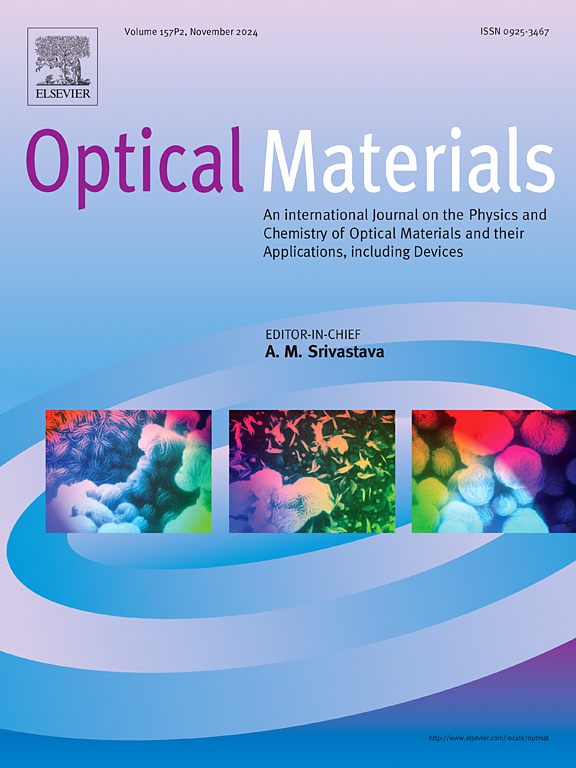
Optical Materials has an open access mirror journal Optical Materials: X, sharing the same aims and scope, editorial team, submission system and rigorous peer review.
The purpose of Optical Materials is to provide a means of communication and technology transfer between researchers who are interested in materials for potential device applications. The journal publishes original papers and review articles on the design, synthesis, characterisation and applications of optical materials.
OPTICAL MATERIALS focuses on:
• Optical Properties of Material Systems;
• The Materials Aspects of Optical Phenomena;
• The Materials Aspects of Devices and Applications.
Authors can submit separate research elements describing their data to Data in Brief and methods to Methods X.



 京公网安备 11010802042870号
京ICP备2023020795号-1
京公网安备 11010802042870号
京ICP备2023020795号-1

 分享
分享
 求助内容:
求助内容: 应助结果提醒方式:
 扫码关注我们
