Benedetta Isella , Federica Sallustio , Sergio Acosta , Dominic Andre , Stefan Jockenhövel , Alicia Fernández-Colino , Jose Carlos Rodriguez-Cabello , Ted J. Vaughan , Alexander Kopp
{"title":"A new approach for small-diameter vascular grafts using combined dip-coating of silk fibroin and elastin-like recombinamers","authors":"Benedetta Isella , Federica Sallustio , Sergio Acosta , Dominic Andre , Stefan Jockenhövel , Alicia Fernández-Colino , Jose Carlos Rodriguez-Cabello , Ted J. Vaughan , Alexander Kopp","doi":"10.1016/j.bioadv.2025.214312","DOIUrl":null,"url":null,"abstract":"<div><div>Compliance mismatch and suboptimal hemocompatibility prevent the use of the traditional materials used for vascular prostheses or degradable synthetic polymers as small-diameter vessel bypass grafts. Here, we show the combination of silk fibroin and elastin-like recombinamers in a dip-coating multilayer setup to achieve smooth small-diameter vascular grafts with ultrathin wall thickness. We found in both FTIR and mechanical characterization that the novel material combination was successful through the double crosslinked interpenetrated network formed by elastin-like recombinamers and silk fibroin. This enabled the graft to have mechanical compliance that followed physiological behaviour, differently from the synthetic materials traditionally used in clinics. The mechanical behaviour of these grafts also achieved burst pressure (745.44 ± 102.92 mmHg) and suture retention strength (0.86 ± 0.13 N) required for clinical application. The structure proved to have low platelet adhesion in the thrombogenicity assessment (3.79 ± 3.26 % of platelet area coverage), which is essential for successful outcomes in physiological conditions. Our results demonstrate the successful combination of the two materials in a technology platform that can be adjusted in both diameter and wall thickness and possesses suitable properties as a small-diameter vascular graft. We anticipate these results to be the starting point for more in vitro and in vivo tests possibly transitioning into clinical application.</div></div>","PeriodicalId":51111,"journal":{"name":"Materials Science & Engineering C-Materials for Biological Applications","volume":"174 ","pages":"Article 214312"},"PeriodicalIF":6.0000,"publicationDate":"2025-09-01","publicationTypes":"Journal Article","fieldsOfStudy":null,"isOpenAccess":false,"openAccessPdf":"","citationCount":"0","resultStr":null,"platform":"Semanticscholar","paperid":null,"PeriodicalName":"Materials Science & Engineering C-Materials for Biological Applications","FirstCategoryId":"1085","ListUrlMain":"https://www.sciencedirect.com/science/article/pii/S2772950825001396","RegionNum":2,"RegionCategory":"医学","ArticlePicture":[],"TitleCN":null,"AbstractTextCN":null,"PMCID":null,"EPubDate":"2025/4/8 0:00:00","PubModel":"Epub","JCR":"Q2","JCRName":"MATERIALS SCIENCE, BIOMATERIALS","Score":null,"Total":0}
引用次数: 0
Abstract
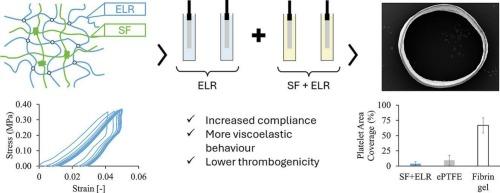
Compliance mismatch and suboptimal hemocompatibility prevent the use of the traditional materials used for vascular prostheses or degradable synthetic polymers as small-diameter vessel bypass grafts. Here, we show the combination of silk fibroin and elastin-like recombinamers in a dip-coating multilayer setup to achieve smooth small-diameter vascular grafts with ultrathin wall thickness. We found in both FTIR and mechanical characterization that the novel material combination was successful through the double crosslinked interpenetrated network formed by elastin-like recombinamers and silk fibroin. This enabled the graft to have mechanical compliance that followed physiological behaviour, differently from the synthetic materials traditionally used in clinics. The mechanical behaviour of these grafts also achieved burst pressure (745.44 ± 102.92 mmHg) and suture retention strength (0.86 ± 0.13 N) required for clinical application. The structure proved to have low platelet adhesion in the thrombogenicity assessment (3.79 ± 3.26 % of platelet area coverage), which is essential for successful outcomes in physiological conditions. Our results demonstrate the successful combination of the two materials in a technology platform that can be adjusted in both diameter and wall thickness and possesses suitable properties as a small-diameter vascular graft. We anticipate these results to be the starting point for more in vitro and in vivo tests possibly transitioning into clinical application.
期刊介绍:
Biomaterials Advances, previously known as Materials Science and Engineering: C-Materials for Biological Applications (P-ISSN: 0928-4931, E-ISSN: 1873-0191). Includes topics at the interface of the biomedical sciences and materials engineering. These topics include:
• Bioinspired and biomimetic materials for medical applications
• Materials of biological origin for medical applications
• Materials for "active" medical applications
• Self-assembling and self-healing materials for medical applications
• "Smart" (i.e., stimulus-response) materials for medical applications
• Ceramic, metallic, polymeric, and composite materials for medical applications
• Materials for in vivo sensing
• Materials for in vivo imaging
• Materials for delivery of pharmacologic agents and vaccines
• Novel approaches for characterizing and modeling materials for medical applications
Manuscripts on biological topics without a materials science component, or manuscripts on materials science without biological applications, will not be considered for publication in Materials Science and Engineering C. New submissions are first assessed for language, scope and originality (plagiarism check) and can be desk rejected before review if they need English language improvements, are out of scope or present excessive duplication with published sources.
Biomaterials Advances sits within Elsevier''s biomaterials science portfolio alongside Biomaterials, Materials Today Bio and Biomaterials and Biosystems. As part of the broader Materials Today family, Biomaterials Advances offers authors rigorous peer review, rapid decisions, and high visibility. We look forward to receiving your submissions!



 京公网安备 11010802042870号
京ICP备2023020795号-1
京公网安备 11010802042870号
京ICP备2023020795号-1

 分享
分享
 求助内容:
求助内容: 应助结果提醒方式:
 扫码关注我们
