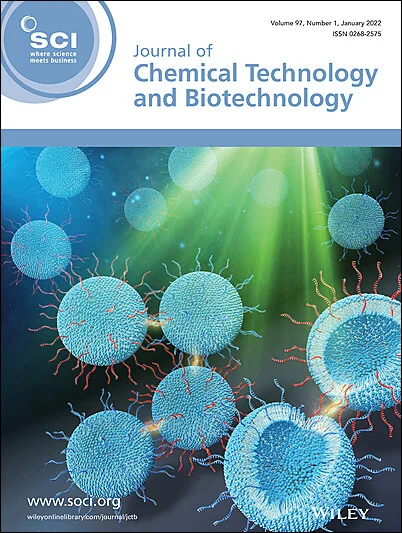
Bismuth oxyiodide-based Bifunctional Z-scheme Heterostructures for Photoelectrochemical Water Splitting

IF 2.4 4区 生物学 Q3 BIOTECHNOLOGY & APPLIED MICROBIOLOGY Journal of chemical technology and biotechnology Pub Date : 2025-03-13 DOI:10.1002/jctb.7845
Syeda Ammara Shabbir, Fatima Naeem, Muhammad Haris, Muhammad Gulbahar Ashiq, Muhammad Younas, Hamid Latif, Hafsa Faiz, Tomas Tamulevičius, Klaudijus Midveris, Sigitas Tamulevičius
{"title":"Bismuth oxyiodide-based Bifunctional Z-scheme Heterostructures for Photoelectrochemical Water Splitting","authors":"Syeda Ammara Shabbir,&nbsp;Fatima Naeem,&nbsp;Muhammad Haris,&nbsp;Muhammad Gulbahar Ashiq,&nbsp;Muhammad Younas,&nbsp;Hamid Latif,&nbsp;Hafsa Faiz,&nbsp;Tomas Tamulevičius,&nbsp;Klaudijus Midveris,&nbsp;Sigitas Tamulevičius","doi":"10.1002/jctb.7845","DOIUrl":null,"url":null,"abstract":"<div>\n \n \n <section>\n \n <h3> BACKGROUND</h3>\n \n <p>The increasing global energy crisis and environmental pollution necessitate the development of clean and sustainable energy sources. Photoelectrochemical (PEC) water splitting is a promising approach for hydrogen production, utilizing semiconductor materials to convert solar energy into chemical energy. However, single semiconductors suffer from high electron–hole recombination, limiting their efficiency. To address this, a bifunctional Z-scheme heterojunction was constructed using bismuth oxyiodide (BiOI) and carbon-doped graphitic carbon nitride (C-gC₃N₄), with carbon nanotubes (CNTs) as mediators, to enhance charge separation and PEC performance.</p>\n </section>\n \n <section>\n \n <h3> RESULTS</h3>\n \n <p>The fabricated C-gC₃N₄/CNT/BiOI heterojunction exhibited the lowest bandgap energy (1.25 eV), improving light absorption and charge carrier separation. The enhanced conductivity and heterostructure formation resulted in a significantly increased photocurrent density, with reduced overpotential (70 mV) and lower Tafel slopes (89 mV dec<sup>−1</sup>) for the hydrogen evolution reaction and oxygen evolution reaction. UV–visible spectroscopy confirmed a broadened absorption range, and electrochemical impedance spectroscopy demonstrated improved charge transfer efficiency. Transmission electron microscopy, X-ray diffraction and Mott–Schottky analysis confirmed the structural integrity and surface morphology and successful fabrication of the heterojunction.</p>\n </section>\n \n <section>\n \n <h3> CONCLUSION</h3>\n \n <p>The sequential layering of BiOI and C-gC₃N₄ in a bifunctional Z-scheme heterojunction significantly improved PEC water-splitting efficiency. The incorporation of CNTs further enhanced charge transfer, stability and conductivity. These findings highlight the potential of BiOI/C-gC₃N₄ heterostructures as efficient photoelectrocatalysts for sustainable hydrogen production. © 2025 Society of Chemical Industry (SCI).</p>\n </section>\n </div>","PeriodicalId":15335,"journal":{"name":"Journal of chemical technology and biotechnology","volume":"100 5","pages":"1096-1104"},"PeriodicalIF":2.4000,"publicationDate":"2025-03-13","publicationTypes":"Journal Article","fieldsOfStudy":null,"isOpenAccess":false,"openAccessPdf":"","citationCount":"0","resultStr":null,"platform":"Semanticscholar","paperid":null,"PeriodicalName":"Journal of chemical technology and biotechnology","FirstCategoryId":"5","ListUrlMain":"https://scijournals.onlinelibrary.wiley.com/doi/10.1002/jctb.7845","RegionNum":4,"RegionCategory":"生物学","ArticlePicture":[],"TitleCN":null,"AbstractTextCN":null,"PMCID":null,"EPubDate":"","PubModel":"","JCR":"Q3","JCRName":"BIOTECHNOLOGY & APPLIED MICROBIOLOGY","Score":null,"Total":0}
引用次数: 0

Abstract

BACKGROUND

The increasing global energy crisis and environmental pollution necessitate the development of clean and sustainable energy sources. Photoelectrochemical (PEC) water splitting is a promising approach for hydrogen production, utilizing semiconductor materials to convert solar energy into chemical energy. However, single semiconductors suffer from high electron–hole recombination, limiting their efficiency. To address this, a bifunctional Z-scheme heterojunction was constructed using bismuth oxyiodide (BiOI) and carbon-doped graphitic carbon nitride (C-gC₃N₄), with carbon nanotubes (CNTs) as mediators, to enhance charge separation and PEC performance.

RESULTS

The fabricated C-gC₃N₄/CNT/BiOI heterojunction exhibited the lowest bandgap energy (1.25 eV), improving light absorption and charge carrier separation. The enhanced conductivity and heterostructure formation resulted in a significantly increased photocurrent density, with reduced overpotential (70 mV) and lower Tafel slopes (89 mV dec−1) for the hydrogen evolution reaction and oxygen evolution reaction. UV–visible spectroscopy confirmed a broadened absorption range, and electrochemical impedance spectroscopy demonstrated improved charge transfer efficiency. Transmission electron microscopy, X-ray diffraction and Mott–Schottky analysis confirmed the structural integrity and surface morphology and successful fabrication of the heterojunction.

CONCLUSION

The sequential layering of BiOI and C-gC₃N₄ in a bifunctional Z-scheme heterojunction significantly improved PEC water-splitting efficiency. The incorporation of CNTs further enhanced charge transfer, stability and conductivity. These findings highlight the potential of BiOI/C-gC₃N₄ heterostructures as efficient photoelectrocatalysts for sustainable hydrogen production. © 2025 Society of Chemical Industry (SCI).

查看原文
分享 分享
微信好友 朋友圈 QQ好友 复制链接
本刊更多论文
基于氧化碘化铋的双功能z型异质结构的光电化学水分解
日益严重的全球能源危机和环境污染要求开发清洁和可持续的能源。光电化学(PEC)水分解是一种很有前途的制氢方法,利用半导体材料将太阳能转化为化学能。然而,单半导体受到高电子-空穴复合的影响,限制了它们的效率。为了解决这一问题,以氧碘化铋(BiOI)和碳掺杂石墨氮化碳(C-gC₃N₄)为介质,以碳纳米管(CNTs)为介质,构建了双功能Z-scheme异质结,以提高电荷分离和PEC性能。结果制备的C-gC₃N₄/CNT/BiOI异质结具有最低的带隙能量(1.25 eV),改善了光吸收和载流子分离。电导率的增强和异质结构的形成导致光电流密度显著增加,析氢反应和析氧反应的过电位降低(70 mV), Tafel斜率降低(89 mV dec−1)。紫外可见光谱证实了其吸收范围的扩大,电化学阻抗谱证实了其电荷转移效率的提高。透射电子显微镜、x射线衍射和Mott-Schottky分析证实了异质结的结构完整性和表面形貌。结论BiOI和C-gC₃N₄在双功能Z-scheme异质结中序层化显著提高了PEC的水分解效率。CNTs的加入进一步增强了电荷转移、稳定性和导电性。这些发现突出了BiOI/C-gC₃N₄异质结构作为可持续制氢的高效光电催化剂的潜力。©2025化学工业学会(SCI)。
本文章由计算机程序翻译,如有差异,请以英文原文为准。
求助全文
约1分钟内获得全文 去求助
来源期刊
CiteScore
7.00
自引率
5.90%
发文量
268
审稿时长
1.7 months
期刊介绍: Journal of Chemical Technology and Biotechnology(JCTB) is an international, inter-disciplinary peer-reviewed journal concerned with the application of scientific discoveries and advancements in chemical and biological technology that aim towards economically and environmentally sustainable industrial processes.

期刊最新文献
Issue Information Issue Information Tailored GQDs heterojunction membranes for photocatalytic degradation of metronidazole from wastewater Engineering S-scheme NiCoMn-LDH/kaolinite heterojunction from spent battery recycling: synergistic photocatalysis for CO₂ reduction and biomass valorization Efficient degradation of sulfonamides by CoS-activated peracetic acid advanced oxidation system
×
引用
GB/T 7714-2015
复制
MLA
复制
APA
复制
导出至
BibTeX EndNote RefMan NoteFirst NoteExpress
×
×
提示
您的信息不完整,为了账户安全,请先补充。
现在去补充
×
提示
您因"违规操作"
具体请查看互助需知
我知道了
×
提示
现在去查看 取消
×
提示
确定
0
微信
客服QQ
Book学术公众号 扫码关注我们
反馈
×
意见反馈
请填写您的意见或建议
请填写您的手机或邮箱
已复制链接
已复制链接
快去分享给好友吧!
我知道了
×
扫码分享
扫码分享
Book学术官方微信
Book学术文献互助
Book学术文献互助群
群 号:604180095
Book学术
文献互助 智能选刊 最新文献 互助须知 联系我们:info@booksci.cn
Book学术提供免费学术资源搜索服务,方便国内外学者检索中英文文献。致力于提供最便捷和优质的服务体验。
Copyright © 2023 Book学术 All rights reserved.
ghs 京公网安备 11010802042870号 京ICP备2023020795号-1