Mengjie Yu, Yuting Liu, Jianhui Xiong, Longfei Miao and Li Wang
{"title":"Electrochemical detection of paracetamol based on CoO/Co3O4/NC nanocomposites derived from COFs†","authors":"Mengjie Yu, Yuting Liu, Jianhui Xiong, Longfei Miao and Li Wang","doi":"10.1039/D5AN00193E","DOIUrl":null,"url":null,"abstract":"<p >Acetaminophen (APAP), also known as paracetamol, is a widely used analgesic and antipyretic, but its metabolites are toxic and can cause liver damage when used in excess. Rapid detection of APAP is essential, and conventional methods such as HPLC and GC are expensive and complex. To this purpose, we successfully prepared CoO/Co<small><sub>3</sub></small>O<small><sub>4</sub></small>/NC porous carbon composites with large specific surface area, homogeneous pore structure, and abundant adsorption active sites as electrochemical sensors for the rapid, simple, and inexpensive detection of acetaminophen. The CoO/Co<small><sub>3</sub></small>O<small><sub>4</sub></small>/NC porous carbon composites were prepared by doping Co<small><sup>2+</sup></small> and calcining, and a large number of N and O metal chelate sites in COF<small><sub>TZT-DVA</sub></small> could coordinate with Co<small><sup>2+</sup></small>, which effectively suppressed the aggregation phenomenon of CoO/Co<small><sub>3</sub></small>O<small><sub>4</sub></small> in the composites, and realized the uniform dispersion of Co<small><sup>2+</sup></small>. This composite material not only has excellent stability, but also exhibits excellent catalytic performance. The experimental results showed that the sensor had an extremely low detection limit (0.79 μM) and a wide linear response range (2.5 μM–423 μM), and the sensitivity was up to 2000 μA mM<small><sup>−1</sup></small> cm<small><sup>−2</sup></small>. This study provides a new strategy for the preparation of high-performance paracetamol sensors.</p>","PeriodicalId":63,"journal":{"name":"Analyst","volume":" 10","pages":" 2170-2178"},"PeriodicalIF":3.3000,"publicationDate":"2025-04-11","publicationTypes":"Journal Article","fieldsOfStudy":null,"isOpenAccess":false,"openAccessPdf":"","citationCount":"0","resultStr":null,"platform":"Semanticscholar","paperid":null,"PeriodicalName":"Analyst","FirstCategoryId":"92","ListUrlMain":"https://pubs.rsc.org/en/content/articlelanding/2025/an/d5an00193e","RegionNum":3,"RegionCategory":"化学","ArticlePicture":[],"TitleCN":null,"AbstractTextCN":null,"PMCID":null,"EPubDate":"","PubModel":"","JCR":"Q2","JCRName":"CHEMISTRY, ANALYTICAL","Score":null,"Total":0}
引用次数: 0
Abstract
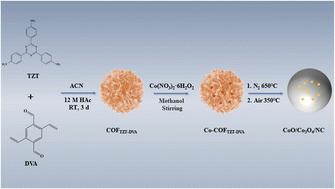
Acetaminophen (APAP), also known as paracetamol, is a widely used analgesic and antipyretic, but its metabolites are toxic and can cause liver damage when used in excess. Rapid detection of APAP is essential, and conventional methods such as HPLC and GC are expensive and complex. To this purpose, we successfully prepared CoO/Co3O4/NC porous carbon composites with large specific surface area, homogeneous pore structure, and abundant adsorption active sites as electrochemical sensors for the rapid, simple, and inexpensive detection of acetaminophen. The CoO/Co3O4/NC porous carbon composites were prepared by doping Co2+ and calcining, and a large number of N and O metal chelate sites in COFTZT-DVA could coordinate with Co2+, which effectively suppressed the aggregation phenomenon of CoO/Co3O4 in the composites, and realized the uniform dispersion of Co2+. This composite material not only has excellent stability, but also exhibits excellent catalytic performance. The experimental results showed that the sensor had an extremely low detection limit (0.79 μM) and a wide linear response range (2.5 μM–423 μM), and the sensitivity was up to 2000 μA mM−1 cm−2. This study provides a new strategy for the preparation of high-performance paracetamol sensors.




 京公网安备 11010802042870号
京ICP备2023020795号-1
京公网安备 11010802042870号
京ICP备2023020795号-1

 分享
分享
 求助内容:
求助内容: 应助结果提醒方式:
 扫码关注我们
