{"title":"Structural insights into RNA-guided RNA editing by the Cas13b–ADAR2 complex","authors":"Junichiro Ishikawa, Kazuki Kato, Soumya Kannan, Sae Okazaki, Soh Ishiguro, Keitaro Yamashita, Nozomu Yachie, Tomohiro Nishizawa, Feng Zhang, Hiroshi Nishimasu","doi":"10.1038/s41594-025-01529-1","DOIUrl":null,"url":null,"abstract":"Cas13 is an RNA-guided RNA endonuclease derived from the type VI CRISPR–Cas system, which has been used in numerous RNA-targeting technologies, such as RNA knockdown, detection and editing. The catalytically inactive Prevotella sp. Cas13b (dPspCas13b) fused to the human adenosine deaminase acting on RNA 2 (ADAR2) deaminase domain can edit adenosine in target transcripts to inosine, in an RNA-editing technology called REPAIR (RNA editing for programmable A-to-I replacement), which has potential for gene therapy. Here we report the cryo-electron microscopy structures of the PspCas13b–guide RNA binary complex, the PspCas13b–guide RNA–target RNA ternary complex and the dPspCas13b–ADAR2–guide RNA–target RNA complex. These structures provide mechanistic insights into RNA cleavage and editing. We applied our structural insights to engineer a compact and efficient dPspCas13b–ADAR2 complex (REPAIR-mini). Overall, our findings advance the understanding of CRISPR–Cas13 effector nucleases and could enable the development of improved RNA-targeting technologies. Here Ishikawa et al. determine the cryo-electron microscopy structures of the PspCas13b–guide RNA complex alone and in complex with target RNA, as well as that of the dPspCas13b–ADAR2–guide RNA–target RNA complex, thereby providing mechanistic insights into RNA cleavage and editing.","PeriodicalId":49141,"journal":{"name":"Nature Structural & Molecular Biology","volume":"32 8","pages":"1567-1578"},"PeriodicalIF":10.1000,"publicationDate":"2025-04-11","publicationTypes":"Journal Article","fieldsOfStudy":null,"isOpenAccess":false,"openAccessPdf":"","citationCount":"0","resultStr":null,"platform":"Semanticscholar","paperid":null,"PeriodicalName":"Nature Structural & Molecular Biology","FirstCategoryId":"99","ListUrlMain":"https://www.nature.com/articles/s41594-025-01529-1","RegionNum":1,"RegionCategory":"生物学","ArticlePicture":[],"TitleCN":null,"AbstractTextCN":null,"PMCID":null,"EPubDate":"","PubModel":"","JCR":"Q1","JCRName":"BIOCHEMISTRY & MOLECULAR BIOLOGY","Score":null,"Total":0}
引用次数: 0
Abstract
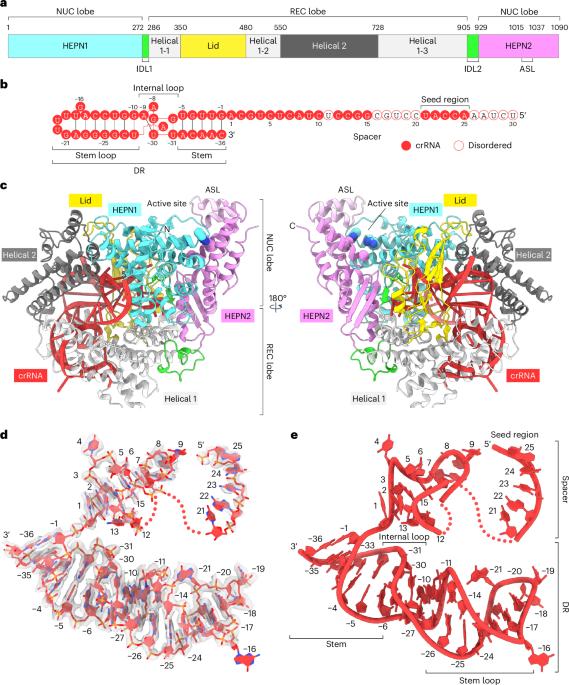
Cas13 is an RNA-guided RNA endonuclease derived from the type VI CRISPR–Cas system, which has been used in numerous RNA-targeting technologies, such as RNA knockdown, detection and editing. The catalytically inactive Prevotella sp. Cas13b (dPspCas13b) fused to the human adenosine deaminase acting on RNA 2 (ADAR2) deaminase domain can edit adenosine in target transcripts to inosine, in an RNA-editing technology called REPAIR (RNA editing for programmable A-to-I replacement), which has potential for gene therapy. Here we report the cryo-electron microscopy structures of the PspCas13b–guide RNA binary complex, the PspCas13b–guide RNA–target RNA ternary complex and the dPspCas13b–ADAR2–guide RNA–target RNA complex. These structures provide mechanistic insights into RNA cleavage and editing. We applied our structural insights to engineer a compact and efficient dPspCas13b–ADAR2 complex (REPAIR-mini). Overall, our findings advance the understanding of CRISPR–Cas13 effector nucleases and could enable the development of improved RNA-targeting technologies. Here Ishikawa et al. determine the cryo-electron microscopy structures of the PspCas13b–guide RNA complex alone and in complex with target RNA, as well as that of the dPspCas13b–ADAR2–guide RNA–target RNA complex, thereby providing mechanistic insights into RNA cleavage and editing.
期刊介绍:
Nature Structural & Molecular Biology is a comprehensive platform that combines structural and molecular research. Our journal focuses on exploring the functional and mechanistic aspects of biological processes, emphasizing how molecular components collaborate to achieve a particular function. While structural data can shed light on these insights, our publication does not require them as a prerequisite.




 京公网安备 11010802042870号
京ICP备2023020795号-1
京公网安备 11010802042870号
京ICP备2023020795号-1

 分享
分享
 求助内容:
求助内容: 应助结果提醒方式:
 扫码关注我们
