{"title":"Pyrolysis and in-line chemical looping cracking-gasification of face mask waste into hydrogen-rich syngas","authors":"Haiping Yang, Tianle He, Zongtao Yu, Wei Cheng, Qiang Hu, Jingai Shao, Hanping Chen, Chi-Hwa Wang","doi":"10.1016/j.cej.2025.162539","DOIUrl":null,"url":null,"abstract":"The thermochemical recycling of face mask (FM) waste into syngas shows great potential for the harmless treating, rapid quantity reducing and resource utilization. In this study, a novel pyrolysis and chemical looping cracking-gasification method was developed to achieve the highly efficient conversion of two disposable surgical masks (White FM and Blue FM) and N95 mask into syngas. The redox catalysts of Fe/Co/Ni oxide supported with Al<sub>2</sub>O<sub>3</sub> were synthesized by the co-precipitation method with the molar ratio of 2:1 for the conversion of FMs. Results showed that the pyrolysis and in-line chemical looping cracking-gasification method could efficiently convert White FM into syngas with the H<sub>2</sub> productivity of 93.84 mmol/g with Fe2Al. Moreover, the quality of the produced syngas was very high with the concentration of 92.37 % and the H<sub>2</sub>/CO ratio of 2.03, which was the ideal feedstock for the Fischer-Tropsch synthesis into chemical compounds. Fe2Al was found to perform the best syngas properties compared with Co2Al and Ni2Al due to its higher reduction degree at chemical looping cracking step, and this would produce more H<sub>2</sub> via steam-iron reaction during chemical looping gasification. The hydrocarbon vapors react with the redox catalyst, initially depositing carbon via chemical looping cracking, followed by syngas production and catalyst regeneration through steam-char gasification and steam-iron reoxidation reactions. It provided a promising technology for the recycling of FM with high carbon conversion efficiency and syngas concentration to produce syngas with H<sub>2</sub>/CO ratio of about 2.","PeriodicalId":270,"journal":{"name":"Chemical Engineering Journal","volume":"543 1","pages":""},"PeriodicalIF":13.2000,"publicationDate":"2025-04-11","publicationTypes":"Journal Article","fieldsOfStudy":null,"isOpenAccess":false,"openAccessPdf":"","citationCount":"0","resultStr":null,"platform":"Semanticscholar","paperid":null,"PeriodicalName":"Chemical Engineering Journal","FirstCategoryId":"5","ListUrlMain":"https://doi.org/10.1016/j.cej.2025.162539","RegionNum":1,"RegionCategory":"工程技术","ArticlePicture":[],"TitleCN":null,"AbstractTextCN":null,"PMCID":null,"EPubDate":"","PubModel":"","JCR":"Q1","JCRName":"ENGINEERING, CHEMICAL","Score":null,"Total":0}
引用次数: 0
Abstract
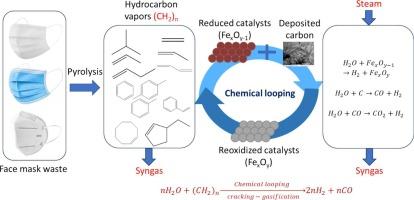
The thermochemical recycling of face mask (FM) waste into syngas shows great potential for the harmless treating, rapid quantity reducing and resource utilization. In this study, a novel pyrolysis and chemical looping cracking-gasification method was developed to achieve the highly efficient conversion of two disposable surgical masks (White FM and Blue FM) and N95 mask into syngas. The redox catalysts of Fe/Co/Ni oxide supported with Al2O3 were synthesized by the co-precipitation method with the molar ratio of 2:1 for the conversion of FMs. Results showed that the pyrolysis and in-line chemical looping cracking-gasification method could efficiently convert White FM into syngas with the H2 productivity of 93.84 mmol/g with Fe2Al. Moreover, the quality of the produced syngas was very high with the concentration of 92.37 % and the H2/CO ratio of 2.03, which was the ideal feedstock for the Fischer-Tropsch synthesis into chemical compounds. Fe2Al was found to perform the best syngas properties compared with Co2Al and Ni2Al due to its higher reduction degree at chemical looping cracking step, and this would produce more H2 via steam-iron reaction during chemical looping gasification. The hydrocarbon vapors react with the redox catalyst, initially depositing carbon via chemical looping cracking, followed by syngas production and catalyst regeneration through steam-char gasification and steam-iron reoxidation reactions. It provided a promising technology for the recycling of FM with high carbon conversion efficiency and syngas concentration to produce syngas with H2/CO ratio of about 2.
期刊介绍:
The Chemical Engineering Journal is an international research journal that invites contributions of original and novel fundamental research. It aims to provide an international platform for presenting original fundamental research, interpretative reviews, and discussions on new developments in chemical engineering. The journal welcomes papers that describe novel theory and its practical application, as well as those that demonstrate the transfer of techniques from other disciplines. It also welcomes reports on carefully conducted experimental work that is soundly interpreted. The main focus of the journal is on original and rigorous research results that have broad significance. The Catalysis section within the Chemical Engineering Journal focuses specifically on Experimental and Theoretical studies in the fields of heterogeneous catalysis, molecular catalysis, and biocatalysis. These studies have industrial impact on various sectors such as chemicals, energy, materials, foods, healthcare, and environmental protection.




 京公网安备 11010802042870号
京ICP备2023020795号-1
京公网安备 11010802042870号
京ICP备2023020795号-1

 分享
分享
 求助内容:
求助内容: 应助结果提醒方式:
 扫码关注我们
