{"title":"Gradient-Structured sodiophilic skeleton integrated with spatial confinement effect Enables high-rate and ultra-stable Na metal batteries","authors":"Fang-Yu Tao, Dan Xie, Wan-Yue Diao, Chang Liu, Godefroid Gahungu, Wen-Liang Li, Jing-Ping Zhang","doi":"10.1016/j.cej.2025.161718","DOIUrl":null,"url":null,"abstract":"Despite the dendrite growth and volume change faced by Na metal anodes (SMAs) can be suppressed by constructing sodiophilic three-dimensional (3D) skeleton, the long-term cycling stability of SMAs under harsh work conditions (>10 mA cm<sup>−2</sup>; >5 mA h cm<sup>−2</sup>) is still unsatisfactory. Herein, a gradient-structured sodiophilic carbon skeleton, composed of carbon foam decorated with gradient-distributed Ag nanoparticles (Ag NPs@CF), is elaborately designed to enable the stable operation of SMAs even in harsh work environments. Firstly, the gradient sodiophilic structure of Ag NPs@CF directionally regulates the Na<sup>+</sup> nucleation/growth behavior, homogenizing Na<sup>+</sup> flux and electric field near the electrode and inhibiting dendrites formation. Secondly, the sodiophilic Ag NPs promote the formation of gradient solid electrolyte interphase, enhancing the interfacial stability and expediting Na<sup>+</sup> transport kinetics at the interface. Furthermore, the open 3D structure of CF spatially confines Na deposition without volume change during cycling. Consequently, the Na-Ag NPs@CF symmetrical battery demonstrates stable cycling for over 2200h with an ultralow overpotential of 10.2 mV under harsh conditions of 10 mA cm<sup>−2</sup>/10 mA h cm<sup>−2</sup>. Meanwhile, the assembled Na-Ag NPs@CF||NVPOF full cells show superior rate capability and cycling stability. The gradient sodiophilic structure proposed in this work sparks new insights for designing high-performance SMAs.","PeriodicalId":270,"journal":{"name":"Chemical Engineering Journal","volume":"25 1","pages":""},"PeriodicalIF":13.2000,"publicationDate":"2025-04-11","publicationTypes":"Journal Article","fieldsOfStudy":null,"isOpenAccess":false,"openAccessPdf":"","citationCount":"0","resultStr":null,"platform":"Semanticscholar","paperid":null,"PeriodicalName":"Chemical Engineering Journal","FirstCategoryId":"5","ListUrlMain":"https://doi.org/10.1016/j.cej.2025.161718","RegionNum":1,"RegionCategory":"工程技术","ArticlePicture":[],"TitleCN":null,"AbstractTextCN":null,"PMCID":null,"EPubDate":"","PubModel":"","JCR":"Q1","JCRName":"ENGINEERING, CHEMICAL","Score":null,"Total":0}
引用次数: 0
Abstract
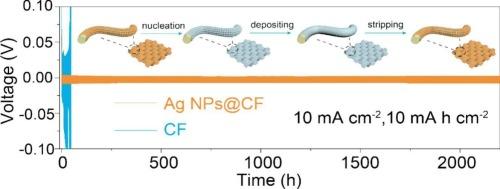
Despite the dendrite growth and volume change faced by Na metal anodes (SMAs) can be suppressed by constructing sodiophilic three-dimensional (3D) skeleton, the long-term cycling stability of SMAs under harsh work conditions (>10 mA cm−2; >5 mA h cm−2) is still unsatisfactory. Herein, a gradient-structured sodiophilic carbon skeleton, composed of carbon foam decorated with gradient-distributed Ag nanoparticles (Ag NPs@CF), is elaborately designed to enable the stable operation of SMAs even in harsh work environments. Firstly, the gradient sodiophilic structure of Ag NPs@CF directionally regulates the Na+ nucleation/growth behavior, homogenizing Na+ flux and electric field near the electrode and inhibiting dendrites formation. Secondly, the sodiophilic Ag NPs promote the formation of gradient solid electrolyte interphase, enhancing the interfacial stability and expediting Na+ transport kinetics at the interface. Furthermore, the open 3D structure of CF spatially confines Na deposition without volume change during cycling. Consequently, the Na-Ag NPs@CF symmetrical battery demonstrates stable cycling for over 2200h with an ultralow overpotential of 10.2 mV under harsh conditions of 10 mA cm−2/10 mA h cm−2. Meanwhile, the assembled Na-Ag NPs@CF||NVPOF full cells show superior rate capability and cycling stability. The gradient sodiophilic structure proposed in this work sparks new insights for designing high-performance SMAs.
尽管通过构建亲钠三维(3D)骨架可以抑制Na金属阳极(sma)的枝晶生长和体积变化,但sma在恶劣工作条件下的长期循环稳定性(>10 mA cm−2;5ma h cm−2)仍然不能令人满意。本文精心设计了一种梯度结构的亲钠碳骨架,由碳泡沫组成,并装饰有梯度分布的银纳米颗粒(Ag NPs@CF),使sma即使在恶劣的工作环境下也能稳定运行。首先,Ag NPs@CF的梯度亲钠结构定向调节Na+的成核/生长行为,使电极附近的Na+通量和电场均匀化,抑制树枝晶的形成。其次,亲钠性Ag NPs促进了梯度固体电解质界面相的形成,增强了界面稳定性,加快了界面上Na+的输运动力学。此外,CF的开放三维结构在空间上限制了Na的沉积,而在循环过程中没有体积变化。因此,在10 mA cm−2/10 mA h cm−2的恶劣条件下,Na-Ag NPs@CF对称电池表现出超过2200h的稳定循环和10.2 mV的超低过电位。同时,组装的Na-Ag NPs@CF||NVPOF全电池表现出优异的倍率性能和循环稳定性。本研究提出的梯度亲钠结构为高性能sma的设计提供了新的思路。
期刊介绍:
The Chemical Engineering Journal is an international research journal that invites contributions of original and novel fundamental research. It aims to provide an international platform for presenting original fundamental research, interpretative reviews, and discussions on new developments in chemical engineering. The journal welcomes papers that describe novel theory and its practical application, as well as those that demonstrate the transfer of techniques from other disciplines. It also welcomes reports on carefully conducted experimental work that is soundly interpreted. The main focus of the journal is on original and rigorous research results that have broad significance. The Catalysis section within the Chemical Engineering Journal focuses specifically on Experimental and Theoretical studies in the fields of heterogeneous catalysis, molecular catalysis, and biocatalysis. These studies have industrial impact on various sectors such as chemicals, energy, materials, foods, healthcare, and environmental protection.



 京公网安备 11010802042870号
京ICP备2023020795号-1
京公网安备 11010802042870号
京ICP备2023020795号-1

 分享
分享
 求助内容:
求助内容: 应助结果提醒方式:
 扫码关注我们
