Trimester-specific associations of exposure to epoxide alkanes, alkenals, and 1,3-butadiene with preschool children’s intellectual development: A birth cohort study in Wuhan, China
Shuting Cao , Yanjian Wan , Zhaoying Xiong , Ruiying Li , Yin Wang , Xi Qian , Ruixin Chen , Jingyu Wang , Liping Zhang , Yuan Cui , Rongrong Cheng , Yuanyuan Li , Shunqing Xu , Wei Xia
{"title":"Trimester-specific associations of exposure to epoxide alkanes, alkenals, and 1,3-butadiene with preschool children’s intellectual development: A birth cohort study in Wuhan, China","authors":"Shuting Cao , Yanjian Wan , Zhaoying Xiong , Ruiying Li , Yin Wang , Xi Qian , Ruixin Chen , Jingyu Wang , Liping Zhang , Yuan Cui , Rongrong Cheng , Yuanyuan Li , Shunqing Xu , Wei Xia","doi":"10.1016/j.envint.2025.109456","DOIUrl":null,"url":null,"abstract":"<div><div>The impact of prenatal exposure to contaminants with neurotoxicity like epoxide alkanes (ethylene oxide, propylene oxide), alkenals (acrolein, crotonaldehyde), and 1,3-butadiene on children’s intellectual development remains underreported, and related sensitive window is of interest. In this cohort study, metabolites of these contaminants were measured in 3,081 urine samples from 1,027 pregnant women across three trimesters. Children’s intelligence quotient was evaluated at 4–6 years old. Generalized estimating equation models showed that higher urinary concentrations of 2-hydroxypropyl mercapturic acid (a metabolite of propylene oxide), 3-hydroxypropyl mercapturic acid (HPMMA, a metabolite of crotonaldehyde), and the sum of acrolein metabolites in the first trimester were associated with lower visual spatial index (VSI), working memory index (WMI), or processing speed index scores. Quantile g-computation models revealed that co-exposure to these contaminants in the first trimester were associated with lower VSI (<em>β</em> = –0.98, 95 % CI: –1.94, –0.03) and WMI (<em>β</em> = –0.86, 95 % CI: –1.66, –0.06) scores, with HPMMA as the major contributor. These results suggested that early pregnancy could be a sensitive window during which exposure to propylene oxide, crotonaldehyde, and acrolein may impair offspring’s intellectual development.</div></div>","PeriodicalId":308,"journal":{"name":"Environment International","volume":"199 ","pages":"Article 109456"},"PeriodicalIF":9.7000,"publicationDate":"2025-05-01","publicationTypes":"Journal Article","fieldsOfStudy":null,"isOpenAccess":false,"openAccessPdf":"","citationCount":"0","resultStr":null,"platform":"Semanticscholar","paperid":null,"PeriodicalName":"Environment International","FirstCategoryId":"93","ListUrlMain":"https://www.sciencedirect.com/science/article/pii/S0160412025002077","RegionNum":1,"RegionCategory":"环境科学与生态学","ArticlePicture":[],"TitleCN":null,"AbstractTextCN":null,"PMCID":null,"EPubDate":"2025/4/11 0:00:00","PubModel":"Epub","JCR":"Q1","JCRName":"ENVIRONMENTAL SCIENCES","Score":null,"Total":0}
引用次数: 0
Abstract
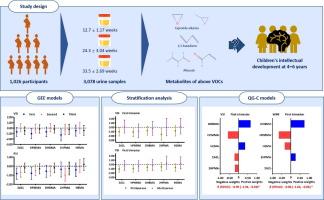
The impact of prenatal exposure to contaminants with neurotoxicity like epoxide alkanes (ethylene oxide, propylene oxide), alkenals (acrolein, crotonaldehyde), and 1,3-butadiene on children’s intellectual development remains underreported, and related sensitive window is of interest. In this cohort study, metabolites of these contaminants were measured in 3,081 urine samples from 1,027 pregnant women across three trimesters. Children’s intelligence quotient was evaluated at 4–6 years old. Generalized estimating equation models showed that higher urinary concentrations of 2-hydroxypropyl mercapturic acid (a metabolite of propylene oxide), 3-hydroxypropyl mercapturic acid (HPMMA, a metabolite of crotonaldehyde), and the sum of acrolein metabolites in the first trimester were associated with lower visual spatial index (VSI), working memory index (WMI), or processing speed index scores. Quantile g-computation models revealed that co-exposure to these contaminants in the first trimester were associated with lower VSI (β = –0.98, 95 % CI: –1.94, –0.03) and WMI (β = –0.86, 95 % CI: –1.66, –0.06) scores, with HPMMA as the major contributor. These results suggested that early pregnancy could be a sensitive window during which exposure to propylene oxide, crotonaldehyde, and acrolein may impair offspring’s intellectual development.
期刊介绍:
Environmental Health publishes manuscripts focusing on critical aspects of environmental and occupational medicine, including studies in toxicology and epidemiology, to illuminate the human health implications of exposure to environmental hazards. The journal adopts an open-access model and practices open peer review.
It caters to scientists and practitioners across all environmental science domains, directly or indirectly impacting human health and well-being. With a commitment to enhancing the prevention of environmentally-related health risks, Environmental Health serves as a public health journal for the community and scientists engaged in matters of public health significance concerning the environment.




 京公网安备 11010802042870号
京ICP备2023020795号-1
京公网安备 11010802042870号
京ICP备2023020795号-1

 分享
分享
 求助内容:
求助内容: 应助结果提醒方式:
 扫码关注我们
