Dongrui Li , Hong Li , Xujun Liang , Qingliang Chen , Xu Bai , Lizhong Zhu , Yuxi Gao , Jiating Zhao
{"title":"Hydroxyl radicals produced from oxidation of ferrous sulfides promote mobilization of mercuric sulfide in soil–water system","authors":"Dongrui Li , Hong Li , Xujun Liang , Qingliang Chen , Xu Bai , Lizhong Zhu , Yuxi Gao , Jiating Zhao","doi":"10.1016/j.watres.2025.123625","DOIUrl":null,"url":null,"abstract":"<div><div>Mercuric sulfide nanoparticles (HgS-NPs) are recognized as a significant source of bioavailable mercury in paddy fields. The factors influencing the mobilization and bioavailability of HgS-NPs formed in flooded or drained paddy field-like systems are complicated and remain unexplored to date. Here, we show that ferrous sulfide (FeS) as an important mineral substance plays a crucial role in the dissolution and transformation of HgS-NPs in overlying water or during the drainage stage, as well as their bioavailability toward rice. Specifically, we found that oxidation of FeS significantly enhances the dissolution of HgS-NPs, with the degree of activation intensified with increasing FeS concentrations. This activation was further evidenced to be driven by the generation of hydroxyl radicals (•OH) during FeS oxidation, leading to the release of Hg(Ⅱ). The enhanced dissolution of HgS-NPs increases its bioavailability, as verified by the augmented accumulation of Hg in rice upon FeS oxidation. This study underscores the overlooked yet important role of FeS in affecting the fate of HgS-NPs and offers valuable insights for pollution control of Hg-contaminated paddy fields and wetlands.</div></div>","PeriodicalId":443,"journal":{"name":"Water Research","volume":"281 ","pages":"Article 123625"},"PeriodicalIF":12.4000,"publicationDate":"2025-08-01","publicationTypes":"Journal Article","fieldsOfStudy":null,"isOpenAccess":false,"openAccessPdf":"","citationCount":"0","resultStr":null,"platform":"Semanticscholar","paperid":null,"PeriodicalName":"Water Research","FirstCategoryId":"93","ListUrlMain":"https://www.sciencedirect.com/science/article/pii/S0043135425005354","RegionNum":1,"RegionCategory":"环境科学与生态学","ArticlePicture":[],"TitleCN":null,"AbstractTextCN":null,"PMCID":null,"EPubDate":"2025/4/10 0:00:00","PubModel":"Epub","JCR":"Q1","JCRName":"ENGINEERING, ENVIRONMENTAL","Score":null,"Total":0}
引用次数: 0
Abstract
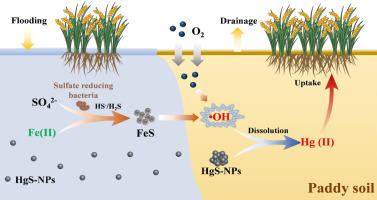
Mercuric sulfide nanoparticles (HgS-NPs) are recognized as a significant source of bioavailable mercury in paddy fields. The factors influencing the mobilization and bioavailability of HgS-NPs formed in flooded or drained paddy field-like systems are complicated and remain unexplored to date. Here, we show that ferrous sulfide (FeS) as an important mineral substance plays a crucial role in the dissolution and transformation of HgS-NPs in overlying water or during the drainage stage, as well as their bioavailability toward rice. Specifically, we found that oxidation of FeS significantly enhances the dissolution of HgS-NPs, with the degree of activation intensified with increasing FeS concentrations. This activation was further evidenced to be driven by the generation of hydroxyl radicals (•OH) during FeS oxidation, leading to the release of Hg(Ⅱ). The enhanced dissolution of HgS-NPs increases its bioavailability, as verified by the augmented accumulation of Hg in rice upon FeS oxidation. This study underscores the overlooked yet important role of FeS in affecting the fate of HgS-NPs and offers valuable insights for pollution control of Hg-contaminated paddy fields and wetlands.
期刊介绍:
Water Research, along with its open access companion journal Water Research X, serves as a platform for publishing original research papers covering various aspects of the science and technology related to the anthropogenic water cycle, water quality, and its management worldwide. The audience targeted by the journal comprises biologists, chemical engineers, chemists, civil engineers, environmental engineers, limnologists, and microbiologists. The scope of the journal include:
•Treatment processes for water and wastewaters (municipal, agricultural, industrial, and on-site treatment), including resource recovery and residuals management;
•Urban hydrology including sewer systems, stormwater management, and green infrastructure;
•Drinking water treatment and distribution;
•Potable and non-potable water reuse;
•Sanitation, public health, and risk assessment;
•Anaerobic digestion, solid and hazardous waste management, including source characterization and the effects and control of leachates and gaseous emissions;
•Contaminants (chemical, microbial, anthropogenic particles such as nanoparticles or microplastics) and related water quality sensing, monitoring, fate, and assessment;
•Anthropogenic impacts on inland, tidal, coastal and urban waters, focusing on surface and ground waters, and point and non-point sources of pollution;
•Environmental restoration, linked to surface water, groundwater and groundwater remediation;
•Analysis of the interfaces between sediments and water, and between water and atmosphere, focusing specifically on anthropogenic impacts;
•Mathematical modelling, systems analysis, machine learning, and beneficial use of big data related to the anthropogenic water cycle;
•Socio-economic, policy, and regulations studies.




 京公网安备 11010802042870号
京ICP备2023020795号-1
京公网安备 11010802042870号
京ICP备2023020795号-1

 分享
分享
 求助内容:
求助内容: 应助结果提醒方式:
 扫码关注我们
