Multi-mechanistic effects of bisphenol A on testicular dysfunction and endocrine disruption in adult male Labeo bata: oxidative stress, inflammation, and dysregulated energy sensors
{"title":"Multi-mechanistic effects of bisphenol A on testicular dysfunction and endocrine disruption in adult male Labeo bata: oxidative stress, inflammation, and dysregulated energy sensors","authors":"Urmi Mukherjee, Soumyajyoti Ghosh, Sudipta Maitra","doi":"10.1016/j.envpol.2025.126231","DOIUrl":null,"url":null,"abstract":"<div><div>Leaching of BPA, a potent endocrine disruptor, from microplastics in aquatic environments has garnered renewed interest in its impact on male reproduction. However, the mechanisms underlying BPA modulation of testicular metabolic, endocrine, and autocrine-paracrine axes in teleost remained relatively unexplored, prompting us to examine BPA-induced testicular dysfunction in adult male <em>Labeo bata</em>. Present results demonstrate that congruent with reduced gonadosomatic index (GSI), chronic BPA treatment at environmentally relevant concentrations enhanced ROS synthesis, oxidative stress, and testicular histopathology characterized by reduced diameter of seminiferous tubules, a sharp decline in spermatozoa, and elevated fibrosis during the spawning season. Elevated NO levels, pro-inflammatory cytokines and NLRP3-inflammasome activation correlated with cleaved caspase −8, −9, −3 activation, altered Bax/Bcl-2 ratio, heightened caspase −3 immunolocalization and TUNEL staining, suggesting DNA damage and apoptosis in BPA-treated testis. Besides, BPA attenuation of cyclin B synthesis and p-p34cdc2 (Thr161) phosphorylation (activation), markers associated with altered meiotic cell cycle progression, corresponded with heightened apoptosis and loss of spermatogenic cells. Importantly, disrupted estrogen and membrane progestin receptor (ERα, ERβ, mPRα-PGRMC1) homeostasis, alteration in gonadotropin receptor (LHCGR) and steroidogenic markers and elevated P450 aromatase immunolocalization indicate endocrine disruption and heightened estrogenic influence of BPA, inducing testicular dysfunction. Congruently, BPA modulation of cellular energy sensors (SIRT1/p-AMPKα/PGC-1α), factors influencing testicular endocrine, paracrine and prostaglandin signalling, and MAPK modulation might indicate pleiotropic regulation by BPA triggering reproductive toxicity. While Pearson's correlation and elevated multi-biomarker IBR indices support testicular dysfunction, present findings highlight the need for further research initiatives and strict regimens to combat ecological risks posed by BPA contamination.</div></div>","PeriodicalId":311,"journal":{"name":"Environmental Pollution","volume":"374 ","pages":"Article 126231"},"PeriodicalIF":7.3000,"publicationDate":"2025-06-01","publicationTypes":"Journal Article","fieldsOfStudy":null,"isOpenAccess":false,"openAccessPdf":"","citationCount":"0","resultStr":null,"platform":"Semanticscholar","paperid":null,"PeriodicalName":"Environmental Pollution","FirstCategoryId":"93","ListUrlMain":"https://www.sciencedirect.com/science/article/pii/S0269749125006049","RegionNum":2,"RegionCategory":"环境科学与生态学","ArticlePicture":[],"TitleCN":null,"AbstractTextCN":null,"PMCID":null,"EPubDate":"2025/4/11 0:00:00","PubModel":"Epub","JCR":"Q1","JCRName":"ENVIRONMENTAL SCIENCES","Score":null,"Total":0}
引用次数: 0
Abstract
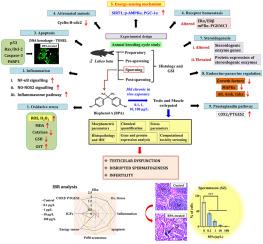
Leaching of BPA, a potent endocrine disruptor, from microplastics in aquatic environments has garnered renewed interest in its impact on male reproduction. However, the mechanisms underlying BPA modulation of testicular metabolic, endocrine, and autocrine-paracrine axes in teleost remained relatively unexplored, prompting us to examine BPA-induced testicular dysfunction in adult male Labeo bata. Present results demonstrate that congruent with reduced gonadosomatic index (GSI), chronic BPA treatment at environmentally relevant concentrations enhanced ROS synthesis, oxidative stress, and testicular histopathology characterized by reduced diameter of seminiferous tubules, a sharp decline in spermatozoa, and elevated fibrosis during the spawning season. Elevated NO levels, pro-inflammatory cytokines and NLRP3-inflammasome activation correlated with cleaved caspase −8, −9, −3 activation, altered Bax/Bcl-2 ratio, heightened caspase −3 immunolocalization and TUNEL staining, suggesting DNA damage and apoptosis in BPA-treated testis. Besides, BPA attenuation of cyclin B synthesis and p-p34cdc2 (Thr161) phosphorylation (activation), markers associated with altered meiotic cell cycle progression, corresponded with heightened apoptosis and loss of spermatogenic cells. Importantly, disrupted estrogen and membrane progestin receptor (ERα, ERβ, mPRα-PGRMC1) homeostasis, alteration in gonadotropin receptor (LHCGR) and steroidogenic markers and elevated P450 aromatase immunolocalization indicate endocrine disruption and heightened estrogenic influence of BPA, inducing testicular dysfunction. Congruently, BPA modulation of cellular energy sensors (SIRT1/p-AMPKα/PGC-1α), factors influencing testicular endocrine, paracrine and prostaglandin signalling, and MAPK modulation might indicate pleiotropic regulation by BPA triggering reproductive toxicity. While Pearson's correlation and elevated multi-biomarker IBR indices support testicular dysfunction, present findings highlight the need for further research initiatives and strict regimens to combat ecological risks posed by BPA contamination.
期刊介绍:
Environmental Pollution is an international peer-reviewed journal that publishes high-quality research papers and review articles covering all aspects of environmental pollution and its impacts on ecosystems and human health.
Subject areas include, but are not limited to:
• Sources and occurrences of pollutants that are clearly defined and measured in environmental compartments, food and food-related items, and human bodies;
• Interlinks between contaminant exposure and biological, ecological, and human health effects, including those of climate change;
• Contaminants of emerging concerns (including but not limited to antibiotic resistant microorganisms or genes, microplastics/nanoplastics, electronic wastes, light, and noise) and/or their biological, ecological, or human health effects;
• Laboratory and field studies on the remediation/mitigation of environmental pollution via new techniques and with clear links to biological, ecological, or human health effects;
• Modeling of pollution processes, patterns, or trends that is of clear environmental and/or human health interest;
• New techniques that measure and examine environmental occurrences, transport, behavior, and effects of pollutants within the environment or the laboratory, provided that they can be clearly used to address problems within regional or global environmental compartments.




 京公网安备 11010802042870号
京ICP备2023020795号-1
京公网安备 11010802042870号
京ICP备2023020795号-1

 分享
分享
 求助内容:
求助内容: 应助结果提醒方式:
 扫码关注我们
