{"title":"The repairing effect of baicalein on lead induced damage to the gut-liver axis in tadpoles","authors":"Minyi Huang , Wentao Huang , Renyan Duan , Yingfeng Huang , Yongqiang Xia","doi":"10.1016/j.envpol.2025.126232","DOIUrl":null,"url":null,"abstract":"<div><div>Baicalein has pharmacological functions, such as antioxidant and anti-inflammatory properties, and has been shown to alleviate damage to organs caused by environmental pollutants. However, the mechanism by which baicalein reduces the toxic effects of metals needs further research. This study used <em>Pelophylax nigromaculatus</em> tadpoles as a model to explore the toxicological effects of lead (Pb) on the gut-liver axis, and the mechanism by which baicalein alleviates lead toxicity. Analysis of the gut microbiota showed that baicalein alleviated abnormal changes in the gut microbiota following Pb exposure, mainly by increasing the abundance of beneficial bacterial genera, including <em>Cetobacterium</em>, <em>Clostridioides</em>, and <em>Monoglobus</em>. Liver metabolomics showed that compared to a natural recovery, baicalein treatment significantly increased the content of metabolites such as uridine, 17α-hydroxypregnenolone, niacin, and cucurbitacin E, and significantly reduced the content of metabolites such as linoleic, gluconic acid, and tetrahydrocortisone. These differential metabolites could be enriched in pathways such as pyrimidine metabolism, nicotinic acid and nicotinamide metabolism, and steroid hormone biosynthesis, which were beneficial for the treatment of liver injury. There was a significant correlation between the gut microbiota and the main differential metabolites in the liver with the addition of baicalein. The improvement of these metabolic pathways by baicalein is beneficial for the repair of the liver and intestines. Therefore, baicalein can increase the abundance of beneficial gut microbiota, improve liver metabolism, and thus reduce the damage of Pb exposure to the gut-liver axis.</div></div>","PeriodicalId":311,"journal":{"name":"Environmental Pollution","volume":"374 ","pages":"Article 126232"},"PeriodicalIF":7.3000,"publicationDate":"2025-06-01","publicationTypes":"Journal Article","fieldsOfStudy":null,"isOpenAccess":false,"openAccessPdf":"","citationCount":"0","resultStr":null,"platform":"Semanticscholar","paperid":null,"PeriodicalName":"Environmental Pollution","FirstCategoryId":"93","ListUrlMain":"https://www.sciencedirect.com/science/article/pii/S0269749125006050","RegionNum":2,"RegionCategory":"环境科学与生态学","ArticlePicture":[],"TitleCN":null,"AbstractTextCN":null,"PMCID":null,"EPubDate":"2025/4/11 0:00:00","PubModel":"Epub","JCR":"Q1","JCRName":"ENVIRONMENTAL SCIENCES","Score":null,"Total":0}
引用次数: 0
Abstract
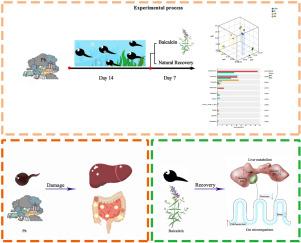
Baicalein has pharmacological functions, such as antioxidant and anti-inflammatory properties, and has been shown to alleviate damage to organs caused by environmental pollutants. However, the mechanism by which baicalein reduces the toxic effects of metals needs further research. This study used Pelophylax nigromaculatus tadpoles as a model to explore the toxicological effects of lead (Pb) on the gut-liver axis, and the mechanism by which baicalein alleviates lead toxicity. Analysis of the gut microbiota showed that baicalein alleviated abnormal changes in the gut microbiota following Pb exposure, mainly by increasing the abundance of beneficial bacterial genera, including Cetobacterium, Clostridioides, and Monoglobus. Liver metabolomics showed that compared to a natural recovery, baicalein treatment significantly increased the content of metabolites such as uridine, 17α-hydroxypregnenolone, niacin, and cucurbitacin E, and significantly reduced the content of metabolites such as linoleic, gluconic acid, and tetrahydrocortisone. These differential metabolites could be enriched in pathways such as pyrimidine metabolism, nicotinic acid and nicotinamide metabolism, and steroid hormone biosynthesis, which were beneficial for the treatment of liver injury. There was a significant correlation between the gut microbiota and the main differential metabolites in the liver with the addition of baicalein. The improvement of these metabolic pathways by baicalein is beneficial for the repair of the liver and intestines. Therefore, baicalein can increase the abundance of beneficial gut microbiota, improve liver metabolism, and thus reduce the damage of Pb exposure to the gut-liver axis.
期刊介绍:
Environmental Pollution is an international peer-reviewed journal that publishes high-quality research papers and review articles covering all aspects of environmental pollution and its impacts on ecosystems and human health.
Subject areas include, but are not limited to:
• Sources and occurrences of pollutants that are clearly defined and measured in environmental compartments, food and food-related items, and human bodies;
• Interlinks between contaminant exposure and biological, ecological, and human health effects, including those of climate change;
• Contaminants of emerging concerns (including but not limited to antibiotic resistant microorganisms or genes, microplastics/nanoplastics, electronic wastes, light, and noise) and/or their biological, ecological, or human health effects;
• Laboratory and field studies on the remediation/mitigation of environmental pollution via new techniques and with clear links to biological, ecological, or human health effects;
• Modeling of pollution processes, patterns, or trends that is of clear environmental and/or human health interest;
• New techniques that measure and examine environmental occurrences, transport, behavior, and effects of pollutants within the environment or the laboratory, provided that they can be clearly used to address problems within regional or global environmental compartments.




 京公网安备 11010802042870号
京ICP备2023020795号-1
京公网安备 11010802042870号
京ICP备2023020795号-1

 分享
分享
 求助内容:
求助内容: 应助结果提醒方式:
 扫码关注我们
