{"title":"Characteristics, influencing factors, and ecological risks of microplastics in the north branch tidal marshes of the Yangtze River estuary","authors":"Qing Wang , Songshuo Li , Yongcheng Ding","doi":"10.1016/j.envpol.2025.126230","DOIUrl":null,"url":null,"abstract":"<div><div>Microplastic pollution is a growing global environmental issue, particularly in vulnerable tidal marsh ecosystems, where its environmental behaviour and ecological risks remain poorly understood. This study investigated the microplastic contamination in the north branch tidal marshes of the Yangtze River estuary. Surface sediment samples were collected from 42 stations across 6 transects, revealing an average microplastic abundance of 506.80 ± 386.82 items/kg. The distribution of microplastics was strongly influenced by salinity and vegetation, with seawater intrusion playing a critical role. A significant negative correlation between salinity and microplastic abundance was observed; areas dominated by <em>Phragmites australis</em> (low salinity) had higher microplastic abundance compared to high-salinity areas with sparse vegetation. 12 types of microplastics were identified, with polyethylene and polystyrene being the most abundant (20 % and 19 %, respectively). The most common colours were transparent (26 %) and yellow (23 %), while the predominant shapes were granular (37 %) and fragmentary (32 %). Most microplastics measured under 2000 μm, with the 200–500 μm size range accounting for 49 % of the total. Likely sources of microplastics include aquaculture equipment, industrial products, agricultural cultivation supplies, and daily necessities. Although the ecological risk index for the region is relatively low, the presence of diverse species highlights potential ecological threats.</div></div>","PeriodicalId":311,"journal":{"name":"Environmental Pollution","volume":"374 ","pages":"Article 126230"},"PeriodicalIF":7.3000,"publicationDate":"2025-06-01","publicationTypes":"Journal Article","fieldsOfStudy":null,"isOpenAccess":false,"openAccessPdf":"","citationCount":"0","resultStr":null,"platform":"Semanticscholar","paperid":null,"PeriodicalName":"Environmental Pollution","FirstCategoryId":"93","ListUrlMain":"https://www.sciencedirect.com/science/article/pii/S0269749125006037","RegionNum":2,"RegionCategory":"环境科学与生态学","ArticlePicture":[],"TitleCN":null,"AbstractTextCN":null,"PMCID":null,"EPubDate":"2025/4/11 0:00:00","PubModel":"Epub","JCR":"Q1","JCRName":"ENVIRONMENTAL SCIENCES","Score":null,"Total":0}
引用次数: 0
Abstract
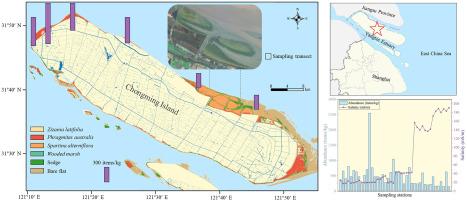
Microplastic pollution is a growing global environmental issue, particularly in vulnerable tidal marsh ecosystems, where its environmental behaviour and ecological risks remain poorly understood. This study investigated the microplastic contamination in the north branch tidal marshes of the Yangtze River estuary. Surface sediment samples were collected from 42 stations across 6 transects, revealing an average microplastic abundance of 506.80 ± 386.82 items/kg. The distribution of microplastics was strongly influenced by salinity and vegetation, with seawater intrusion playing a critical role. A significant negative correlation between salinity and microplastic abundance was observed; areas dominated by Phragmites australis (low salinity) had higher microplastic abundance compared to high-salinity areas with sparse vegetation. 12 types of microplastics were identified, with polyethylene and polystyrene being the most abundant (20 % and 19 %, respectively). The most common colours were transparent (26 %) and yellow (23 %), while the predominant shapes were granular (37 %) and fragmentary (32 %). Most microplastics measured under 2000 μm, with the 200–500 μm size range accounting for 49 % of the total. Likely sources of microplastics include aquaculture equipment, industrial products, agricultural cultivation supplies, and daily necessities. Although the ecological risk index for the region is relatively low, the presence of diverse species highlights potential ecological threats.
期刊介绍:
Environmental Pollution is an international peer-reviewed journal that publishes high-quality research papers and review articles covering all aspects of environmental pollution and its impacts on ecosystems and human health.
Subject areas include, but are not limited to:
• Sources and occurrences of pollutants that are clearly defined and measured in environmental compartments, food and food-related items, and human bodies;
• Interlinks between contaminant exposure and biological, ecological, and human health effects, including those of climate change;
• Contaminants of emerging concerns (including but not limited to antibiotic resistant microorganisms or genes, microplastics/nanoplastics, electronic wastes, light, and noise) and/or their biological, ecological, or human health effects;
• Laboratory and field studies on the remediation/mitigation of environmental pollution via new techniques and with clear links to biological, ecological, or human health effects;
• Modeling of pollution processes, patterns, or trends that is of clear environmental and/or human health interest;
• New techniques that measure and examine environmental occurrences, transport, behavior, and effects of pollutants within the environment or the laboratory, provided that they can be clearly used to address problems within regional or global environmental compartments.




 京公网安备 11010802042870号
京ICP备2023020795号-1
京公网安备 11010802042870号
京ICP备2023020795号-1

 分享
分享
 求助内容:
求助内容: 应助结果提醒方式:
 扫码关注我们
