{"title":"Highly biodegradable piezoelectric flexible wearable tactile sensors with amino acid crystals: a paradigm shift towards smart transient electronics","authors":"Sourav Maity, Ritesh Kumar Singh, Monika Gadhewal, Shree Prakash Tiwari","doi":"10.1016/j.cej.2025.162531","DOIUrl":null,"url":null,"abstract":"The unprecedented interest towards flexible and portable electronics of the modern tech-savvy world increases the burden of e-waste. This work presents a biodegradable, wearable electronic skin (e-skin) with precise tactile sensing capability to address this challenge. The functional layers have been designed by fabricating β-glycine structures within gelatine matrix. These enhance the piezoelectric nature of the functional layer, yielding a piezoelectric coefficient of 22.5 pm/V. The fabricated self-powered e-skin demonstrates an excellent output voltage of 2.1 ± 0.1 V, yielding dynamic pressure sensitivity of 41.3 ± 1.3 mV/kPa with an ultralow response time of 1.0 ± 0.1 ms. Additionally, this e-skin effectively senses static pressure as low as 0.35 Pa in the form of a rice grain with a distinguishable output signal exhibiting the highest sensitivity of 1.74 ± 0.07 Pa<sup>−1</sup>. Further, a matrix structure based on the e-skin obtains the 2d projection of any unknown objects placed over it. Furthermore, the e-skin demonstrates efficient application in real-time wireless human–machine interactions. More significantly, the fabricated e-skin degrades within 7 days in tap water. Therefore, the abilities of the fabricated devices upgrade their potential in not only continuous health care monitoring but also human–machine interaction, enabling it as a smart green candidate for next-generation biodegradable flexible electronics.","PeriodicalId":270,"journal":{"name":"Chemical Engineering Journal","volume":"39 1","pages":""},"PeriodicalIF":13.2000,"publicationDate":"2025-04-11","publicationTypes":"Journal Article","fieldsOfStudy":null,"isOpenAccess":false,"openAccessPdf":"","citationCount":"0","resultStr":null,"platform":"Semanticscholar","paperid":null,"PeriodicalName":"Chemical Engineering Journal","FirstCategoryId":"5","ListUrlMain":"https://doi.org/10.1016/j.cej.2025.162531","RegionNum":1,"RegionCategory":"工程技术","ArticlePicture":[],"TitleCN":null,"AbstractTextCN":null,"PMCID":null,"EPubDate":"","PubModel":"","JCR":"Q1","JCRName":"ENGINEERING, CHEMICAL","Score":null,"Total":0}
引用次数: 0
Abstract
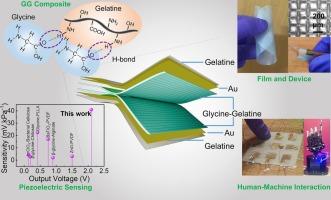
The unprecedented interest towards flexible and portable electronics of the modern tech-savvy world increases the burden of e-waste. This work presents a biodegradable, wearable electronic skin (e-skin) with precise tactile sensing capability to address this challenge. The functional layers have been designed by fabricating β-glycine structures within gelatine matrix. These enhance the piezoelectric nature of the functional layer, yielding a piezoelectric coefficient of 22.5 pm/V. The fabricated self-powered e-skin demonstrates an excellent output voltage of 2.1 ± 0.1 V, yielding dynamic pressure sensitivity of 41.3 ± 1.3 mV/kPa with an ultralow response time of 1.0 ± 0.1 ms. Additionally, this e-skin effectively senses static pressure as low as 0.35 Pa in the form of a rice grain with a distinguishable output signal exhibiting the highest sensitivity of 1.74 ± 0.07 Pa−1. Further, a matrix structure based on the e-skin obtains the 2d projection of any unknown objects placed over it. Furthermore, the e-skin demonstrates efficient application in real-time wireless human–machine interactions. More significantly, the fabricated e-skin degrades within 7 days in tap water. Therefore, the abilities of the fabricated devices upgrade their potential in not only continuous health care monitoring but also human–machine interaction, enabling it as a smart green candidate for next-generation biodegradable flexible electronics.
期刊介绍:
The Chemical Engineering Journal is an international research journal that invites contributions of original and novel fundamental research. It aims to provide an international platform for presenting original fundamental research, interpretative reviews, and discussions on new developments in chemical engineering. The journal welcomes papers that describe novel theory and its practical application, as well as those that demonstrate the transfer of techniques from other disciplines. It also welcomes reports on carefully conducted experimental work that is soundly interpreted. The main focus of the journal is on original and rigorous research results that have broad significance. The Catalysis section within the Chemical Engineering Journal focuses specifically on Experimental and Theoretical studies in the fields of heterogeneous catalysis, molecular catalysis, and biocatalysis. These studies have industrial impact on various sectors such as chemicals, energy, materials, foods, healthcare, and environmental protection.




 京公网安备 11010802042870号
京ICP备2023020795号-1
京公网安备 11010802042870号
京ICP备2023020795号-1

 分享
分享
 求助内容:
求助内容: 应助结果提醒方式:
 扫码关注我们
