Václav Kolařík , Aneta Hromádková , Adam Knirsch , Zdeňka Prucková , Petr Janovský , Michal Rouchal , Jas S. Ward , Kari Rissanen , Robert Vícha
{"title":"Metal cations switch geometry of β-cyclodextrin complexes†","authors":"Václav Kolařík , Aneta Hromádková , Adam Knirsch , Zdeňka Prucková , Petr Janovský , Michal Rouchal , Jas S. Ward , Kari Rissanen , Robert Vícha","doi":"10.1039/d5cc00868a","DOIUrl":null,"url":null,"abstract":"<div><div>Cationic guests with an adamantylphenyl moiety can form two distinct arrangements with the conical β-cyclodextrin macrocycle. Different metal cations were found to promote the formation of one of the two possible forms, depending on their van der Waals radii. Bulkier ions prefer the wider secondary rim of β-cyclodextrin, pushing the cationic part of the guest towards the narrower primary rim, and <em>vice versa</em>.</div></div>","PeriodicalId":67,"journal":{"name":"Chemical Communications","volume":"61 39","pages":"Pages 7077-7080"},"PeriodicalIF":4.2000,"publicationDate":"2025-04-14","publicationTypes":"Journal Article","fieldsOfStudy":null,"isOpenAccess":false,"openAccessPdf":"","citationCount":"0","resultStr":null,"platform":"Semanticscholar","paperid":null,"PeriodicalName":"Chemical Communications","FirstCategoryId":"92","ListUrlMain":"https://www.sciencedirect.com/org/science/article/pii/S1359734525007591","RegionNum":2,"RegionCategory":"化学","ArticlePicture":[],"TitleCN":null,"AbstractTextCN":null,"PMCID":null,"EPubDate":"2025/4/10 0:00:00","PubModel":"Epub","JCR":"Q2","JCRName":"CHEMISTRY, MULTIDISCIPLINARY","Score":null,"Total":0}
引用次数: 0
Abstract
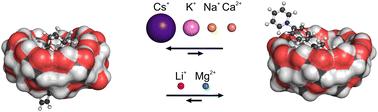
Cationic guests with an adamantylphenyl moiety can form two distinct arrangements with the conical β-cyclodextrin macrocycle. Different metal cations were found to promote the formation of one of the two possible forms, depending on their van der Waals radii. Bulkier ions prefer the wider secondary rim of β-cyclodextrin, pushing the cationic part of the guest towards the narrower primary rim, and vice versa.
期刊介绍:
ChemComm (Chemical Communications) is renowned as the fastest publisher of articles providing information on new avenues of research, drawn from all the world''s major areas of chemical research.



 京公网安备 11010802042870号
京ICP备2023020795号-1
京公网安备 11010802042870号
京ICP备2023020795号-1

 分享
分享
 求助内容:
求助内容: 应助结果提醒方式:
 扫码关注我们
