{"title":"Elucidating of moisture-induced degradation and rehealing of alluaudite Na2+2xFe2-x(SO4)3 cathode for Sodium-Ion batteries","authors":"Jiayue Wu, Xing Chen, Jing Zeng, Jinbao Zhao","doi":"10.1016/j.cej.2025.162535","DOIUrl":null,"url":null,"abstract":"Polyanion-type iron-based sulfates are promising candidates for cathode in sodium-ion batteries due to the cost-effectiveness. However, the material exhibits a high sensitivity to humidity, which significantly increases the costs associated with cell fabrication. Therefore, it’s critical for the industrial application to understand the humidity-induced degradation mechanism and develop regeneration strategies. In this study, Na<sub>2.67</sub>Fe<sub>1.67</sub>(SO<sub>4</sub>)<sub>3</sub> (NFS) exhibiting an outstanding capacity retention of 77.8 % after 6000 cycles, is used as the model to systematically investigate the intrinsic causes of degradation upon exposure to moisture. Specifically, water ingress and the strong Coulombic repulsion between Fe-Fe induce the decoupling of the [Fe<sub>2</sub>O<sub>10</sub>] dimer, causing the transformation into bloedite-type Na<sub>2</sub>Fe(SO<sub>4</sub>)<sub>2</sub>·4H<sub>2</sub>O. The π-contributing orbital interaction between O of water and Fe, along with the hydrogen-bonding network formed between H in water and the lattice O, confers additional structural stability to the hydrate. Theoretical calculations and enthalpy measurements indicate that the hydration reaction is thermodynamically spontaneous, with the Gibbs free energy change of −0.91 eV and the enthalpy change of –22.083 kJ/mol. After two days of exposure to 50 % humidity, the capacity degrades to approximately 83.5 % and a secondary heating strategy is developed to restore the fully degraded NFS to its original crystal structure and recover up to 94 % of the initial capacity. This study provides comprehensive insights into the causes of air instability in NFS and proposes an effective strategy for capacity regeneration.","PeriodicalId":270,"journal":{"name":"Chemical Engineering Journal","volume":"218 1","pages":""},"PeriodicalIF":13.2000,"publicationDate":"2025-04-11","publicationTypes":"Journal Article","fieldsOfStudy":null,"isOpenAccess":false,"openAccessPdf":"","citationCount":"0","resultStr":null,"platform":"Semanticscholar","paperid":null,"PeriodicalName":"Chemical Engineering Journal","FirstCategoryId":"5","ListUrlMain":"https://doi.org/10.1016/j.cej.2025.162535","RegionNum":1,"RegionCategory":"工程技术","ArticlePicture":[],"TitleCN":null,"AbstractTextCN":null,"PMCID":null,"EPubDate":"","PubModel":"","JCR":"Q1","JCRName":"ENGINEERING, CHEMICAL","Score":null,"Total":0}
引用次数: 0
Abstract
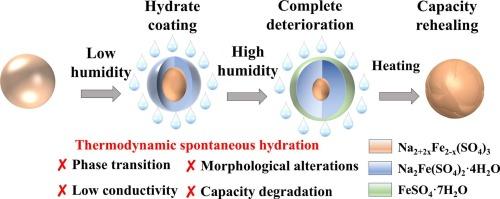
Polyanion-type iron-based sulfates are promising candidates for cathode in sodium-ion batteries due to the cost-effectiveness. However, the material exhibits a high sensitivity to humidity, which significantly increases the costs associated with cell fabrication. Therefore, it’s critical for the industrial application to understand the humidity-induced degradation mechanism and develop regeneration strategies. In this study, Na2.67Fe1.67(SO4)3 (NFS) exhibiting an outstanding capacity retention of 77.8 % after 6000 cycles, is used as the model to systematically investigate the intrinsic causes of degradation upon exposure to moisture. Specifically, water ingress and the strong Coulombic repulsion between Fe-Fe induce the decoupling of the [Fe2O10] dimer, causing the transformation into bloedite-type Na2Fe(SO4)2·4H2O. The π-contributing orbital interaction between O of water and Fe, along with the hydrogen-bonding network formed between H in water and the lattice O, confers additional structural stability to the hydrate. Theoretical calculations and enthalpy measurements indicate that the hydration reaction is thermodynamically spontaneous, with the Gibbs free energy change of −0.91 eV and the enthalpy change of –22.083 kJ/mol. After two days of exposure to 50 % humidity, the capacity degrades to approximately 83.5 % and a secondary heating strategy is developed to restore the fully degraded NFS to its original crystal structure and recover up to 94 % of the initial capacity. This study provides comprehensive insights into the causes of air instability in NFS and proposes an effective strategy for capacity regeneration.
期刊介绍:
The Chemical Engineering Journal is an international research journal that invites contributions of original and novel fundamental research. It aims to provide an international platform for presenting original fundamental research, interpretative reviews, and discussions on new developments in chemical engineering. The journal welcomes papers that describe novel theory and its practical application, as well as those that demonstrate the transfer of techniques from other disciplines. It also welcomes reports on carefully conducted experimental work that is soundly interpreted. The main focus of the journal is on original and rigorous research results that have broad significance. The Catalysis section within the Chemical Engineering Journal focuses specifically on Experimental and Theoretical studies in the fields of heterogeneous catalysis, molecular catalysis, and biocatalysis. These studies have industrial impact on various sectors such as chemicals, energy, materials, foods, healthcare, and environmental protection.



 京公网安备 11010802042870号
京ICP备2023020795号-1
京公网安备 11010802042870号
京ICP备2023020795号-1

 分享
分享
 求助内容:
求助内容: 应助结果提醒方式:
 扫码关注我们
