{"title":"High-capacity biomass-based composite aerogel for efficient multi-ion adsorption of vanadium, molybdenum, and nickel","authors":"Zeming Qiu , Yuhan Zhang , Xuewei Lv, Jie Dang","doi":"10.1016/j.seppur.2025.132990","DOIUrl":null,"url":null,"abstract":"<div><div>Biomass adsorbents have great potential in the fields of wastewater treatment and metal recovery. However, single biomass materials have low adsorption capacities. A novel composite biomass aerogel (Co-Zn/DMIM@NCC) was designed and prepared for the adsorption of vanadium, molybdenum, and nickel ions by in situ growth of metal–organic framework (MOF) on cellulose. The growth of MOF provided sufficient ion transport channels for metal ions, making them easier to diffuse from the outside to the inner adsorption sites of the aerogel. Adsorption experiments showed that MOF improved the composite material’s adsorption performance. The maximum adsorption capacity for V(V) is 1035.67 mg/g, for Mo(VI) is 908.06 mg/g, and for Ni(II) is 400.35 mg/g. In a mixed ion solution, the removal rate exceeded 80% and remained above 75% after five cycles, indicating good stability. The prepared adsorbent exhibited excellent removal and selective adsorption capabilities for vanadium, molybdenum, and nickel ions. Adsorption studies revealed different adsorption regions on the adsorbent surface, indicating a complex adsorption process. Comprehensive characterization indicated that the adsorption involved chemical adsorption, electrostatic interactions, redox reactions, and chelation processes. This research offers a framework for the creation and synthesis of innovative adsorbents that integrate MOF and cellulose, serving as a valuable reference for future developments in the field.</div></div>","PeriodicalId":427,"journal":{"name":"Separation and Purification Technology","volume":"368 ","pages":"Article 132990"},"PeriodicalIF":9.0000,"publicationDate":"2025-04-11","publicationTypes":"Journal Article","fieldsOfStudy":null,"isOpenAccess":false,"openAccessPdf":"","citationCount":"0","resultStr":null,"platform":"Semanticscholar","paperid":null,"PeriodicalName":"Separation and Purification Technology","FirstCategoryId":"5","ListUrlMain":"https://www.sciencedirect.com/science/article/pii/S1383586625015874","RegionNum":1,"RegionCategory":"工程技术","ArticlePicture":[],"TitleCN":null,"AbstractTextCN":null,"PMCID":null,"EPubDate":"","PubModel":"","JCR":"Q1","JCRName":"ENGINEERING, CHEMICAL","Score":null,"Total":0}
引用次数: 0
Abstract
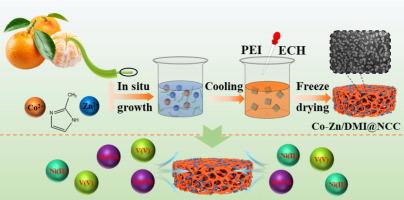
Biomass adsorbents have great potential in the fields of wastewater treatment and metal recovery. However, single biomass materials have low adsorption capacities. A novel composite biomass aerogel (Co-Zn/DMIM@NCC) was designed and prepared for the adsorption of vanadium, molybdenum, and nickel ions by in situ growth of metal–organic framework (MOF) on cellulose. The growth of MOF provided sufficient ion transport channels for metal ions, making them easier to diffuse from the outside to the inner adsorption sites of the aerogel. Adsorption experiments showed that MOF improved the composite material’s adsorption performance. The maximum adsorption capacity for V(V) is 1035.67 mg/g, for Mo(VI) is 908.06 mg/g, and for Ni(II) is 400.35 mg/g. In a mixed ion solution, the removal rate exceeded 80% and remained above 75% after five cycles, indicating good stability. The prepared adsorbent exhibited excellent removal and selective adsorption capabilities for vanadium, molybdenum, and nickel ions. Adsorption studies revealed different adsorption regions on the adsorbent surface, indicating a complex adsorption process. Comprehensive characterization indicated that the adsorption involved chemical adsorption, electrostatic interactions, redox reactions, and chelation processes. This research offers a framework for the creation and synthesis of innovative adsorbents that integrate MOF and cellulose, serving as a valuable reference for future developments in the field.
期刊介绍:
Separation and Purification Technology is a premier journal committed to sharing innovative methods for separation and purification in chemical and environmental engineering, encompassing both homogeneous solutions and heterogeneous mixtures. Our scope includes the separation and/or purification of liquids, vapors, and gases, as well as carbon capture and separation techniques. However, it's important to note that methods solely intended for analytical purposes are not within the scope of the journal. Additionally, disciplines such as soil science, polymer science, and metallurgy fall outside the purview of Separation and Purification Technology. Join us in advancing the field of separation and purification methods for sustainable solutions in chemical and environmental engineering.




 京公网安备 11010802042870号
京ICP备2023020795号-1
京公网安备 11010802042870号
京ICP备2023020795号-1

 分享
分享
 求助内容:
求助内容: 应助结果提醒方式:
 扫码关注我们
