Chengming Zhang, Wanqing Su, Jianan Sun, Yi Man, Ying Wei, Chunbo Duan, Chunmiao Han, Hui Xu
{"title":"Energy Transfer Loop Enables Thermally Activated Delayed Fluorescence with >20% EQE and Near-Zero Roll-Offs at 104 Nits","authors":"Chengming Zhang, Wanqing Su, Jianan Sun, Yi Man, Ying Wei, Chunbo Duan, Chunmiao Han, Hui Xu","doi":"10.1002/adma.202502747","DOIUrl":null,"url":null,"abstract":"<p>The bottleneck in efficiency stability at high luminance limits the development of thermally activated delayed fluorescence (TADF) diodes, due to the insufficient management of quenching factors, especially exciton-phonon coupling during reverse intersystem crossing (RISC) assistant with vibrational coupling. Herein, this challenge is overcome by a TADF sensitizer based “energy transfer loop” strategy. A dimethylacridine-phosphole oxide hybrid sensitizer named 24DDMACPPPO is constructed with vibration-free RISC and excited-state energy levels equal to a TADF emitter 4CzTPNBu. The former displaces the latter in RISC for phonon decoupling through reverse triplet and positive singlet energy transfer between them. As a result, co-doping 0 .1%wt. 24DDMACPPPO doubles the RISC rate constant and triples the singlet radiation rate of 4CzTPNBu, and simultaneously nearly halves non-radiation rate constants, giving rise to 70% and 90% increased photo- and electro-luminescence quantum efficiencies of 4CzTPNBu. More importantly, the energy transfer loop between 24DDMACPPPO and 4CzTPNBu combines their advantages in RISC, quenching suppression, and singlet radiation, giving rise to the record values of external quantum efficiency (≈23%wt.) and roll-off (2.6%) at 10<sup>4</sup> cd m<sup>−2</sup>.</p>","PeriodicalId":114,"journal":{"name":"Advanced Materials","volume":"37 26","pages":""},"PeriodicalIF":26.8000,"publicationDate":"2025-04-10","publicationTypes":"Journal Article","fieldsOfStudy":null,"isOpenAccess":false,"openAccessPdf":"","citationCount":"0","resultStr":null,"platform":"Semanticscholar","paperid":null,"PeriodicalName":"Advanced Materials","FirstCategoryId":"88","ListUrlMain":"https://advanced.onlinelibrary.wiley.com/doi/10.1002/adma.202502747","RegionNum":1,"RegionCategory":"材料科学","ArticlePicture":[],"TitleCN":null,"AbstractTextCN":null,"PMCID":null,"EPubDate":"","PubModel":"","JCR":"Q1","JCRName":"CHEMISTRY, MULTIDISCIPLINARY","Score":null,"Total":0}
引用次数: 0
Abstract
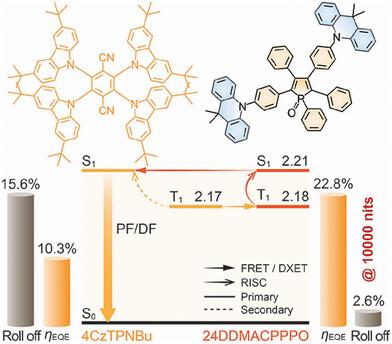
The bottleneck in efficiency stability at high luminance limits the development of thermally activated delayed fluorescence (TADF) diodes, due to the insufficient management of quenching factors, especially exciton-phonon coupling during reverse intersystem crossing (RISC) assistant with vibrational coupling. Herein, this challenge is overcome by a TADF sensitizer based “energy transfer loop” strategy. A dimethylacridine-phosphole oxide hybrid sensitizer named 24DDMACPPPO is constructed with vibration-free RISC and excited-state energy levels equal to a TADF emitter 4CzTPNBu. The former displaces the latter in RISC for phonon decoupling through reverse triplet and positive singlet energy transfer between them. As a result, co-doping 0 .1%wt. 24DDMACPPPO doubles the RISC rate constant and triples the singlet radiation rate of 4CzTPNBu, and simultaneously nearly halves non-radiation rate constants, giving rise to 70% and 90% increased photo- and electro-luminescence quantum efficiencies of 4CzTPNBu. More importantly, the energy transfer loop between 24DDMACPPPO and 4CzTPNBu combines their advantages in RISC, quenching suppression, and singlet radiation, giving rise to the record values of external quantum efficiency (≈23%wt.) and roll-off (2.6%) at 104 cd m−2.
期刊介绍:
Advanced Materials, one of the world's most prestigious journals and the foundation of the Advanced portfolio, is the home of choice for best-in-class materials science for more than 30 years. Following this fast-growing and interdisciplinary field, we are considering and publishing the most important discoveries on any and all materials from materials scientists, chemists, physicists, engineers as well as health and life scientists and bringing you the latest results and trends in modern materials-related research every week.






 京公网安备 11010802042870号
京ICP备2023020795号-1
京公网安备 11010802042870号
京ICP备2023020795号-1

 分享
分享
 求助内容:
求助内容: 应助结果提醒方式:
 扫码关注我们
