Jin Yang, Xiayuan Zhang, Guofeng Wang, Dengkai Xu, Xiaohua Jia, Haojie Song
{"title":"Multifunctional all-biomass superelastic aerogel evaporator for efficient desalination and wastewater treatment","authors":"Jin Yang, Xiayuan Zhang, Guofeng Wang, Dengkai Xu, Xiaohua Jia, Haojie Song","doi":"10.1016/j.seppur.2025.132893","DOIUrl":null,"url":null,"abstract":"The rapid growth of the global population has led to an increasing scarcity of freshwater resources. In response to this challenge, solar interfacial evaporation has emerged as a viable solution for the production of potable water. The cellulose aerogel evaporator has garnered significant attention as a readily accessible material known for its renewable nature and adsorption properties. However, the swelling of cellulose aerogel upon water absorption results in structural alterations and a concomitant decline in mechanical properties. To mitigate these issues, the ice template directional freezing method was employed to incorporate hydroxyapatite nanowires between the cellulose layers, functioning as “springs”. This approach facilitated the preparation of three-dimensional all-biomass aerogels with superelastic structures derived from <em>Thalia dealbata</em>. The resultant aerogel demonstrated excellent mechanical properties in air, maintaining 97.8 % of its initial pressure after 500 compression cycles. Given that the evaporator operates within aqueous environments, it was subjected to 5,000 cycles of compression resilience testing, exhibiting nearly zero plastic deformation in water, which highlights its superior mechanical performance. Additionally, the aerogel demonstrated remarkable stability, with an average evaporation rate of 1.92 kg m<sup>−2</sup> h<sup>−1</sup> under 1 sun intensity. The evaporation rate exceeds the evaporation limit due to the presence of bound water within the hydrogel network. The ion content of the resulting condensate was found to be well below the World Health Organization standards for seawater and heavy metal aqueous solutions, achieving a retention rate exceeding 99 %. Furthermore, the evaporator exhibited exceptional adsorption capabilities for organic dyes, with the adsorption rate under 1 solar intensity being 6–7 times higher compared to dark conditions. Due to temperature rises, molecular thermal motion intensifies, increasing the frequency and energy of collisions between adsorbent and adsorbate, thereby accelerating the adsorption process. The multifunctional all-biomass superelastic aerogel evaporator developed in this study presents a promising approach for achieving long-term stable solar interfacial evaporation, offering a potential solution to alleviate the challenges associated with water scarcity.","PeriodicalId":427,"journal":{"name":"Separation and Purification Technology","volume":"25 1","pages":""},"PeriodicalIF":9.0000,"publicationDate":"2025-04-11","publicationTypes":"Journal Article","fieldsOfStudy":null,"isOpenAccess":false,"openAccessPdf":"","citationCount":"0","resultStr":null,"platform":"Semanticscholar","paperid":null,"PeriodicalName":"Separation and Purification Technology","FirstCategoryId":"5","ListUrlMain":"https://doi.org/10.1016/j.seppur.2025.132893","RegionNum":1,"RegionCategory":"工程技术","ArticlePicture":[],"TitleCN":null,"AbstractTextCN":null,"PMCID":null,"EPubDate":"","PubModel":"","JCR":"Q1","JCRName":"ENGINEERING, CHEMICAL","Score":null,"Total":0}
引用次数: 0
Abstract
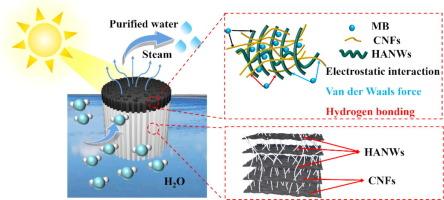
The rapid growth of the global population has led to an increasing scarcity of freshwater resources. In response to this challenge, solar interfacial evaporation has emerged as a viable solution for the production of potable water. The cellulose aerogel evaporator has garnered significant attention as a readily accessible material known for its renewable nature and adsorption properties. However, the swelling of cellulose aerogel upon water absorption results in structural alterations and a concomitant decline in mechanical properties. To mitigate these issues, the ice template directional freezing method was employed to incorporate hydroxyapatite nanowires between the cellulose layers, functioning as “springs”. This approach facilitated the preparation of three-dimensional all-biomass aerogels with superelastic structures derived from Thalia dealbata. The resultant aerogel demonstrated excellent mechanical properties in air, maintaining 97.8 % of its initial pressure after 500 compression cycles. Given that the evaporator operates within aqueous environments, it was subjected to 5,000 cycles of compression resilience testing, exhibiting nearly zero plastic deformation in water, which highlights its superior mechanical performance. Additionally, the aerogel demonstrated remarkable stability, with an average evaporation rate of 1.92 kg m−2 h−1 under 1 sun intensity. The evaporation rate exceeds the evaporation limit due to the presence of bound water within the hydrogel network. The ion content of the resulting condensate was found to be well below the World Health Organization standards for seawater and heavy metal aqueous solutions, achieving a retention rate exceeding 99 %. Furthermore, the evaporator exhibited exceptional adsorption capabilities for organic dyes, with the adsorption rate under 1 solar intensity being 6–7 times higher compared to dark conditions. Due to temperature rises, molecular thermal motion intensifies, increasing the frequency and energy of collisions between adsorbent and adsorbate, thereby accelerating the adsorption process. The multifunctional all-biomass superelastic aerogel evaporator developed in this study presents a promising approach for achieving long-term stable solar interfacial evaporation, offering a potential solution to alleviate the challenges associated with water scarcity.
期刊介绍:
Separation and Purification Technology is a premier journal committed to sharing innovative methods for separation and purification in chemical and environmental engineering, encompassing both homogeneous solutions and heterogeneous mixtures. Our scope includes the separation and/or purification of liquids, vapors, and gases, as well as carbon capture and separation techniques. However, it's important to note that methods solely intended for analytical purposes are not within the scope of the journal. Additionally, disciplines such as soil science, polymer science, and metallurgy fall outside the purview of Separation and Purification Technology. Join us in advancing the field of separation and purification methods for sustainable solutions in chemical and environmental engineering.



 京公网安备 11010802042870号
京ICP备2023020795号-1
京公网安备 11010802042870号
京ICP备2023020795号-1

 分享
分享
 求助内容:
求助内容: 应助结果提醒方式:
 扫码关注我们
