Wenjing Ji, Hongtao Xie, Bangwei Deng, Yangyang Yu, Qin Geng, Yali Cao, Yizhao Li
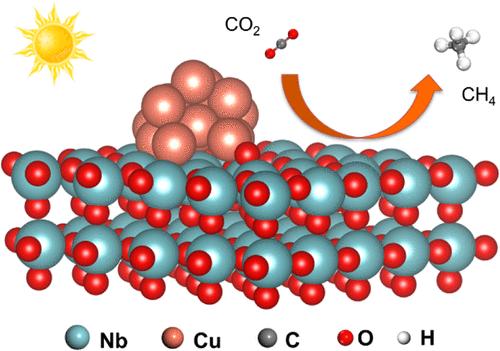
{"title":"Cu Metal-Modified Nb2O5 Microspheres Boost Photoreduction of CO2 to CH4 via Enhanced Adsorption of C1 Intermediates","authors":"Wenjing Ji, Hongtao Xie, Bangwei Deng, Yangyang Yu, Qin Geng, Yali Cao, Yizhao Li","doi":"10.1021/acs.iecr.5c00316","DOIUrl":null,"url":null,"abstract":"Selective photoreduction of carbon dioxide (CO<sub>2</sub>) to methane (CH<sub>4</sub>) remains a major challenge, which involves a kinetically unfavorable transfer of eight protons and eight electrons. Herein, a photodeposition strategy was employed to deposit nano Cu metal on flower-like Nb<sub>2</sub>O<sub>5</sub> microspheres (Cu/Nb<sub>2</sub>O<sub>5</sub>) for CO<sub>2</sub> photoreduction to generate CH<sub>4</sub> under simulated sunlight. The results show that the 1.0% Cu/Nb<sub>2</sub>O<sub>5</sub> catalyst produces CH<sub>4</sub> with an electron selectivity of 84.8% and a formation rate of 15.89 μmol g<sup>–1</sup> h<sup>–1</sup> without the use of sacrificial agents and photosensitizers. The generation of *CH<sub>3</sub>O on the 1.0% Cu/Nb<sub>2</sub>O<sub>5</sub> catalyst during the CO<sub>2</sub> photoreduction process was monitored using in situ Fourier transform infrared spectroscopy. Theoretical calculations further indicate the formation of highly stable C1 intermediates plays a crucial role in determining the reaction selectivity. By optimizing the electronic structure of the catalyst, this strategy provides a viable strategy for the photocatalytic conversion of CO<sub>2</sub> and H<sub>2</sub>O into CH<sub>4</sub> products, offering new insights into the development of efficient and sustainable CO<sub>2</sub> conversion technologies. Moreover, it provides strong theoretical support and an experimental basis for the widespread application of photocatalytic CO<sub>2</sub> reduction in greenhouse gas emission reduction and green energy production.","PeriodicalId":39,"journal":{"name":"Industrial & Engineering Chemistry Research","volume":"14 1","pages":""},"PeriodicalIF":3.9000,"publicationDate":"2025-04-11","publicationTypes":"Journal Article","fieldsOfStudy":null,"isOpenAccess":false,"openAccessPdf":"","citationCount":"0","resultStr":null,"platform":"Semanticscholar","paperid":null,"PeriodicalName":"Industrial & Engineering Chemistry Research","FirstCategoryId":"5","ListUrlMain":"https://doi.org/10.1021/acs.iecr.5c00316","RegionNum":3,"RegionCategory":"工程技术","ArticlePicture":[],"TitleCN":null,"AbstractTextCN":null,"PMCID":null,"EPubDate":"","PubModel":"","JCR":"Q2","JCRName":"ENGINEERING, CHEMICAL","Score":null,"Total":0}
引用次数: 0
Abstract
Selective photoreduction of carbon dioxide (CO2) to methane (CH4) remains a major challenge, which involves a kinetically unfavorable transfer of eight protons and eight electrons. Herein, a photodeposition strategy was employed to deposit nano Cu metal on flower-like Nb2O5 microspheres (Cu/Nb2O5) for CO2 photoreduction to generate CH4 under simulated sunlight. The results show that the 1.0% Cu/Nb2O5 catalyst produces CH4 with an electron selectivity of 84.8% and a formation rate of 15.89 μmol g–1 h–1 without the use of sacrificial agents and photosensitizers. The generation of *CH3O on the 1.0% Cu/Nb2O5 catalyst during the CO2 photoreduction process was monitored using in situ Fourier transform infrared spectroscopy. Theoretical calculations further indicate the formation of highly stable C1 intermediates plays a crucial role in determining the reaction selectivity. By optimizing the electronic structure of the catalyst, this strategy provides a viable strategy for the photocatalytic conversion of CO2 and H2O into CH4 products, offering new insights into the development of efficient and sustainable CO2 conversion technologies. Moreover, it provides strong theoretical support and an experimental basis for the widespread application of photocatalytic CO2 reduction in greenhouse gas emission reduction and green energy production.
期刊介绍:
ndustrial & Engineering Chemistry, with variations in title and format, has been published since 1909 by the American Chemical Society. Industrial & Engineering Chemistry Research is a weekly publication that reports industrial and academic research in the broad fields of applied chemistry and chemical engineering with special focus on fundamentals, processes, and products.



 京公网安备 11010802042870号
京ICP备2023020795号-1
京公网安备 11010802042870号
京ICP备2023020795号-1

 分享
分享
 求助内容:
求助内容: 应助结果提醒方式:
 扫码关注我们
