{"title":"Intensified modified fruit blender reactor for emulsifier synthesis via glycerol esterification of free fatty acids at mild conditions","authors":"Narita Chanthon , Kanokwan Ngaosuwan , Worapon Kiatkittipong , Doonyapong Wongsawaeng , Weerinda Mens , Nopphon Weeranoppanant , Apinan Soottitantawat , Pongtorn Charoensuppanimit , Samuel Lalthazuala Rokhum , Suttichai Assabumrungrat","doi":"10.1016/j.biortech.2025.132510","DOIUrl":null,"url":null,"abstract":"<div><div>A modified fruit blender reactor (M−FBR) was applied to synthesize monoacylglycerols (MAGs) and diacylglycerols (DAGs) through biphasic esterification of glycerol (Gly) with oleic acid (OA). The high stirring speed in the M−FBR provided a high mixing efficiency to generate significantly small droplets and cavitation compared to those in conventional processes. The increased interfacial surface area and distribution of dispersed phases into continuous phases promote momentum, heat, and mass transfer to improve mixing efficiency and high glycerol esterification rate. The reaction time and methanesulfonic acid (MSA) concentration were the most significant factors, affecting both OA conversion and MAG-DAG yields, while the Gly/OA molar ratio exhibited a less significant effect. The highest yields for MAG-DAG in 60 min using the M−FBR were 80.4 and 82.9% at 110 and 130 °C, respectively. The values of yield efficiency of M−FBR were 67.3 x 10<sup>−4</sup> g/J at 110 °C and 69.8 x 10<sup>−4</sup> g/J at 130 °C, which were up to 25–fold higher than that of the mechanical stirred reactor. The M−FBR generated small glycerol droplet (46–56 µm) to enhance the glycerol solubility in the OA phase, allowing the MAG and DAG synthesis to be conducted at a lower Gly/OA molar ratio. This offered higher selectivities of MAG and DAG and prevent undesirable TAG. Additionally, the simplified evolution of MAG-DAG formation during the glycerol esterification of OA was elucidated by ATR-FTIR spectroscopy.</div></div>","PeriodicalId":258,"journal":{"name":"Bioresource Technology","volume":"429 ","pages":"Article 132510"},"PeriodicalIF":9.0000,"publicationDate":"2025-08-01","publicationTypes":"Journal Article","fieldsOfStudy":null,"isOpenAccess":false,"openAccessPdf":"","citationCount":"0","resultStr":null,"platform":"Semanticscholar","paperid":null,"PeriodicalName":"Bioresource Technology","FirstCategoryId":"5","ListUrlMain":"https://www.sciencedirect.com/science/article/pii/S0960852425004766","RegionNum":1,"RegionCategory":"环境科学与生态学","ArticlePicture":[],"TitleCN":null,"AbstractTextCN":null,"PMCID":null,"EPubDate":"2025/4/9 0:00:00","PubModel":"Epub","JCR":"Q1","JCRName":"AGRICULTURAL ENGINEERING","Score":null,"Total":0}
引用次数: 0
Abstract
A modified fruit blender reactor (M−FBR) was applied to synthesize monoacylglycerols (MAGs) and diacylglycerols (DAGs) through biphasic esterification of glycerol (Gly) with oleic acid (OA). The high stirring speed in the M−FBR provided a high mixing efficiency to generate significantly small droplets and cavitation compared to those in conventional processes. The increased interfacial surface area and distribution of dispersed phases into continuous phases promote momentum, heat, and mass transfer to improve mixing efficiency and high glycerol esterification rate. The reaction time and methanesulfonic acid (MSA) concentration were the most significant factors, affecting both OA conversion and MAG-DAG yields, while the Gly/OA molar ratio exhibited a less significant effect. The highest yields for MAG-DAG in 60 min using the M−FBR were 80.4 and 82.9% at 110 and 130 °C, respectively. The values of yield efficiency of M−FBR were 67.3 x 10⁻⁴ g/J at 110 °C and 69.8 x 10⁻⁴ g/J at 130 °C, which were up to 25–fold higher than that of the mechanical stirred reactor. The M−FBR generated small glycerol droplet (46–56 µm) to enhance the glycerol solubility in the OA phase, allowing the MAG and DAG synthesis to be conducted at a lower Gly/OA molar ratio. This offered higher selectivities of MAG and DAG and prevent undesirable TAG. Additionally, the simplified evolution of MAG-DAG formation during the glycerol esterification of OA was elucidated by ATR-FTIR spectroscopy.
期刊介绍:
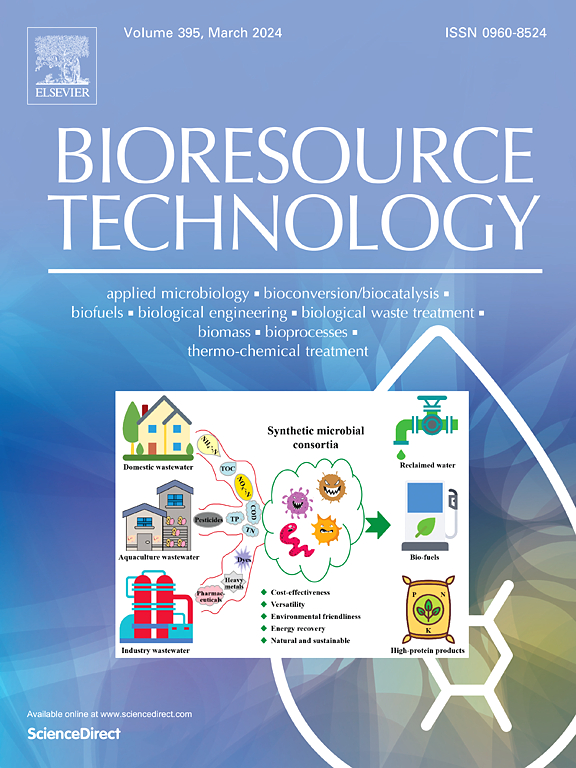
Bioresource Technology publishes original articles, review articles, case studies, and short communications covering the fundamentals, applications, and management of bioresource technology. The journal seeks to advance and disseminate knowledge across various areas related to biomass, biological waste treatment, bioenergy, biotransformations, bioresource systems analysis, and associated conversion or production technologies.
Topics include:
• Biofuels: liquid and gaseous biofuels production, modeling and economics
• Bioprocesses and bioproducts: biocatalysis and fermentations
• Biomass and feedstocks utilization: bioconversion of agro-industrial residues
• Environmental protection: biological waste treatment
• Thermochemical conversion of biomass: combustion, pyrolysis, gasification, catalysis.




 京公网安备 11010802042870号
京ICP备2023020795号-1
京公网安备 11010802042870号
京ICP备2023020795号-1

 分享
分享
 求助内容:
求助内容: 应助结果提醒方式:
 扫码关注我们
