Manyuan Gan , Yanhui Song , Jingyuan Wei , Yongqing Shen , Peizhi Liu , Mengxue Xia , Pengfei Zhang , Zhiyuan Tian , Bingshe Xu , Junjie Guo
{"title":"Steering the electronic transfer between Ir nanoparticles and Ni(OH)2/FeOOH for overall water splitting in both alkaline and neutral media","authors":"Manyuan Gan , Yanhui Song , Jingyuan Wei , Yongqing Shen , Peizhi Liu , Mengxue Xia , Pengfei Zhang , Zhiyuan Tian , Bingshe Xu , Junjie Guo","doi":"10.1016/j.apsusc.2025.163249","DOIUrl":null,"url":null,"abstract":"<div><div>Manipulating the electronic structure of iridium (Ir)-based catalyst has been recognized as an effective strategy to boost the hydrogen evolution reaction (HER) and oxygen evolution reaction (OER) activities of overall water splitting (OWS). It is, however, still a challenge to develop bifunctional HER/OER Ir-based electrocatalysts in a wide range of pH conditions (alkaline and neutral). Herein, a novel heterostructure comprising Ir nanoparticles anchored on Ni(OH)<sub>2</sub>/FeOOH electrocatalyst (Ir@Ni(OH)<sub>2</sub>/FeOOH) was constructed. Experimental and theoretical results demonstrated that the charge transfer from Ni(OH)<sub>2</sub>/FeOOH to Ir nanoparticles could steer the electronic density of Ir sites, reduce the HER and OER process Gibbs free energy, and thus facilitate the adsorption and dissociation of water. Profiting from these favorable factors, the optimized Ir@Ni(OH)<sub>2</sub>/FeOOH exhibited excellent HER/OER electrocatalytic performances in both alkaline (1.0 M KOH, 20/183 mV@10 mA cm<sup>−2</sup>) and neutral (1.0 M PBS, 14/288 mV@10 mA cm<sup>−2</sup>), respectively. Further, the constructed Ir@Ni(OH)<sub>2</sub>/FeOOH)||Ir@Ni(OH)<sub>2</sub>/FeOOH electrolyzer demands only 1.47 and 1.58 V to afford 10 mA cm<sup>−2</sup> in 1.0 M KOH and 1.0 M PBS, and exhibit a stability of more than 200 h. This work contributes to understanding the catalytic mechanism of carrier and nanoparticle co-catalysis during water splitting.</div></div>","PeriodicalId":247,"journal":{"name":"Applied Surface Science","volume":"700 ","pages":"Article 163249"},"PeriodicalIF":6.9000,"publicationDate":"2025-08-15","publicationTypes":"Journal Article","fieldsOfStudy":null,"isOpenAccess":false,"openAccessPdf":"","citationCount":"0","resultStr":null,"platform":"Semanticscholar","paperid":null,"PeriodicalName":"Applied Surface Science","FirstCategoryId":"88","ListUrlMain":"https://www.sciencedirect.com/science/article/pii/S0169433225009638","RegionNum":2,"RegionCategory":"材料科学","ArticlePicture":[],"TitleCN":null,"AbstractTextCN":null,"PMCID":null,"EPubDate":"2025/4/12 0:00:00","PubModel":"Epub","JCR":"Q2","JCRName":"CHEMISTRY, PHYSICAL","Score":null,"Total":0}
引用次数: 0
Abstract
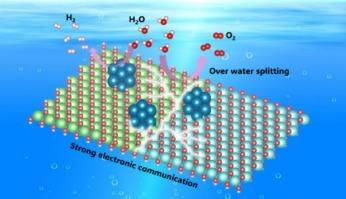
Manipulating the electronic structure of iridium (Ir)-based catalyst has been recognized as an effective strategy to boost the hydrogen evolution reaction (HER) and oxygen evolution reaction (OER) activities of overall water splitting (OWS). It is, however, still a challenge to develop bifunctional HER/OER Ir-based electrocatalysts in a wide range of pH conditions (alkaline and neutral). Herein, a novel heterostructure comprising Ir nanoparticles anchored on Ni(OH)2/FeOOH electrocatalyst (Ir@Ni(OH)2/FeOOH) was constructed. Experimental and theoretical results demonstrated that the charge transfer from Ni(OH)2/FeOOH to Ir nanoparticles could steer the electronic density of Ir sites, reduce the HER and OER process Gibbs free energy, and thus facilitate the adsorption and dissociation of water. Profiting from these favorable factors, the optimized Ir@Ni(OH)2/FeOOH exhibited excellent HER/OER electrocatalytic performances in both alkaline (1.0 M KOH, 20/183 mV@10 mA cm−2) and neutral (1.0 M PBS, 14/288 mV@10 mA cm−2), respectively. Further, the constructed Ir@Ni(OH)2/FeOOH)||Ir@Ni(OH)2/FeOOH electrolyzer demands only 1.47 and 1.58 V to afford 10 mA cm−2 in 1.0 M KOH and 1.0 M PBS, and exhibit a stability of more than 200 h. This work contributes to understanding the catalytic mechanism of carrier and nanoparticle co-catalysis during water splitting.
引导 Ir 纳米粒子和 Ni(OH)2/FeOOH 之间的电子转移,实现碱性和中性介质中的整体水分离
调控铱(Ir)基催化剂的电子结构是提高全水裂解(OWS)析氢反应(HER)和析氧反应(OER)活性的有效策略。然而,在大范围的pH条件下(碱性和中性)开发双功能HER/OER ir电催化剂仍然是一个挑战。本文构建了一种新型异质结构,该异质结构由Ir纳米颗粒锚定在Ni(OH)2/FeOOH电催化剂(Ir@Ni(OH)2/FeOOH)上。实验和理论结果表明,Ni(OH)2/FeOOH向Ir纳米粒子的电荷转移可以控制Ir位点的电子密度,降低HER和OER过程的吉布斯自由能,从而促进水的吸附和解离。得益于这些有利因素,优化Ir@Ni (OH) 2 / FeOOH展出优秀的她/ OER electrocatalytic表演在碱性(KOH 1.0米,20/183 mV@10 马厘米−2)和中性(1.0 M PBS, 14/288 mV@10 马厘米−2),分别。此外,所构建的Ir@Ni(OH)2/FeOOH)||Ir@Ni(OH)2/FeOOH电解槽在1.0 M KOH和1.0 M PBS条件下仅需1.47和1.58 V就能提供10 mA cm - 2,且稳定性大于200 h。本研究有助于理解载体与纳米粒子在水裂解过程中共催化的机理。
期刊介绍:
Applied Surface Science covers topics contributing to a better understanding of surfaces, interfaces, nanostructures and their applications. The journal is concerned with scientific research on the atomic and molecular level of material properties determined with specific surface analytical techniques and/or computational methods, as well as the processing of such structures.




 京公网安备 11010802042870号
京ICP备2023020795号-1
京公网安备 11010802042870号
京ICP备2023020795号-1

 分享
分享
 求助内容:
求助内容: 应助结果提醒方式:
 扫码关注我们
