Anqi Song, Xiaodong Qi, Shangyu Xie, Xiaolin Wu, Jie Wei, Yong Dai
{"title":"Hydrogel Containing Bismuth Molybdate Nanosheets with Piezoelectricity and Nanoenzyme Activity for Promoting Osteoblast Responses","authors":"Anqi Song, Xiaodong Qi, Shangyu Xie, Xiaolin Wu, Jie Wei, Yong Dai","doi":"10.1021/acsami.5c00774","DOIUrl":null,"url":null,"abstract":"The development of piezoelectric biomaterials with the capability to produce electrical signals and scavenge reactive oxygen species (ROS) is a novel strategy for stimulating osteoblast responses and promoting bone regeneration. Herein, tungsten (W), iridium (Ir), and ruthenium (Ru) codoped bismuth molybdate (4(W/Ru/Ir)-BMO) nanosheets with improved piezoelectricity and enzyme-like (CAT-like and SOD-like) activities were constructed by using the hydrothermal method. A composite hydrogel of oxidized sodium alginate/gelatin (OSA/GEL) and 4(W/Ru/Ir)-BMO (OSA/GEL/4-B) was also prepared. Due to the presence of 4(W/Ru/Ir)-BMO, OSA/GEL/4-B exhibited not only piezoelectricity but also enzyme-like activities. Under ultrasound (US), OSA/GEL/4-B generated electrical signals that significantly promoted the proliferation and osteogenic differentiation of bone marrow stromal cells. Furthermore, the piezoelectric effect of OSA/GEL/4-B improved the CAT-like (production of oxygen) and SOD-like (scavenger of ROS) activities. The improved piezoelectricity of 4(W/Ru/Ir)-BMO was attributed to the codoping of W, Ir, and Ru ions, which resulted in lattice distortion and enhanced crystal asymmetry, which produced electrical signals for regulating the osteogenic microenvironment. Moreover, the improvement of enzyme-like activities was attributed to the enhanced piezoelectric effect by the codoping of W, Ir, and Ru ions, which generated a piezoelectric field triggered by US that accelerated electron transfer for alleviating cellular oxidative stress and provided an antioxidant microenvironment for osteoblast responses. This piezoelectric hydrogel may provide a novel pathway for promoting osteogenic differentiation and bone regeneration.","PeriodicalId":5,"journal":{"name":"ACS Applied Materials & Interfaces","volume":"34 1","pages":""},"PeriodicalIF":8.2000,"publicationDate":"2025-04-12","publicationTypes":"Journal Article","fieldsOfStudy":null,"isOpenAccess":false,"openAccessPdf":"","citationCount":"0","resultStr":null,"platform":"Semanticscholar","paperid":null,"PeriodicalName":"ACS Applied Materials & Interfaces","FirstCategoryId":"88","ListUrlMain":"https://doi.org/10.1021/acsami.5c00774","RegionNum":2,"RegionCategory":"材料科学","ArticlePicture":[],"TitleCN":null,"AbstractTextCN":null,"PMCID":null,"EPubDate":"","PubModel":"","JCR":"Q1","JCRName":"MATERIALS SCIENCE, MULTIDISCIPLINARY","Score":null,"Total":0}
引用次数: 0
Abstract
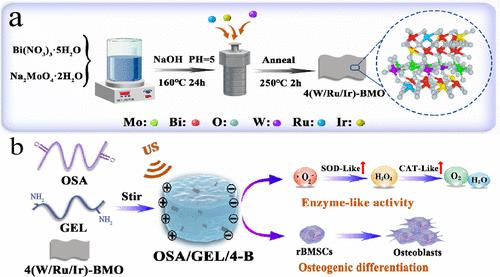
The development of piezoelectric biomaterials with the capability to produce electrical signals and scavenge reactive oxygen species (ROS) is a novel strategy for stimulating osteoblast responses and promoting bone regeneration. Herein, tungsten (W), iridium (Ir), and ruthenium (Ru) codoped bismuth molybdate (4(W/Ru/Ir)-BMO) nanosheets with improved piezoelectricity and enzyme-like (CAT-like and SOD-like) activities were constructed by using the hydrothermal method. A composite hydrogel of oxidized sodium alginate/gelatin (OSA/GEL) and 4(W/Ru/Ir)-BMO (OSA/GEL/4-B) was also prepared. Due to the presence of 4(W/Ru/Ir)-BMO, OSA/GEL/4-B exhibited not only piezoelectricity but also enzyme-like activities. Under ultrasound (US), OSA/GEL/4-B generated electrical signals that significantly promoted the proliferation and osteogenic differentiation of bone marrow stromal cells. Furthermore, the piezoelectric effect of OSA/GEL/4-B improved the CAT-like (production of oxygen) and SOD-like (scavenger of ROS) activities. The improved piezoelectricity of 4(W/Ru/Ir)-BMO was attributed to the codoping of W, Ir, and Ru ions, which resulted in lattice distortion and enhanced crystal asymmetry, which produced electrical signals for regulating the osteogenic microenvironment. Moreover, the improvement of enzyme-like activities was attributed to the enhanced piezoelectric effect by the codoping of W, Ir, and Ru ions, which generated a piezoelectric field triggered by US that accelerated electron transfer for alleviating cellular oxidative stress and provided an antioxidant microenvironment for osteoblast responses. This piezoelectric hydrogel may provide a novel pathway for promoting osteogenic differentiation and bone regeneration.
期刊介绍:
ACS Applied Materials & Interfaces is a leading interdisciplinary journal that brings together chemists, engineers, physicists, and biologists to explore the development and utilization of newly-discovered materials and interfacial processes for specific applications. Our journal has experienced remarkable growth since its establishment in 2009, both in terms of the number of articles published and the impact of the research showcased. We are proud to foster a truly global community, with the majority of published articles originating from outside the United States, reflecting the rapid growth of applied research worldwide.



 京公网安备 11010802042870号
京ICP备2023020795号-1
京公网安备 11010802042870号
京ICP备2023020795号-1

 分享
分享
 求助内容:
求助内容: 应助结果提醒方式:
 扫码关注我们
