Feng Yu , Weiwei Yu , Yan Zhao , Yue Liang , Jiang Hu , Rongqi Liu , Shiling Chen , Qinwei Chen , Yuanxin Liu , Xiyin Zheng , Xinyan Li
{"title":"Correcting microplastic pollution and risk assessment in Chinese watersheds","authors":"Feng Yu , Weiwei Yu , Yan Zhao , Yue Liang , Jiang Hu , Rongqi Liu , Shiling Chen , Qinwei Chen , Yuanxin Liu , Xiyin Zheng , Xinyan Li","doi":"10.1016/j.envpol.2025.126241","DOIUrl":null,"url":null,"abstract":"<div><div>Microplastics (MPs) are emerging pollutants that are attracting attention because of their potential threats posed and their widespread presence in the environment. MP pollution in Chinese watersheds requires assessment; however, existing risk models face data-scale biases. By compiling 2,474 samples from 165 articles, we constructed a national dataset on MPs and propose a novel framework that integrates rescaled MP concentrations with MP characteristics to recalibrate MP pollution and ecological risks. The results showed that MP concentrations show substantial variability across seven orders of magnitude, and corrected data offered a more accurate representation of environmental concentrations. MP shapes, polymers, and colors differed among river basins, and population density and precipitation were important drivers of variations in MP concentrations. MP shapes, colors, and sizes that were not previously considered are now included in the risk assessment of MPs. Furthermore, 50 % of the sampling sites were in the dangerous and extremely dangerous ecological risk classes. The concentrations measured at 16.98 % of the sampling sites exceeded the risk threshold, therefore posing ecological and toxicological risks. The assessment framework may provide overall insights into the differences in MP pollution in river basins.</div></div>","PeriodicalId":311,"journal":{"name":"Environmental Pollution","volume":"374 ","pages":"Article 126241"},"PeriodicalIF":7.3000,"publicationDate":"2025-06-01","publicationTypes":"Journal Article","fieldsOfStudy":null,"isOpenAccess":false,"openAccessPdf":"","citationCount":"0","resultStr":null,"platform":"Semanticscholar","paperid":null,"PeriodicalName":"Environmental Pollution","FirstCategoryId":"93","ListUrlMain":"https://www.sciencedirect.com/science/article/pii/S0269749125006141","RegionNum":2,"RegionCategory":"环境科学与生态学","ArticlePicture":[],"TitleCN":null,"AbstractTextCN":null,"PMCID":null,"EPubDate":"2025/4/11 0:00:00","PubModel":"Epub","JCR":"Q1","JCRName":"ENVIRONMENTAL SCIENCES","Score":null,"Total":0}
引用次数: 0
Abstract
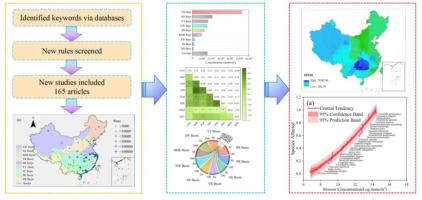
Microplastics (MPs) are emerging pollutants that are attracting attention because of their potential threats posed and their widespread presence in the environment. MP pollution in Chinese watersheds requires assessment; however, existing risk models face data-scale biases. By compiling 2,474 samples from 165 articles, we constructed a national dataset on MPs and propose a novel framework that integrates rescaled MP concentrations with MP characteristics to recalibrate MP pollution and ecological risks. The results showed that MP concentrations show substantial variability across seven orders of magnitude, and corrected data offered a more accurate representation of environmental concentrations. MP shapes, polymers, and colors differed among river basins, and population density and precipitation were important drivers of variations in MP concentrations. MP shapes, colors, and sizes that were not previously considered are now included in the risk assessment of MPs. Furthermore, 50 % of the sampling sites were in the dangerous and extremely dangerous ecological risk classes. The concentrations measured at 16.98 % of the sampling sites exceeded the risk threshold, therefore posing ecological and toxicological risks. The assessment framework may provide overall insights into the differences in MP pollution in river basins.
期刊介绍:
Environmental Pollution is an international peer-reviewed journal that publishes high-quality research papers and review articles covering all aspects of environmental pollution and its impacts on ecosystems and human health.
Subject areas include, but are not limited to:
• Sources and occurrences of pollutants that are clearly defined and measured in environmental compartments, food and food-related items, and human bodies;
• Interlinks between contaminant exposure and biological, ecological, and human health effects, including those of climate change;
• Contaminants of emerging concerns (including but not limited to antibiotic resistant microorganisms or genes, microplastics/nanoplastics, electronic wastes, light, and noise) and/or their biological, ecological, or human health effects;
• Laboratory and field studies on the remediation/mitigation of environmental pollution via new techniques and with clear links to biological, ecological, or human health effects;
• Modeling of pollution processes, patterns, or trends that is of clear environmental and/or human health interest;
• New techniques that measure and examine environmental occurrences, transport, behavior, and effects of pollutants within the environment or the laboratory, provided that they can be clearly used to address problems within regional or global environmental compartments.




 京公网安备 11010802042870号
京ICP备2023020795号-1
京公网安备 11010802042870号
京ICP备2023020795号-1

 分享
分享
 求助内容:
求助内容: 应助结果提醒方式:
 扫码关注我们
