Sea-Ho Oh , Chaehyeong Park , Geun-Hye Yu , Hajeong Jeon , James J. Schauer , Min-Suk Bae
{"title":"Diurnal impacts of tire wear and waste burning on fine particulate matter concentrations in a metropolitan area","authors":"Sea-Ho Oh , Chaehyeong Park , Geun-Hye Yu , Hajeong Jeon , James J. Schauer , Min-Suk Bae","doi":"10.1016/j.envpol.2025.126229","DOIUrl":null,"url":null,"abstract":"<div><div>The ecological toxicity of N-(1,3-dimethylbutyl)-N′-phenyl-p-phenylenediamine (6PPD), an antioxidant used in tires, has been investigated in studies of fine particulate matter (PM<sub>2.5</sub>) related to public health. Using samples collected in 3-h intervals from January to March 2024 (as part of the Asia-AQ campaign in Northeast Asia.), this study identifies 6PPD-quinone (6PPD-Q) along with terephthalic acid from waste polyethylene terephthalate using liquid chromatography–time-of-flight tandem mass spectrometry. The vehicle-tire wear (2 %) and tailpipe emissions (6 %), as well as wood burning (19 %) and waste food burning (9 %) were identified in PM<sub>2.5</sub>. Overall, waste burning contributed 28 % to PM<sub>2.5</sub>. Other identified sources included secondary sulfate and secondary nitrate. 6PPD-Q from tire wear exhibited concentrations peaking during daytime. Titanium emissions, used as a proxy for brake wear, were found to contain redox-active metals for 6PPD-Q. Terephthalic acid, levoglucosan, and cholesterol displayed strong diurnal patterns, with significant nighttime contributions from waste burning. These findings emphasize the substantial impact of primary sources on PM<sub>2.5</sub> concentrations. Additionally, they underscore the importance of high temporal resolution for accurate source identification and highlight the urgent need to address tire- and waste-related pollution in urban environments.</div></div>","PeriodicalId":311,"journal":{"name":"Environmental Pollution","volume":"374 ","pages":"Article 126229"},"PeriodicalIF":7.3000,"publicationDate":"2025-06-01","publicationTypes":"Journal Article","fieldsOfStudy":null,"isOpenAccess":false,"openAccessPdf":"","citationCount":"0","resultStr":null,"platform":"Semanticscholar","paperid":null,"PeriodicalName":"Environmental Pollution","FirstCategoryId":"93","ListUrlMain":"https://www.sciencedirect.com/science/article/pii/S0269749125006025","RegionNum":2,"RegionCategory":"环境科学与生态学","ArticlePicture":[],"TitleCN":null,"AbstractTextCN":null,"PMCID":null,"EPubDate":"2025/4/11 0:00:00","PubModel":"Epub","JCR":"Q1","JCRName":"ENVIRONMENTAL SCIENCES","Score":null,"Total":0}
引用次数: 0
Abstract
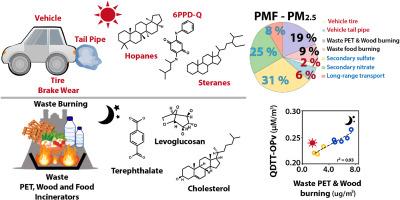
The ecological toxicity of N-(1,3-dimethylbutyl)-N′-phenyl-p-phenylenediamine (6PPD), an antioxidant used in tires, has been investigated in studies of fine particulate matter (PM2.5) related to public health. Using samples collected in 3-h intervals from January to March 2024 (as part of the Asia-AQ campaign in Northeast Asia.), this study identifies 6PPD-quinone (6PPD-Q) along with terephthalic acid from waste polyethylene terephthalate using liquid chromatography–time-of-flight tandem mass spectrometry. The vehicle-tire wear (2 %) and tailpipe emissions (6 %), as well as wood burning (19 %) and waste food burning (9 %) were identified in PM2.5. Overall, waste burning contributed 28 % to PM2.5. Other identified sources included secondary sulfate and secondary nitrate. 6PPD-Q from tire wear exhibited concentrations peaking during daytime. Titanium emissions, used as a proxy for brake wear, were found to contain redox-active metals for 6PPD-Q. Terephthalic acid, levoglucosan, and cholesterol displayed strong diurnal patterns, with significant nighttime contributions from waste burning. These findings emphasize the substantial impact of primary sources on PM2.5 concentrations. Additionally, they underscore the importance of high temporal resolution for accurate source identification and highlight the urgent need to address tire- and waste-related pollution in urban environments.
期刊介绍:
Environmental Pollution is an international peer-reviewed journal that publishes high-quality research papers and review articles covering all aspects of environmental pollution and its impacts on ecosystems and human health.
Subject areas include, but are not limited to:
• Sources and occurrences of pollutants that are clearly defined and measured in environmental compartments, food and food-related items, and human bodies;
• Interlinks between contaminant exposure and biological, ecological, and human health effects, including those of climate change;
• Contaminants of emerging concerns (including but not limited to antibiotic resistant microorganisms or genes, microplastics/nanoplastics, electronic wastes, light, and noise) and/or their biological, ecological, or human health effects;
• Laboratory and field studies on the remediation/mitigation of environmental pollution via new techniques and with clear links to biological, ecological, or human health effects;
• Modeling of pollution processes, patterns, or trends that is of clear environmental and/or human health interest;
• New techniques that measure and examine environmental occurrences, transport, behavior, and effects of pollutants within the environment or the laboratory, provided that they can be clearly used to address problems within regional or global environmental compartments.




 京公网安备 11010802042870号
京ICP备2023020795号-1
京公网安备 11010802042870号
京ICP备2023020795号-1

 分享
分享
 求助内容:
求助内容: 应助结果提醒方式:
 扫码关注我们
