Ultrasensitive electrochemical sensor for monitoring uric acid in sweat based on hexagonally-structured Co2CrMnFeNi high-entropy alloy nanosheets with exceptional catalytic performance
Zhang Qingqing , Li Ruiyi , Yang Yongqiang , Li Zaijun
{"title":"Ultrasensitive electrochemical sensor for monitoring uric acid in sweat based on hexagonally-structured Co2CrMnFeNi high-entropy alloy nanosheets with exceptional catalytic performance","authors":"Zhang Qingqing , Li Ruiyi , Yang Yongqiang , Li Zaijun","doi":"10.1016/j.snb.2025.137790","DOIUrl":null,"url":null,"abstract":"<div><div>The limited sensitivity and selectivity of electrochemical sensors restrict their practical applications in uric acid analysis in human sweat. This study introduces an electrochemical sensor based on hexagonal Co₂CrMnFeNi high-entropy alloy nanosheets (Co₂CrMnFeNi) for uric acid detection. The Co₂CrMnFeNi was synthesized using a strong coordination method with arginine and serine-functionalized and boron-doped graphene quantum dots (RSB-GQD). The introduction of RSB-GQD significantly improves the homogenization, atomization, morphology control and alloying of metal elements. The resulting Co₂CrMnFeNi exhibits a hexagonal sheet structure with homogeneous elemental distribution, small size of 252 ± 1.4 nm, double FCC phase and RSB-GQD surface modification. The combination of Cr, Mn, Fe, Co with Ni elements facilitates the reconstruction of electronic structure, leading to a cobalt-rich phase, while RSB-GQD modification improves the affinity for polar electrolytes. This integration results in an electrocatalytic activity over 3.98 times greater than that of gold nanoparticles. The sensor demonstrates a sensitive response to uric acid, with current at 0.416 V increasing linearly from 0.05 to 500 μM, achieving a detection limit of 8.5 × 10⁻⁹ M. The proposed method offers significant advantages in sensitivity, selectivity, wide linear range, and repeatability for detecting uric acid in human sweat.</div></div>","PeriodicalId":425,"journal":{"name":"Sensors and Actuators B: Chemical","volume":"438 ","pages":"Article 137790"},"PeriodicalIF":3.7000,"publicationDate":"2025-09-01","publicationTypes":"Journal Article","fieldsOfStudy":null,"isOpenAccess":false,"openAccessPdf":"","citationCount":"0","resultStr":null,"platform":"Semanticscholar","paperid":null,"PeriodicalName":"Sensors and Actuators B: Chemical","FirstCategoryId":"92","ListUrlMain":"https://www.sciencedirect.com/science/article/pii/S0925400525005659","RegionNum":1,"RegionCategory":"化学","ArticlePicture":[],"TitleCN":null,"AbstractTextCN":null,"PMCID":null,"EPubDate":"2025/4/11 0:00:00","PubModel":"Epub","JCR":"Q1","JCRName":"CHEMISTRY, ANALYTICAL","Score":null,"Total":0}
引用次数: 0
Abstract
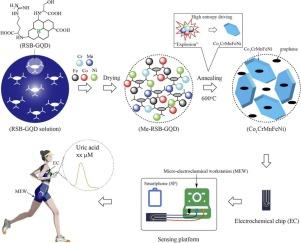
The limited sensitivity and selectivity of electrochemical sensors restrict their practical applications in uric acid analysis in human sweat. This study introduces an electrochemical sensor based on hexagonal Co₂CrMnFeNi high-entropy alloy nanosheets (Co₂CrMnFeNi) for uric acid detection. The Co₂CrMnFeNi was synthesized using a strong coordination method with arginine and serine-functionalized and boron-doped graphene quantum dots (RSB-GQD). The introduction of RSB-GQD significantly improves the homogenization, atomization, morphology control and alloying of metal elements. The resulting Co₂CrMnFeNi exhibits a hexagonal sheet structure with homogeneous elemental distribution, small size of 252 ± 1.4 nm, double FCC phase and RSB-GQD surface modification. The combination of Cr, Mn, Fe, Co with Ni elements facilitates the reconstruction of electronic structure, leading to a cobalt-rich phase, while RSB-GQD modification improves the affinity for polar electrolytes. This integration results in an electrocatalytic activity over 3.98 times greater than that of gold nanoparticles. The sensor demonstrates a sensitive response to uric acid, with current at 0.416 V increasing linearly from 0.05 to 500 μM, achieving a detection limit of 8.5 × 10⁻⁹ M. The proposed method offers significant advantages in sensitivity, selectivity, wide linear range, and repeatability for detecting uric acid in human sweat.
期刊介绍:
Sensors & Actuators, B: Chemical is an international journal focused on the research and development of chemical transducers. It covers chemical sensors and biosensors, chemical actuators, and analytical microsystems. The journal is interdisciplinary, aiming to publish original works showcasing substantial advancements beyond the current state of the art in these fields, with practical applicability to solving meaningful analytical problems. Review articles are accepted by invitation from an Editor of the journal.



 京公网安备 11010802042870号
京ICP备2023020795号-1
京公网安备 11010802042870号
京ICP备2023020795号-1

 分享
分享
 求助内容:
求助内容: 应助结果提醒方式:
 扫码关注我们
