Helena Duering , Thomas Westerhoff , Frank Kipp , Claudia Stein
{"title":"Irradiation with Ultraviolet-C Light-Emitting Diodes: Evaluation of the potential and limitations in controlling the spread of mobile genetic elements","authors":"Helena Duering , Thomas Westerhoff , Frank Kipp , Claudia Stein","doi":"10.1016/j.envint.2025.109453","DOIUrl":null,"url":null,"abstract":"<div><h3>Background</h3><div>Recent reports of multispecies outbreaks show that, in addition to multidrug-resistant bacteria, the accumulation and spread of antibiotic resistance-conferring genes (ARGs) in clinical settings is a growing concern. Ultraviolet-C (UV-C) technology is an effective method for inactivating microorganisms. This study aims to investigate whether it also offers a potential method to inactivate mobile genetic elements that confer antibiotic resistance by examining the effects of UV-C irradiation on plasmid-encoded resistance genes, focusing on DNA degradation and whether sublethal doses impact bacterial competence.</div></div><div><h3>Method</h3><div>We examined the effects of UV-C on the plasmids pCR™-Blunt II-TOPO and pUC19, focusing on DNA integrity and functionality post-irradiation. DNA concentration measurements and gel electrophoresis were used to assess plasmid integrity, while transformation assays evaluated gene functionality and the impact of sub-inhibitory UV-C doses on bacterial competence in <em>Escherichia coli</em> and <em>Citrobacter freundii</em>.</div></div><div><h3>Results</h3><div>Results showed a dose-dependent change in plasmid integrity and transformation efficiency. Significant DNA damage was observed at higher UV-C doses, particularly in the TOPO plasmid, which exhibited more pronounced structural damage compared to pUC19. This damage led to a loss of gene functionality, as evidenced by reduced transformation efficiency. Sub-inhibitory doses of UV-C irradiation did not enhance transformation frequency in <em>Escherichia coli</em> or <em>Citrobacter freundii</em>, indicating that UV-C does not promote bacterial competence.</div></div><div><h3>Conclusion</h3><div>UV-C irradiation effectively damages plasmid DNA, reducing the functionality of ARGs. The study confirms that sub-inhibitory single doses of UV-C do not promote bacterial transformation through increased competence.</div></div>","PeriodicalId":308,"journal":{"name":"Environment International","volume":"199 ","pages":"Article 109453"},"PeriodicalIF":9.7000,"publicationDate":"2025-05-01","publicationTypes":"Journal Article","fieldsOfStudy":null,"isOpenAccess":false,"openAccessPdf":"","citationCount":"0","resultStr":null,"platform":"Semanticscholar","paperid":null,"PeriodicalName":"Environment International","FirstCategoryId":"93","ListUrlMain":"https://www.sciencedirect.com/science/article/pii/S0160412025002041","RegionNum":1,"RegionCategory":"环境科学与生态学","ArticlePicture":[],"TitleCN":null,"AbstractTextCN":null,"PMCID":null,"EPubDate":"2025/4/11 0:00:00","PubModel":"Epub","JCR":"Q1","JCRName":"ENVIRONMENTAL SCIENCES","Score":null,"Total":0}
引用次数: 0
Abstract
Background
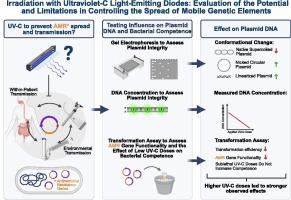
Recent reports of multispecies outbreaks show that, in addition to multidrug-resistant bacteria, the accumulation and spread of antibiotic resistance-conferring genes (ARGs) in clinical settings is a growing concern. Ultraviolet-C (UV-C) technology is an effective method for inactivating microorganisms. This study aims to investigate whether it also offers a potential method to inactivate mobile genetic elements that confer antibiotic resistance by examining the effects of UV-C irradiation on plasmid-encoded resistance genes, focusing on DNA degradation and whether sublethal doses impact bacterial competence.
Method
We examined the effects of UV-C on the plasmids pCR™-Blunt II-TOPO and pUC19, focusing on DNA integrity and functionality post-irradiation. DNA concentration measurements and gel electrophoresis were used to assess plasmid integrity, while transformation assays evaluated gene functionality and the impact of sub-inhibitory UV-C doses on bacterial competence in Escherichia coli and Citrobacter freundii.
Results
Results showed a dose-dependent change in plasmid integrity and transformation efficiency. Significant DNA damage was observed at higher UV-C doses, particularly in the TOPO plasmid, which exhibited more pronounced structural damage compared to pUC19. This damage led to a loss of gene functionality, as evidenced by reduced transformation efficiency. Sub-inhibitory doses of UV-C irradiation did not enhance transformation frequency in Escherichia coli or Citrobacter freundii, indicating that UV-C does not promote bacterial competence.
Conclusion
UV-C irradiation effectively damages plasmid DNA, reducing the functionality of ARGs. The study confirms that sub-inhibitory single doses of UV-C do not promote bacterial transformation through increased competence.
期刊介绍:
Environmental Health publishes manuscripts focusing on critical aspects of environmental and occupational medicine, including studies in toxicology and epidemiology, to illuminate the human health implications of exposure to environmental hazards. The journal adopts an open-access model and practices open peer review.
It caters to scientists and practitioners across all environmental science domains, directly or indirectly impacting human health and well-being. With a commitment to enhancing the prevention of environmentally-related health risks, Environmental Health serves as a public health journal for the community and scientists engaged in matters of public health significance concerning the environment.




 京公网安备 11010802042870号
京ICP备2023020795号-1
京公网安备 11010802042870号
京ICP备2023020795号-1

 分享
分享
 求助内容:
求助内容: 应助结果提醒方式:
 扫码关注我们
