{"title":"Transformation of cyclic amides and uracil-derived nitrogen heterocycles during chlorination","authors":"Sungeun Lim, Yufei Wu, William A. Mitch","doi":"10.1016/j.watres.2025.123639","DOIUrl":null,"url":null,"abstract":"<div><div>Nitrogen heterocycles are important structural components in biomolecules and anthropogenic chemicals, yet their transformation during chlorine disinfection remains poorly understood. This study investigated chlorination kinetics and product formation for six nitrogen heterocycles of increasing structural complexity, including cyclic amides (2-piperidone, glutarimide, 5,6-dihydrouracil) and uracil derivatives (uracil, uridine, and 1,3-dimethyluracil) to determine how structural variations influence reaction pathways. Apparent second-order rate constants varied widely from 9.2 × 10<sup>–3</sup> M<sup>-1</sup> s<sup>-1</sup> (2-piperidone) to >10<sup>3</sup> M<sup>-1</sup> s<sup>-1</sup> (uracil, uridine), largely influenced by the nitrogen pK<sub>a</sub> values. Chlorination proceeded through initial <em>N</em>-chlorination, forming organic chloramides. While most organic chloramides were transient, that derived from 2-piperidone persisted for days under excess chlorine conditions. For saturated heterocyclic imides (glutarimide, 5,6-dihydrouracil), hydrolysis of the organic chloramides between the imide nitrogen and an adjacent acyl group rapidly formed ring-opened organic acids. Among uracil derivatives, chlorine added across the double bond. For uracil, the resulting 5-chlorouracil rapidly fragmented between the C-4 and C-5 position to release trichloroacetaldehyde at ∼100 % yield. Substitution at heterocyclic nitrogens in uridine and 1,3-dimethyluracil limited such fragmentation, forming more stable C-chlorinated heterocyclic or ring-opened products. The reaction patterns observed for these six nitrogen heterocycles were further validated using phthalimide and thymine, demonstrating the broader applicability of the identified reaction trends. These findings enhance our understanding of nitrogen heterocycle chlorination mechanisms and their implications for drinking water disinfection, offering insights into minimizing the formation of potentially harmful DBPs during chlorination.</div></div>","PeriodicalId":443,"journal":{"name":"Water Research","volume":"282 ","pages":"Article 123639"},"PeriodicalIF":12.4000,"publicationDate":"2025-08-15","publicationTypes":"Journal Article","fieldsOfStudy":null,"isOpenAccess":false,"openAccessPdf":"","citationCount":"0","resultStr":null,"platform":"Semanticscholar","paperid":null,"PeriodicalName":"Water Research","FirstCategoryId":"93","ListUrlMain":"https://www.sciencedirect.com/science/article/pii/S0043135425005494","RegionNum":1,"RegionCategory":"环境科学与生态学","ArticlePicture":[],"TitleCN":null,"AbstractTextCN":null,"PMCID":null,"EPubDate":"2025/4/12 0:00:00","PubModel":"Epub","JCR":"Q1","JCRName":"ENGINEERING, ENVIRONMENTAL","Score":null,"Total":0}
引用次数: 0
Abstract
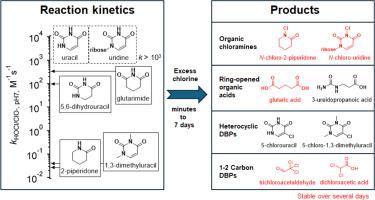
Nitrogen heterocycles are important structural components in biomolecules and anthropogenic chemicals, yet their transformation during chlorine disinfection remains poorly understood. This study investigated chlorination kinetics and product formation for six nitrogen heterocycles of increasing structural complexity, including cyclic amides (2-piperidone, glutarimide, 5,6-dihydrouracil) and uracil derivatives (uracil, uridine, and 1,3-dimethyluracil) to determine how structural variations influence reaction pathways. Apparent second-order rate constants varied widely from 9.2 × 10⁻³ M-1 s-1 (2-piperidone) to >103 M-1 s-1 (uracil, uridine), largely influenced by the nitrogen pKa values. Chlorination proceeded through initial N-chlorination, forming organic chloramides. While most organic chloramides were transient, that derived from 2-piperidone persisted for days under excess chlorine conditions. For saturated heterocyclic imides (glutarimide, 5,6-dihydrouracil), hydrolysis of the organic chloramides between the imide nitrogen and an adjacent acyl group rapidly formed ring-opened organic acids. Among uracil derivatives, chlorine added across the double bond. For uracil, the resulting 5-chlorouracil rapidly fragmented between the C-4 and C-5 position to release trichloroacetaldehyde at ∼100 % yield. Substitution at heterocyclic nitrogens in uridine and 1,3-dimethyluracil limited such fragmentation, forming more stable C-chlorinated heterocyclic or ring-opened products. The reaction patterns observed for these six nitrogen heterocycles were further validated using phthalimide and thymine, demonstrating the broader applicability of the identified reaction trends. These findings enhance our understanding of nitrogen heterocycle chlorination mechanisms and their implications for drinking water disinfection, offering insights into minimizing the formation of potentially harmful DBPs during chlorination.
期刊介绍:
Water Research, along with its open access companion journal Water Research X, serves as a platform for publishing original research papers covering various aspects of the science and technology related to the anthropogenic water cycle, water quality, and its management worldwide. The audience targeted by the journal comprises biologists, chemical engineers, chemists, civil engineers, environmental engineers, limnologists, and microbiologists. The scope of the journal include:
•Treatment processes for water and wastewaters (municipal, agricultural, industrial, and on-site treatment), including resource recovery and residuals management;
•Urban hydrology including sewer systems, stormwater management, and green infrastructure;
•Drinking water treatment and distribution;
•Potable and non-potable water reuse;
•Sanitation, public health, and risk assessment;
•Anaerobic digestion, solid and hazardous waste management, including source characterization and the effects and control of leachates and gaseous emissions;
•Contaminants (chemical, microbial, anthropogenic particles such as nanoparticles or microplastics) and related water quality sensing, monitoring, fate, and assessment;
•Anthropogenic impacts on inland, tidal, coastal and urban waters, focusing on surface and ground waters, and point and non-point sources of pollution;
•Environmental restoration, linked to surface water, groundwater and groundwater remediation;
•Analysis of the interfaces between sediments and water, and between water and atmosphere, focusing specifically on anthropogenic impacts;
•Mathematical modelling, systems analysis, machine learning, and beneficial use of big data related to the anthropogenic water cycle;
•Socio-economic, policy, and regulations studies.




 京公网安备 11010802042870号
京ICP备2023020795号-1
京公网安备 11010802042870号
京ICP备2023020795号-1

 分享
分享
 求助内容:
求助内容: 应助结果提醒方式:
 扫码关注我们
