R. Kukeva , G. Vassilev , M. Kalapsazova , H. Rasheev , A. Tadjer , S. Simova , R. Stoyanova
{"title":"Electrochemical oxidation and reduction of sodium electrolytes tracked by in-situ/ex-situ magnetic resonance spectroscopy and computational modelling","authors":"R. Kukeva , G. Vassilev , M. Kalapsazova , H. Rasheev , A. Tadjer , S. Simova , R. Stoyanova","doi":"10.1016/j.electacta.2025.146191","DOIUrl":null,"url":null,"abstract":"<div><div>Understanding the degradation processes of the sodium electrolyte at the individual level is a key safety issue for extending the cycle life of sodium-ion batteries. This study proposes <em>in-situ</em> EPR and <em>ex-situ</em> NMR tools, complemented by computational modelling, as a universal methodology for the investigation of electrolyte degradation, eliminating the effect of the electrode surface. While <em>in-situ</em> EPR enables the detection of intermediate radical species, <em>ex-situ</em> NMR reveals the final degradation products. The assignment of the EPR signals is based on DFT calculations. To discriminate the effects of the electrolyte salt and solvent on the degradation reactions, three of the most promising sodium electrolytes are investigated, namely sodium hexafluorophosphate, NaPF<sub>6</sub>, dissolved in propylene carbonate, PC, and in the binary propylene/ethylene carbonate, PC/EC, and sodium perchlorate, NaClO<sub>4</sub>, dissolved in PC. Finally, the identified initial and final degradation products are integrated into the possible pathways of electrolyte reduction and oxidation. Thus, the most appropriate scheme of sodium electrolyte oxidation and reduction is proposed. In general, this radical-driven mechanism of electrolyte degradation could help to rationalise the effect of real electrode surfaces on the electrochemical side reactions that occur at both high and low voltages, as well as during cell ageing.</div></div>","PeriodicalId":305,"journal":{"name":"Electrochimica Acta","volume":"526 ","pages":"Article 146191"},"PeriodicalIF":5.6000,"publicationDate":"2025-06-20","publicationTypes":"Journal Article","fieldsOfStudy":null,"isOpenAccess":false,"openAccessPdf":"","citationCount":"0","resultStr":null,"platform":"Semanticscholar","paperid":null,"PeriodicalName":"Electrochimica Acta","FirstCategoryId":"88","ListUrlMain":"https://www.sciencedirect.com/science/article/pii/S0013468625005535","RegionNum":3,"RegionCategory":"材料科学","ArticlePicture":[],"TitleCN":null,"AbstractTextCN":null,"PMCID":null,"EPubDate":"2025/4/11 0:00:00","PubModel":"Epub","JCR":"Q1","JCRName":"ELECTROCHEMISTRY","Score":null,"Total":0}
引用次数: 0
Abstract
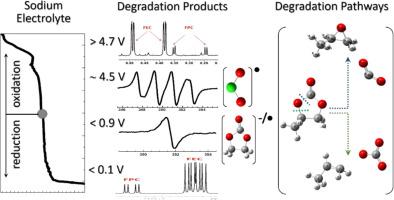
Understanding the degradation processes of the sodium electrolyte at the individual level is a key safety issue for extending the cycle life of sodium-ion batteries. This study proposes in-situ EPR and ex-situ NMR tools, complemented by computational modelling, as a universal methodology for the investigation of electrolyte degradation, eliminating the effect of the electrode surface. While in-situ EPR enables the detection of intermediate radical species, ex-situ NMR reveals the final degradation products. The assignment of the EPR signals is based on DFT calculations. To discriminate the effects of the electrolyte salt and solvent on the degradation reactions, three of the most promising sodium electrolytes are investigated, namely sodium hexafluorophosphate, NaPF6, dissolved in propylene carbonate, PC, and in the binary propylene/ethylene carbonate, PC/EC, and sodium perchlorate, NaClO4, dissolved in PC. Finally, the identified initial and final degradation products are integrated into the possible pathways of electrolyte reduction and oxidation. Thus, the most appropriate scheme of sodium electrolyte oxidation and reduction is proposed. In general, this radical-driven mechanism of electrolyte degradation could help to rationalise the effect of real electrode surfaces on the electrochemical side reactions that occur at both high and low voltages, as well as during cell ageing.
期刊介绍:
Electrochimica Acta is an international journal. It is intended for the publication of both original work and reviews in the field of electrochemistry. Electrochemistry should be interpreted to mean any of the research fields covered by the Divisions of the International Society of Electrochemistry listed below, as well as emerging scientific domains covered by ISE New Topics Committee.




 京公网安备 11010802042870号
京ICP备2023020795号-1
京公网安备 11010802042870号
京ICP备2023020795号-1

 分享
分享
 求助内容:
求助内容: 应助结果提醒方式:
 扫码关注我们
