Xiao-Jing Wang, Jie Wang, Zhizhi Yang, Ye Zhang, Kai Cheng, Jun-Ying Han, Fu-Xiang Chang, Yang-Chun Yong
{"title":"3D printing of synthetic microbial consortium for boosting bioelectricity generation from starch","authors":"Xiao-Jing Wang, Jie Wang, Zhizhi Yang, Ye Zhang, Kai Cheng, Jun-Ying Han, Fu-Xiang Chang, Yang-Chun Yong","doi":"10.1016/j.cej.2025.162519","DOIUrl":null,"url":null,"abstract":"Starch was considered as one of the most abundant and high energy–density fuel for microbial fuel cell (MFC). However, the starch MFC usually encountered the problems of low performance and time-consuming fabrication. Here, a 3D printing approach for construction of starch MFC with rationally designed synthetic bacterial consortium was developed, which dramatically improved the MFC performance and largely simplified the bioelectrode fabrication process. The synthetic consortium containing two surface display starch depolymerization enzymes, fermentation bacterial cell and electroactive bacterial cell. With this synthetic consortium, a ready-to-use bioelectrode was simply printed by homogeneously mixing cells, sodium alginate, cellulose, and acetylene carbon black as the bioink through a 3D printer. After optimization, synthetic consortium embedded 3D-printed bioelectrode exhibited dramatically decrease on the charge transfer resistance with high capacitance, which enabled excellent extracellular electron transfer between cells and the electrode. More impressively, the MFCs with this 3D-printed bioelectrode delivered a power output of 484 mW/m<sup>2</sup> from untreated starch. This work demonstrated the potential of 3D printing for construction of high performance MFC with synthetic consortium, which would add new tool for application of synthetic biology in MFC.","PeriodicalId":270,"journal":{"name":"Chemical Engineering Journal","volume":"38 1","pages":""},"PeriodicalIF":13.2000,"publicationDate":"2025-04-12","publicationTypes":"Journal Article","fieldsOfStudy":null,"isOpenAccess":false,"openAccessPdf":"","citationCount":"0","resultStr":null,"platform":"Semanticscholar","paperid":null,"PeriodicalName":"Chemical Engineering Journal","FirstCategoryId":"5","ListUrlMain":"https://doi.org/10.1016/j.cej.2025.162519","RegionNum":1,"RegionCategory":"工程技术","ArticlePicture":[],"TitleCN":null,"AbstractTextCN":null,"PMCID":null,"EPubDate":"","PubModel":"","JCR":"Q1","JCRName":"ENGINEERING, CHEMICAL","Score":null,"Total":0}
引用次数: 0
Abstract
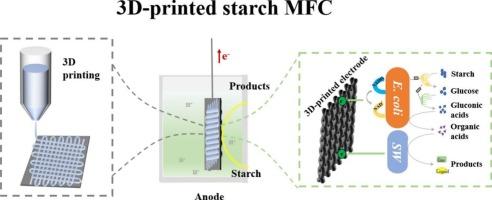
Starch was considered as one of the most abundant and high energy–density fuel for microbial fuel cell (MFC). However, the starch MFC usually encountered the problems of low performance and time-consuming fabrication. Here, a 3D printing approach for construction of starch MFC with rationally designed synthetic bacterial consortium was developed, which dramatically improved the MFC performance and largely simplified the bioelectrode fabrication process. The synthetic consortium containing two surface display starch depolymerization enzymes, fermentation bacterial cell and electroactive bacterial cell. With this synthetic consortium, a ready-to-use bioelectrode was simply printed by homogeneously mixing cells, sodium alginate, cellulose, and acetylene carbon black as the bioink through a 3D printer. After optimization, synthetic consortium embedded 3D-printed bioelectrode exhibited dramatically decrease on the charge transfer resistance with high capacitance, which enabled excellent extracellular electron transfer between cells and the electrode. More impressively, the MFCs with this 3D-printed bioelectrode delivered a power output of 484 mW/m2 from untreated starch. This work demonstrated the potential of 3D printing for construction of high performance MFC with synthetic consortium, which would add new tool for application of synthetic biology in MFC.
期刊介绍:
The Chemical Engineering Journal is an international research journal that invites contributions of original and novel fundamental research. It aims to provide an international platform for presenting original fundamental research, interpretative reviews, and discussions on new developments in chemical engineering. The journal welcomes papers that describe novel theory and its practical application, as well as those that demonstrate the transfer of techniques from other disciplines. It also welcomes reports on carefully conducted experimental work that is soundly interpreted. The main focus of the journal is on original and rigorous research results that have broad significance. The Catalysis section within the Chemical Engineering Journal focuses specifically on Experimental and Theoretical studies in the fields of heterogeneous catalysis, molecular catalysis, and biocatalysis. These studies have industrial impact on various sectors such as chemicals, energy, materials, foods, healthcare, and environmental protection.



 京公网安备 11010802042870号
京ICP备2023020795号-1
京公网安备 11010802042870号
京ICP备2023020795号-1

 分享
分享
 求助内容:
求助内容: 应助结果提醒方式:
 扫码关注我们
