Haidong Liang, Yuan Chen, Leyi Loh, Nicholas Lin Quan Cheng, Dmitrii Litvinov, Chengyuan Yang, Yifeng Chen, Zhepeng Zhang, Kenji Watanabe, Takashi Taniguchi, Maciej Koperski, Su Ying Quek, Michel Bosman, Goki Eda, Andrew Anthony Bettiol
{"title":"Site-Selective Creation of Blue Emitters in Hexagonal Boron Nitride","authors":"Haidong Liang, Yuan Chen, Leyi Loh, Nicholas Lin Quan Cheng, Dmitrii Litvinov, Chengyuan Yang, Yifeng Chen, Zhepeng Zhang, Kenji Watanabe, Takashi Taniguchi, Maciej Koperski, Su Ying Quek, Michel Bosman, Goki Eda, Andrew Anthony Bettiol","doi":"10.1021/acsnano.5c03423","DOIUrl":null,"url":null,"abstract":"Hexagonal boron nitride (hBN) has been of great interest due to its ability to host several bright quantum emitters at room temperature. However, the identification of the observed emitters remains challenging due to spectral variability, as well as the lack of atomic defect structure information. In this work, we demonstrate the site-selective creation of blue emitters in exfoliated hBN flakes with high-energy ion irradiation. With the correlation analysis of cryogenic and temperature-dependent photoluminescence (PL) spectroscopy, we observe two zero phonon lines (ZPLs) at ∼432.8 and 454.3 nm. Photoluminescence excitation (PLE) measurements further confirm the emission origins of the two prominent lines. Scanning transmission electron microscopy (STEM) reveals that the dominant defect structures present in ion-irradiated samples are vacancy-type (V<sub><i>x</i></sub>) and adatom(intercalant)-type (A<sub><i>x</i></sub>). Together with first-principles GW-BSE (Bethe–Salpeter equation) calculations, we deduce that the observed blue emissions are likely related to boron intercalants (B<sub>int</sub>). Our results not only discover a group of blue emissions in hBN but also provide insights into the physical origin of the emissions with local atomic structures in hBN.","PeriodicalId":21,"journal":{"name":"ACS Nano","volume":"50 1","pages":""},"PeriodicalIF":17.3000,"publicationDate":"2025-04-12","publicationTypes":"Journal Article","fieldsOfStudy":null,"isOpenAccess":false,"openAccessPdf":"","citationCount":"0","resultStr":null,"platform":"Semanticscholar","paperid":null,"PeriodicalName":"ACS Nano","FirstCategoryId":"88","ListUrlMain":"https://doi.org/10.1021/acsnano.5c03423","RegionNum":1,"RegionCategory":"材料科学","ArticlePicture":[],"TitleCN":null,"AbstractTextCN":null,"PMCID":null,"EPubDate":"","PubModel":"","JCR":"Q1","JCRName":"CHEMISTRY, MULTIDISCIPLINARY","Score":null,"Total":0}
引用次数: 0
Abstract
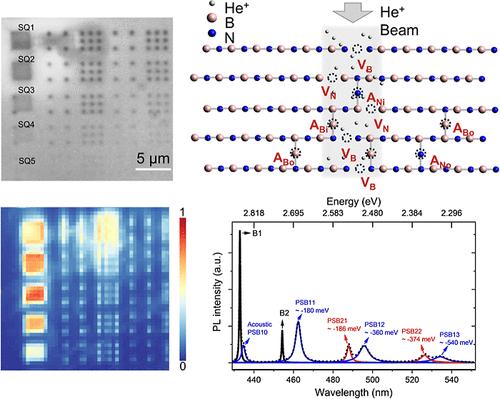
Hexagonal boron nitride (hBN) has been of great interest due to its ability to host several bright quantum emitters at room temperature. However, the identification of the observed emitters remains challenging due to spectral variability, as well as the lack of atomic defect structure information. In this work, we demonstrate the site-selective creation of blue emitters in exfoliated hBN flakes with high-energy ion irradiation. With the correlation analysis of cryogenic and temperature-dependent photoluminescence (PL) spectroscopy, we observe two zero phonon lines (ZPLs) at ∼432.8 and 454.3 nm. Photoluminescence excitation (PLE) measurements further confirm the emission origins of the two prominent lines. Scanning transmission electron microscopy (STEM) reveals that the dominant defect structures present in ion-irradiated samples are vacancy-type (Vx) and adatom(intercalant)-type (Ax). Together with first-principles GW-BSE (Bethe–Salpeter equation) calculations, we deduce that the observed blue emissions are likely related to boron intercalants (Bint). Our results not only discover a group of blue emissions in hBN but also provide insights into the physical origin of the emissions with local atomic structures in hBN.
期刊介绍:
ACS Nano, published monthly, serves as an international forum for comprehensive articles on nanoscience and nanotechnology research at the intersections of chemistry, biology, materials science, physics, and engineering. The journal fosters communication among scientists in these communities, facilitating collaboration, new research opportunities, and advancements through discoveries. ACS Nano covers synthesis, assembly, characterization, theory, and simulation of nanostructures, nanobiotechnology, nanofabrication, methods and tools for nanoscience and nanotechnology, and self- and directed-assembly. Alongside original research articles, it offers thorough reviews, perspectives on cutting-edge research, and discussions envisioning the future of nanoscience and nanotechnology.




 京公网安备 11010802042870号
京ICP备2023020795号-1
京公网安备 11010802042870号
京ICP备2023020795号-1

 分享
分享
 求助内容:
求助内容: 应助结果提醒方式:
 扫码关注我们
