Yunqiu Liu , Yu Zhang , Dengpan Nie , Qian Shang , Juan Tian , Wenxing Chen
{"title":"Mechanism of flotation separation of barite and quartz by starch/aluminum sulfate composite depressant","authors":"Yunqiu Liu , Yu Zhang , Dengpan Nie , Qian Shang , Juan Tian , Wenxing Chen","doi":"10.1016/j.apsusc.2025.163252","DOIUrl":null,"url":null,"abstract":"<div><div>Low-grade barite ore can be utilized as a substitute for barite resources, and its exploitation is becoming more and more important. High-grade, easily extracted barite resources have been rapidly depleted. For flotation studies on barite ore, this thesis combined forward and reverse flotation using a combination of maize starch and aluminum sulfate as a depressant. The flotation concentrates BaSO<sub>4</sub> grade was 92.18%, and the recovery was 91.38%, which was 7.51% higher than that with a single CS acting as a depressant. Contact angle measurements and zeta potential indicate that SO<sub>4</sub><sup>2-</sup> or Al(OH)<sub>4</sub><sup>-</sup> in aluminum sulfate increases the hydrophilicity of barite through complex formation or interaction with CS in a weakly alkaline environment. AFM analysis showed that the barite surface presented dense and uniform layered adsorption, and the co-adsorption characteristics of the mixed depressant were stronger than those of the single depressant. With the presence of double-dentate mononuclear and double-dentate dinuclear connections, the CS/AS mixed depressant exhibits strong selectivity, according to the results of molecular simulations. Its adsorption on the barite surface is primarily achieved through hydrogen bonding. Water molecules hydroxylate the barite surface to increase its hydrophilicity by acting as a bridge between the CS/AS and barite (001) surfaces.</div></div>","PeriodicalId":247,"journal":{"name":"Applied Surface Science","volume":"701 ","pages":"Article 163252"},"PeriodicalIF":6.9000,"publicationDate":"2025-08-30","publicationTypes":"Journal Article","fieldsOfStudy":null,"isOpenAccess":false,"openAccessPdf":"","citationCount":"0","resultStr":null,"platform":"Semanticscholar","paperid":null,"PeriodicalName":"Applied Surface Science","FirstCategoryId":"88","ListUrlMain":"https://www.sciencedirect.com/science/article/pii/S0169433225009663","RegionNum":2,"RegionCategory":"材料科学","ArticlePicture":[],"TitleCN":null,"AbstractTextCN":null,"PMCID":null,"EPubDate":"2025/4/12 0:00:00","PubModel":"Epub","JCR":"Q2","JCRName":"CHEMISTRY, PHYSICAL","Score":null,"Total":0}
引用次数: 0
Abstract
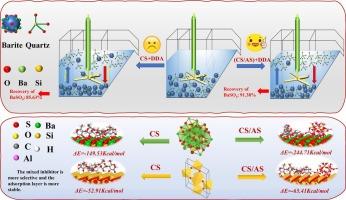
Low-grade barite ore can be utilized as a substitute for barite resources, and its exploitation is becoming more and more important. High-grade, easily extracted barite resources have been rapidly depleted. For flotation studies on barite ore, this thesis combined forward and reverse flotation using a combination of maize starch and aluminum sulfate as a depressant. The flotation concentrates BaSO4 grade was 92.18%, and the recovery was 91.38%, which was 7.51% higher than that with a single CS acting as a depressant. Contact angle measurements and zeta potential indicate that SO42- or Al(OH)4- in aluminum sulfate increases the hydrophilicity of barite through complex formation or interaction with CS in a weakly alkaline environment. AFM analysis showed that the barite surface presented dense and uniform layered adsorption, and the co-adsorption characteristics of the mixed depressant were stronger than those of the single depressant. With the presence of double-dentate mononuclear and double-dentate dinuclear connections, the CS/AS mixed depressant exhibits strong selectivity, according to the results of molecular simulations. Its adsorption on the barite surface is primarily achieved through hydrogen bonding. Water molecules hydroxylate the barite surface to increase its hydrophilicity by acting as a bridge between the CS/AS and barite (001) surfaces.
期刊介绍:
Applied Surface Science covers topics contributing to a better understanding of surfaces, interfaces, nanostructures and their applications. The journal is concerned with scientific research on the atomic and molecular level of material properties determined with specific surface analytical techniques and/or computational methods, as well as the processing of such structures.




 京公网安备 11010802042870号
京ICP备2023020795号-1
京公网安备 11010802042870号
京ICP备2023020795号-1

 分享
分享
 求助内容:
求助内容: 应助结果提醒方式:
 扫码关注我们
