Muhammad Sohail Asghar , Muhammad Sultan Irshad , Naila Arshad , Maryam Al Huwayz , Muneerah Alomar , Ghazala Maqsood , Muhammad Atif Ali , Uzma Ghanzanfar , Muhammad Sabir , Jinhua Li , Van-Duong Dao , Nang Xuan Ho , Xianbao Wang , Zhiguang Guo
{"title":"Functionalized carbon nanotubes interconnected with metal-organic frameworks for in-situ solar-driven evaporation and salt recovery from seawater","authors":"Muhammad Sohail Asghar , Muhammad Sultan Irshad , Naila Arshad , Maryam Al Huwayz , Muneerah Alomar , Ghazala Maqsood , Muhammad Atif Ali , Uzma Ghanzanfar , Muhammad Sabir , Jinhua Li , Van-Duong Dao , Nang Xuan Ho , Xianbao Wang , Zhiguang Guo","doi":"10.1016/j.watres.2025.123643","DOIUrl":null,"url":null,"abstract":"<div><div>Innovative solutions are needed to meet global water demand and to ensure the sustainable management of saline water resources. Indeed, solar-driven interfacial evaporation systems hold great environmental significance as they offer a sustainable and eco-friendly solution to several pressing issues. Herein, a 3D umbrella-shaped hybrid solar evaporator is innovatively developed by functionalized carbon nanotubes interlinked with metal-organic framework (MOF) nanocubes ZIF-67@CNT is sequentially anchored on cotton fabric with a centralized water supply. Combining these two materials results in a remarkable synergy, where the MOFs may trap and release water molecules (5.75 gg<sup>-1</sup>), and the CNTs facilitate broadband solar absorption (95 %). The hybrid solar evaporator endows solitary heat accumulation (49.5 °C) under 1k Wm<sup>-2</sup> solar irradiance owing to its effective thermal management supported by centralized wicks-inspired water supply as compared to the conventional direct contact structures. More importantly, an efficient evaporation rate (2.1 kg m<sup>-2</sup> h<sup>-1</sup>) was achieved, along with 99.9 % rejection efficacy and sustained reproducibility under natural conditions. Meanwhile, the system effectively concentrates and recovers salts from the brine stream, reducing waste and minimizing environmental impact. The sustainable utilization of solar energy reduces the energy cost associated with desalination, contributing to the economic viability of this technology.</div></div>","PeriodicalId":443,"journal":{"name":"Water Research","volume":"282 ","pages":"Article 123643"},"PeriodicalIF":12.4000,"publicationDate":"2025-08-15","publicationTypes":"Journal Article","fieldsOfStudy":null,"isOpenAccess":false,"openAccessPdf":"","citationCount":"0","resultStr":null,"platform":"Semanticscholar","paperid":null,"PeriodicalName":"Water Research","FirstCategoryId":"93","ListUrlMain":"https://www.sciencedirect.com/science/article/pii/S0043135425005536","RegionNum":1,"RegionCategory":"环境科学与生态学","ArticlePicture":[],"TitleCN":null,"AbstractTextCN":null,"PMCID":null,"EPubDate":"2025/4/12 0:00:00","PubModel":"Epub","JCR":"Q1","JCRName":"ENGINEERING, ENVIRONMENTAL","Score":null,"Total":0}
引用次数: 0
Abstract
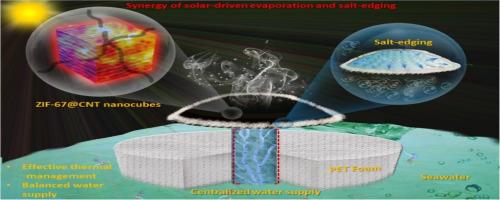
Innovative solutions are needed to meet global water demand and to ensure the sustainable management of saline water resources. Indeed, solar-driven interfacial evaporation systems hold great environmental significance as they offer a sustainable and eco-friendly solution to several pressing issues. Herein, a 3D umbrella-shaped hybrid solar evaporator is innovatively developed by functionalized carbon nanotubes interlinked with metal-organic framework (MOF) nanocubes ZIF-67@CNT is sequentially anchored on cotton fabric with a centralized water supply. Combining these two materials results in a remarkable synergy, where the MOFs may trap and release water molecules (5.75 gg-1), and the CNTs facilitate broadband solar absorption (95 %). The hybrid solar evaporator endows solitary heat accumulation (49.5 °C) under 1k Wm-2 solar irradiance owing to its effective thermal management supported by centralized wicks-inspired water supply as compared to the conventional direct contact structures. More importantly, an efficient evaporation rate (2.1 kg m-2 h-1) was achieved, along with 99.9 % rejection efficacy and sustained reproducibility under natural conditions. Meanwhile, the system effectively concentrates and recovers salts from the brine stream, reducing waste and minimizing environmental impact. The sustainable utilization of solar energy reduces the energy cost associated with desalination, contributing to the economic viability of this technology.
期刊介绍:
Water Research, along with its open access companion journal Water Research X, serves as a platform for publishing original research papers covering various aspects of the science and technology related to the anthropogenic water cycle, water quality, and its management worldwide. The audience targeted by the journal comprises biologists, chemical engineers, chemists, civil engineers, environmental engineers, limnologists, and microbiologists. The scope of the journal include:
•Treatment processes for water and wastewaters (municipal, agricultural, industrial, and on-site treatment), including resource recovery and residuals management;
•Urban hydrology including sewer systems, stormwater management, and green infrastructure;
•Drinking water treatment and distribution;
•Potable and non-potable water reuse;
•Sanitation, public health, and risk assessment;
•Anaerobic digestion, solid and hazardous waste management, including source characterization and the effects and control of leachates and gaseous emissions;
•Contaminants (chemical, microbial, anthropogenic particles such as nanoparticles or microplastics) and related water quality sensing, monitoring, fate, and assessment;
•Anthropogenic impacts on inland, tidal, coastal and urban waters, focusing on surface and ground waters, and point and non-point sources of pollution;
•Environmental restoration, linked to surface water, groundwater and groundwater remediation;
•Analysis of the interfaces between sediments and water, and between water and atmosphere, focusing specifically on anthropogenic impacts;
•Mathematical modelling, systems analysis, machine learning, and beneficial use of big data related to the anthropogenic water cycle;
•Socio-economic, policy, and regulations studies.




 京公网安备 11010802042870号
京ICP备2023020795号-1
京公网安备 11010802042870号
京ICP备2023020795号-1

 分享
分享
 求助内容:
求助内容: 应助结果提醒方式:
 扫码关注我们
