Bradley S. Van Gosen , Susan M. Hall , Craig A. Johnson , William M. Benzel
{"title":"Solution-collapse breccia pipe uranium deposits of the southern Colorado Plateau, northwestern Arizona, USA","authors":"Bradley S. Van Gosen , Susan M. Hall , Craig A. Johnson , William M. Benzel","doi":"10.1016/j.oregeorev.2025.106590","DOIUrl":null,"url":null,"abstract":"<div><div>Some of the highest-grade uranium deposits in the United States occur in breccia pipes that formed by solution and collapse of sedimentary strata, which occur in the southern portion of the Colorado Plateau in northwestern Arizona. The host breccia pipes are up to 1200 m in vertical extent, average about 90 m in diameter, and can cross-cut strata from their base in the Mississippian Redwall Limestone to as stratigraphically high on some plateaus as the Triassic Chinle Formation. These uranium-base metal deposits are up to 600 m thick and formed within the breccia pipes where they transect the Permian Coconino Sandstone, Hermit Formation, and the Esplanade Sandstone. Of the hundreds of breccia pipes identified across this region, only a small percentage are known to contain mineralization. The main uranium ore mineral is uraninite that is intergrown with at least 20 base-metal sulfide minerals, which contribute Fe, Cu, Co, As, Pb, Zn, Ni, and Ag to the deposits.</div><div>This study considered regional stratigraphy, sulfur isotope systematics, mineralogy, in situ dating, and compilation and analysis of previous work on the deposits. A comprehensive deposit model has not been published for these deposits. This analysis identified new additions to update the deposit model for these unusual, possibly unique deposits. Proposed modifications to the model include: (1) the source, mechanisms, timing of the base-metal sulfide mineral assemblages, and (2) the source, mechanism, and timing of the uranium mineralization. Sulfide and uranium deposition are shown to be separate mineralization events. The study proposes the possible role of gypsum as a source of sulfur for the sulfide minerals in the deposits. Groundwaters carrying uranium encountered the preexisting sulfides in breccia pipes, reducing the uranyl ions, and precipitating U oxide (as uraninite). Analysis of the regional stratigraphy recognized that numerous beds of gypsum are in the strata that lie only tens of meters above the breccia pipe deposits. In the breccia pipe region, if these stratigraphic units (Toroweap and Kaibab Formations) do not contain gypsum layers then the underlying pipes are not mineralized; where these Permian gypsum layers do occur, breccia pipes can host mineralization. This new understanding should be useful in identifying the prospective region for mineralized pipes.</div></div>","PeriodicalId":19644,"journal":{"name":"Ore Geology Reviews","volume":"181 ","pages":"Article 106590"},"PeriodicalIF":3.6000,"publicationDate":"2025-06-01","publicationTypes":"Journal Article","fieldsOfStudy":null,"isOpenAccess":false,"openAccessPdf":"","citationCount":"0","resultStr":null,"platform":"Semanticscholar","paperid":null,"PeriodicalName":"Ore Geology Reviews","FirstCategoryId":"89","ListUrlMain":"https://www.sciencedirect.com/science/article/pii/S0169136825001507","RegionNum":2,"RegionCategory":"地球科学","ArticlePicture":[],"TitleCN":null,"AbstractTextCN":null,"PMCID":null,"EPubDate":"2025/4/9 0:00:00","PubModel":"Epub","JCR":"Q1","JCRName":"GEOLOGY","Score":null,"Total":0}
引用次数: 0
Abstract
Some of the highest-grade uranium deposits in the United States occur in breccia pipes that formed by solution and collapse of sedimentary strata, which occur in the southern portion of the Colorado Plateau in northwestern Arizona. The host breccia pipes are up to 1200 m in vertical extent, average about 90 m in diameter, and can cross-cut strata from their base in the Mississippian Redwall Limestone to as stratigraphically high on some plateaus as the Triassic Chinle Formation. These uranium-base metal deposits are up to 600 m thick and formed within the breccia pipes where they transect the Permian Coconino Sandstone, Hermit Formation, and the Esplanade Sandstone. Of the hundreds of breccia pipes identified across this region, only a small percentage are known to contain mineralization. The main uranium ore mineral is uraninite that is intergrown with at least 20 base-metal sulfide minerals, which contribute Fe, Cu, Co, As, Pb, Zn, Ni, and Ag to the deposits.
This study considered regional stratigraphy, sulfur isotope systematics, mineralogy, in situ dating, and compilation and analysis of previous work on the deposits. A comprehensive deposit model has not been published for these deposits. This analysis identified new additions to update the deposit model for these unusual, possibly unique deposits. Proposed modifications to the model include: (1) the source, mechanisms, timing of the base-metal sulfide mineral assemblages, and (2) the source, mechanism, and timing of the uranium mineralization. Sulfide and uranium deposition are shown to be separate mineralization events. The study proposes the possible role of gypsum as a source of sulfur for the sulfide minerals in the deposits. Groundwaters carrying uranium encountered the preexisting sulfides in breccia pipes, reducing the uranyl ions, and precipitating U oxide (as uraninite). Analysis of the regional stratigraphy recognized that numerous beds of gypsum are in the strata that lie only tens of meters above the breccia pipe deposits. In the breccia pipe region, if these stratigraphic units (Toroweap and Kaibab Formations) do not contain gypsum layers then the underlying pipes are not mineralized; where these Permian gypsum layers do occur, breccia pipes can host mineralization. This new understanding should be useful in identifying the prospective region for mineralized pipes.
期刊介绍:
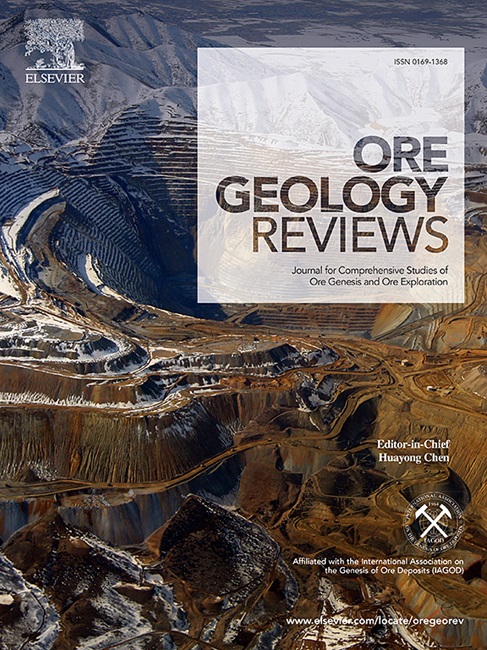
Ore Geology Reviews aims to familiarize all earth scientists with recent advances in a number of interconnected disciplines related to the study of, and search for, ore deposits. The reviews range from brief to longer contributions, but the journal preferentially publishes manuscripts that fill the niche between the commonly shorter journal articles and the comprehensive book coverages, and thus has a special appeal to many authors and readers.




 京公网安备 11010802042870号
京ICP备2023020795号-1
京公网安备 11010802042870号
京ICP备2023020795号-1

 分享
分享
 求助内容:
求助内容: 应助结果提醒方式:
 扫码关注我们
